Words from the Pastor’s Desk
Biblical insights, pastoral reflections, and timeless wisdom to nurture your faith and strengthen the church.


Words to Strengthen and Guide
Explore our collection of writings, arranged by topic, to help you discover truth and wisdom for every season.
John's Apocalypse and Christ's Headship Over His Church
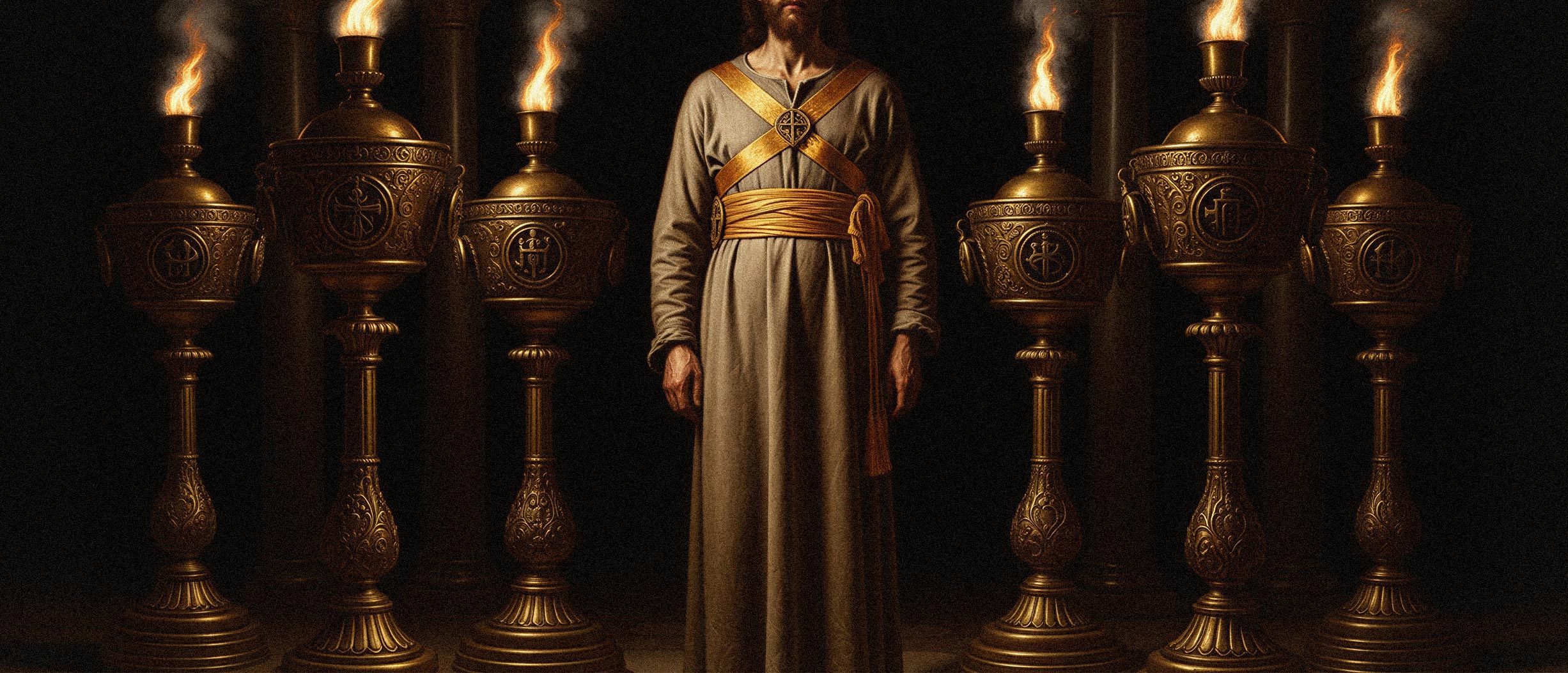
The crucial truth that Christ is the Head of His church is powerfully pictured in the first chapter of the book of Revelation, in the vision the apostle John had of the glorified Christ. John writes, "I saw seven golden lampstands; and in the middle of the lampstands I saw one like a son of Man, clothed in a robe reaching to the feet, and girded across His chest with a golden sash" (1:12-13). In Revelation 1:20, Christ explains that "the seven lampstands are the seven churches," the recipients of his letter. So, when John saw Christ walking among the lampstands, it was to portray the reality of Christ's abiding presence with His church.
This vision pictures the exalted Christ standing among the seven, first-century churches that received this circular letter, sovereignly overseeing and intimately involved with each one. The same is true of Christ's relationship with His churches today. What a comfort! Christ Himself promised His continued abiding presence with his church: "I am with you always, even to the end of the age" (Matt. 28:20).
The domain or realm in which Christ reigns, the focus of His attention, is not the great centers of political power—although He is sovereign over the events in every great capital of the world. Rather, His attention is focused on His church. He walks among His churches, exercising an intimate personal relationship with each one. There isn't a single true church on this planet that Christ isn't personally shepherding.
Revelation 1:14-16 vividly describes Christ's present ministry with and to His church:
His head and His hair were white like white wool, like snow; and His eyes were like a flame of fire. His feet were like burnished bronze, when it has been made to glow in a furnace, and His voice was like the sound of many waters. In His right hand He held seven stars, and out of His mouth came a sharp two-edged sword; and His face was like the sun shining in its strength.
This vision of the risen, glorified Christ explains and illustrates our Lord's relationship to the whole church—and every local church. The series of qualities described here paints a beautiful portrait of Jesus' relationship to His church:
1. Christ's incomparable wisdom leads His church: "His head and His hair were white like white wool, like snow" (v. 14). The description of Jesus with white hair emphasizes His incomparable wisdom—the kind of wisdom that is associated with age and experience.
2. Christ's penetrating omniscience evaluates His church: "His eyes were like a flame of fire" (v. 14). Like a torch in the ancient world, His eyes light up what He sees and reveal it to His eyes as it really is. The character of every single church is absolutely clear and transparent to the gaze of Jesus Christ—He sees everything! His penetrating omniscience sees the heart of each church with supreme clarity.
3. Christ's personal holiness purifies His church: "His feet were like burnished bronze, when it has been made to glow in a furnace" (v. 15; see Dan. 10:6). "Burnished bronze" describes gleaming metal still in its molten form. Metal still in a molten state is like a crucible for everything it touches. In the same way, as Christ walks among His churches, He purifies them like metal in a furnace is purified by His own personal holiness. Christ's authoritative word directs His church: "His voice was like the sound of many waters" (v. 15; see Ezek. 1:24). Like the deafening sound of the relentless crashing of the waves on the rocky shore of the island of Patmos, where John was imprisoned, Christ's powerful voice can be easily heard, so that His sheep can hear and obey Him. Jesus speaks with commanding authority to His church through His authoritative, Spirit-inspired Word.
4. Christ's sovereign lordship controls His church: "In His right hand He held seven stars" (v. 16). According to Revelation 1:20, the "stars" are "angels," best understood as the messengers or leaders of the seven churches to whom the letter was addressed. In the vision, Christ holds the leaders of the church in His hands. He is the Head of the church, and He exercises His headship through the leaders He has placed in each local church. He is the chief Shepherd and leads His sheep through His under-shepherds.
5. Christ's devastating judgment defends His church: "Out of His mouth came a sharp two-edged sword" (v. 16). This doesn't mean a literal sword comes from His mouth. John's point is that He will defend His church. The sword pictures Christ's destructive judgment against the enemies of His church: they are destroyed with the word of His mouth (Rev. 19:15; see 2 Thess. 2:8).
6. Christ's matchless glory captivates and characterizes His church: "His face was like the sun shining in its strength" (v. 16). Sixty-five years earlier, in Jesus' Transfiguration, John had seen Jesus' face when it "shone like the sun" (Matt. 17:2). On Patmos, he witnessed it again. Today, believers have all seen Christ's glory revealed in the gospel: "God, who said, 'Light shall shine out of darkness,' is the One who has shone in our hearts to give the Light of the knowledge of the glory of God in the face of Christ" (2 Cor. 4:6). We not only see Christ's matchless glory in the gospel, but we also increasingly reflect His glory as His people: "We all, with unveiled face, beholding as in a mirror the glory of the Lord, are being transformed into the same image from glory to glory, just as from the Lord, the Spirit" (2 Cor. 3:18).
Those New Testament texts, along with many others, prove that Christ, not the pope, is the Head of the church. First Timothy 2:5 says, "There is one God, and one mediator also between God and men, the man Christ Jesus." Scripture nowhere speaks of a vicar or substitute for Christ on earth, or of anyone other than Christ as the Head of His church. Christ leads His church, now as then, through His Word in the power of the Holy Spirit. He leads through His Word, when it is read by individual believers, and when it is taught corporately by the gifted pastor-teachers He gives the church, whose teaching, like that of the apostles, must be carefully examined against Scripture.
Christ alone is the head of His church!
This content was edited and adapted from Tom Pennington, From Rome to Reformation: An Introduction to the Key Issues Then and Now (Southlake, TX: The Word Unleashed, 2024).

Do Not Love the World - Pt. 4 | The Things of the World, and Why We Should Not Love Them (Pt. 1)
Last time, we looked at what John means when he says "the world." Today, let's consider what John means when he says "Do not love the world, nor the things in the world" (1 John 2:15). John adds, "For all that is in the world, the lust of the flesh and the lust of the eyes and the boastful pride of life, is not from the Father, but is from the world. The world is passing away, and also its lusts" (v. 16-17). Here are the things in the world we are not to love:The lust of the fleshThe lust of the eyesThe boastful pride of lifeThe lusts of the worldWe are not to love the world system Satan has created or the primary features of that system, as listed above. We are not to have an affection for, or a devotion to, anything that's a part of the world system Satan has created and that stands opposed to God and His will. John is effectively saying, "Don't love the world or the things in the world." That's a categorical prohibition.Thankfully, John does not command Christians to not love the world, and then not explain why. He gives his readers four compelling reasons as to why we are not to love the world, nor what's in it. We will look at the first reason today: loving the world is mutually exclusive with loving God, taken from the second half verse 15: "...If anyone loves the world , the love of the Father is not in him."While some may find the expression the "love of the Father" ambiguous, the meaning is quite clear in this context. It is contrasting a person's love for something: either you love the world or you love the Father. But notice what John says about the person who loves the world. He doesn't say, "This person who loves the world does not love the Father." While that statement is true, John goes even further and says, "...there's no love for the Father in him," meaning that love of God does not even exist in him. Search his soul, and you won't find a trace of the love of God. You can't love the world and love God at the same time. They are mutually exclusive!The Lord Jesus supports the separation between loving the world and loving God. In Matthew 6:24, He says, "No one can serve two masters; for either he will hate the one and love the other, or he will be devoted to one and despise the other. You cannot serve God and wealth." You've got to choose whom you're going to serve and whom you're going to love.2 Timothy 4:10 describes Demas, one of Paul's traveling companions on his missionary journey, and it says, "...Demas, having loved this present world, has deserted me." Why? Because you have got to choose. You can't love God and love the world too. And Demas, having decided he was going to love the world, abandoned Paul.James 4:4 puts it this way: "You adulteresses, do you not know that friendship with the world is hostility toward God? Therefore, whoever wishes to be a friend of the world, makes himself to be an enemy of God." So, you don't have to actively choose to be God's enemy; just choose to love the world, and, by choosing the world over God, you've declared yourself to be an enemy of God.Lastly, John Calvin explains that "There is no medium between these two extremes. Either the world must become vile in our estimation, or it must retain our immoderate love." So, the first compelling reason that we shouldn't love the world is because loving the world is mutually exclusive with loving God.Next time, join us as we look into the second reason John gives us as to why we should not love the world or the things in the world: loving the world is primarily expressed by sinful lusts.

The Heart of Thanksgiving | Psalm 100
On this Thanksgiving holiday, as you gather with family and friends, I encourage you to make today about more than family, food, and football. Of course, enjoy those things, they are good in their own right-everything good comes from God. But don't let your Thanksgiving just be about those things. Make a thanksgiving sacrifice, a thank offering to God, today. Psalm 100 provides five practical ways for Christians to make a thank offering to God.First, eat your Thanksgiving meal with the same attitude as Old Testament worshipers, as if you were truly having a meal with God. If you had lived during the period of the Old Testament, you would have offered a sacrifice of thanksgiving-a thank offering. You would have chosen, depending on your wealth, an ox, lamb, or goat. You would have taken that animal to the temple and placed your hands on its head-transferring your guilt to it. And then you would have taken a knife and slit its throat. Afterwards, the fatty portions of that animal, its entrails, would have been burned on the altar.But this offering was unique. It was the only one in which the worshiper ate some of the sacrificed animal. In other words, you would have cooked the rest of the animal, and eaten it that day as a fellowship meal with the priest. Ultimately, the meal wasn't about you and the priest eating together. The real significance was that you were enjoying a meal with God as you celebrated His goodness to you. If you understand Thanksgiving in that context, you begin to look at this holiday in a different light. There have been times in the past where my family and I have set an extra place at the table to remind ourselves that God is having a meal with us. It serves as an important message and reminder as we celebrate Thanksgiving. It's as if we're eating with God. And we should be grateful to Him for His generosity to us.Second, as you have conversations throughout the day, rehearse with one another what you're thankful for. Psalm 100:4 says, "Give thanks to Him." The basic meaning of the Hebrew word translated "thanks" is to confess. In fact, the Old Testament only uses this word to thank God, never to thank other humans. It is always used for confessing something about God or something that He's done. Thanking God for who He is or what He has done captures the heart of Thanksgiving.When you are sitting around the table today, take turns sharing what you are grateful for. This can be anything from the trivial and everyday temporal blessings of this life, to the things that are true about God, Christ, and the gospel.Third, set aside time to sing together. We ought to sing to and about God. Come before Him with joyful singing from your heart. Our God loves to hear His people sing.Fourth, take time to pray and give thanks directly to God. Don't just tell your family and friends that you are thankful-thank God personally!Fifth, make God the focus of your Thanksgiving. Recognize what He has done in your life-the fact that in His sovereign grace He bought you out of the slave market of sin and adopted you into His family as a son or daughter. And you weren't bought with silver or gold, but with the precious blood of our Lord Jesus Christ (1 Pet. 1:18-19).Psalm 69:30-31 says, "I will praise the name of God with song and magnify Him with thanksgiving. And it will please the LORD better than an ox or a young bull with horns and hoofs." A truly grateful heart toward God will please Him more than if you offered Him an animal sacrifice. In addition to pleasing God, our thanksgiving magnifies God-it points out His greatness.As Christians, the primary focus of our Thanksgiving ought to be exactly what the psalmist says, "We are His people and the sheep of His pasture" (Ps. 100:3). What a stunning reality! God has made us His own. That's why the writer of Hebrews says, "Let us continually offer up a sacrifice of praise to God, that is, the fruit of lips that give thanks to His name" (Heb. 13:15).May the Lord help us make a thank offering that pleases Him.
Do Not Love the World - Pt. 3 | The Meaning of "World"
Last time, we saw that John warned his readers to not love the world or the things of the world. The Greek word for "world" is kosmos, and it is by far the most common word for "world" in the New Testament, occurring over 180 times. Its basic meaning is "order or arrangement." It describes an ordered system as opposed to chaos. This word, however, has led to serious misunderstandings, predominantly because kosmos, like our English word world, has several senses in which it's used. This is even true in the New Testament. Here's a brief list of its possible meanings:The universe (Romans 1:20; Acts 17:24).All intelligent life, including both men and angels (1 Corinthians 4:9).The earth (Romans 4:13; 1 Corinthians 5:10).All of humanity (John 3:16).Fallen humanity in its opposition to God (1 John 5:19).An organized system created and ruled by Satan, that dominates fallen humanity, and is alienated from and hostile to God (1 John 2:15).John is mostly likely using "world" to describe Satan's organized system. Donald Burdick writes, "The term involves all that goes into making up the organized system of evil on this earth. It includes such elements as all unregenerate men, their thoughts, attitudes, purposes and desires, all influences and forces that are opposed to God, and the patterns of evil practice that characterize life apart from God." Everett Harrison in the Evangelical Dictionary of Theology describes Satan's world system this way: "It is the powers of spiritual evil, which have Satan as their head and appear to be organized on a vast scale and with great efficiency. These powers dominate the life of unredeemed humanity. Satan rules a kingdom, which is opposed to the Kingdom of God." Everett is borrowing from Jesus' words in Luke 11:18. In that passage, Jesus refers to two kingdoms. To paraphrase, Christ said, "There is Satan's kingdom, and there is the Kingdom of God." According to Christ, Satan has a kingdom. And that kingdom defines the "world" in 1 John 2. John Calvin, in The Institutes of the Christian Religion, writes: "Whatever is opposed to the spiritual Kingdom of Christ is the world." What are the characteristics of Satan's world system?It is under Satan's control. Our Lord called Satan the ruler of this kosmos (cf. John 12:31; 14:30; 16:11). Jesus doesn't mean the earth or universe; rather, He means the evil system that Satan has constructed and composed-Satan's kingdom. 1 John 5:19 says, "We know that we are of God, and that the whole world lies in the power of the evil one." Here, John is not just speaking of unredeemed humanity, but that system that Satan has enslaved unredeemed humanity in.The evil world system appears to be chaotic and to be defined by massive conflict and confusion, as anyone can see from the news. This world doesn't appear to have any organization whatsoever. But the Bible says there is a mastermind behind it. While the world appears chaotic, it is directed by Satan.It lies in darkness and sin. The apostle Peter tells us that the world "defiles...entangles...and overcomes" (2 Peter 2:20).Its lust corrupts the souls of people (2 Peter 1:4).It hates Christ and His followers. Jesus says that the world hates Him and therefore it will hate His followers as well (John 15:18-19; 1 John 3:13).Neither Christ nor Christians belong to the world. They are in the world, but not of the world (John 17:14, 16; 1 John 3:1).Supported by satanically inspired human philosophy, religion, and pragmatic viewpoints (1 John 4:5). The world listens to those who are not from God, and if they are not of God, they are of the devil. Thus, anything that does not come from God, like philosophy, religion, etc., is satanically inspired. Does not know God nor does it know or believe in Jesus Christ (John 17:25; 1:10; 7:7).When John says, "do not love the world," that is the world he is describing. James adds, "Pure and undefiled religion in the sight of our God and Father is...to keep oneself unstained by the world" (James 1:27). Now that we know what John means when he refers to "the world," we will be able to understand the "things of the world." Join us next time as we walk through John's teaching on the "things of the world."
Do Not Love the World - Pt. 2 | The Meaning of Love
Before we examine the issue of worldliness, we must consider John's previous insights about love: the divine priority of love and the believer's commitment to love. These truths are given in 1 John 2:7-17. John's point is that you can know that you are a Christian and have eternal life because you have a new love for God and a new love for His people. The divine priority of love, found in verses 7-8, is an old commandment, but it's also a new commandment, as well as an eternal commandment. The believer's commitment to love produces a new love for God's people (v. 9-11) and a new love for God (v. 12-17). The message of verses 12-15, the verses we are considering in this blog series, is that the true Christian knows and loves the Father and everything the Father loves. If you're a Christian, you know that your sins have been forgiven. You've come to know the Almighty God as Father, and you are growing in your knowledge of His Word to the goal of a full, mature, experiential knowledge of God and of our Lord Jesus Christ. That is the goal of the Christian life and experience, and it's accomplished through the Scripture and the Spirit (1 Cor. 2).In 1 John 2:15-17, John teaches that the true Christian does not love the world or everything the world loves. Phrased negatively, the false Christian does love the world and everything the world loves. "Do not love the world nor the things in the world. If anyone loves the world, the love of the Father is not in him. For all that is in the world, the lust of the flesh and the lust of the eyes and the boastful pride of life, is not from the Father, but is from the world. The world is passing away, and also its lusts; but the one who does the will of God lives forever."1 john 2:15-17The structure of these verses is clear; John begins in the first part of verse 15 with a categorical prohibition. Notice the command he gives: "Do not love." In the original Greek, the structure of this imperative could have two meanings. First, it could carry the idea of stopping a pattern that is already being practiced-you already love the world but need to stop. Second, and more likely, John is commanding his readers that they should never start this pattern of loving the world; don't let loving the world be something that is in your life. John is not saying, "Stop it!" Rather, he's saying: "If you're a Christian, don't ever start a pattern of loving the world."The word for "love" is agapao, the Greek verb from which we get the Greek noun agape. Why does John use the word agape for loving the world? Because it has a nuance that fits this particular context. This word is not an uncontrollable emotion that comes over you. It is primarily used for a decision of the will. Often in the New Testament it's used for loving God, loving others, and loving Christ. But John uses it for loving the world. He does so because it conjures up, not something that just happens to you, but a decision you make.The key elements of this word in this context are affection and devotion. That's the key point of what John means when he says, "Do not love the world." Believers must not have affection and devotion to the world. Next week, we'll consider what John means when he says that you must not love the "world" or the "things" of the world.
Do Not Love the World - Pt. 1 | Unbiblical Views of Worldliness
You don't hear much from today's pulpits about the concept of worldliness. I think that's tragic because although the word worldliness isn't found in Scripture, the concept certainly is. The Apostle John writes, "Do not love the world, nor the things in the world" (1 John 2:15). That seems like a fairly straight forward command, but it is fraught with potential confusion and misunderstanding. Throughout church history, several terribly flawed approaches to worldliness have been offered, leading to terrible fruit. First, there are some who have defined worldliness as regularly associating with the sinful people of this world. That has led to isolationism and even, in its extreme form, to monasticism.With the conversion of Constantine during the days of the Roman Empire, the Christian church suddenly found itself intermingled with pagan Roman culture. Christians desperately tried to resist being swept into the debauchery that was rampant in that culture. True Christians had to stay on guard against being lured into that lifestyle and away from Christ. They initially began to do that by separation, but eventually promoted the idea of total isolation from the world-monasticism. This, of course, is not a biblical concept for the Christian life. The apostle Paul writes, "I wrote you in my letter not to associate with immoral people; I did not at all mean with the immoral people of this world, or with the covetous and swindlers, or with idolaters, for then you would have to go out of the world (1 Cor. 5:9-10).A second wrong approach to worldliness is practicing behaviors that are not directly addressed in Scripture, but that other Christians think are wrong. That's how a lot of people define worldliness. Tragically, this type of thinking and behaving has led to legalism. As one author put it, "This passage has been used to denounce everything from buttons to beer." I personally have encountered people who believe that you shouldn't do things that comfort your body like taking a hot bath (such bathing panders the flesh). I've traveled to certain places in Asia where several Christians believed that it was worldly for God's people to wear deodorant. I'm grateful we don't believe that here in Texas! This approach to worldliness fails to distinguish between "Thus saith the LORD" and issues of conscience (Rom. 14-15; 1 Cor. 8-10). Paul writes Romans 14:14, "I know and am convinced in the Lord Jesus that nothing is unclean in itself; but to him who thinks anything to be unclean, to him and it is unclean" (Rom. 14:14). Honest, biblical decisions of the conscience don't define worldliness.A third wrong way to approach worldliness is by forbidding non-sinful, pleasurable human activities. This type of thinking is normally labeled asceticism, which punishes the body by refraining from anything that is pleasurable. This has led some to reject marriage, and has even led others to reject sex in marriage. In fact, asceticism has led to rejecting any forms of music and literature that aren't built on Scripture. A fourth wrong way to approach worldliness is to create your own definitions to help justify your choices. This is commonly known as rationalization. Worldliness, therefore, is not what I do; it's what you do. A fifth wrong approach is simply dismissing the concept of worldliness as if it's trivial or unimportant. Sadly, this is what most professing Christians do today. They either deny Scripture's clarity and/or deny its authority.Over the next few blogs, we will examine together the issue of worldliness. It is my prayer that we will allow God's Word to define worldliness in order to properly understand what we should not love. In addition, we need God's Word and His Spirit to teach and warn us about the soul-destroying dangers of worldliness.

The King Is Coming! Pt. 8 | The Unalterable Certainty of Christ's Return
In the final installment of our current series, there is a final feature we must consider about the Second Coming of Christ: its unalterable certainty. Revelation 1:8 is God's signature on the promise of the Second Coming: "'I am the Alpha and the Omega,' says the Lord God, 'who is and who was and who is to come, the Almighty.'" "I am" intentionally recalls the personal name of God-Yahweh (see Exod. 3:14). Regarding Christ's statement, "I am the Alpha and the Omega," Alpha is the first letter in the Greek alphabet and Omega is the last letter in the Greek alphabet. The point of this expression is that God controls the beginning, the end, and everything in the middle. In other words, God is sovereign over all of human history. He existed before history began, and He will bring it to its end, and He deals with all of the details in between. He is the Lord of history. He was there at the beginning, and He will be there at the end. Moreover, He's over every single detail of every event of human history and every life in between. He is "the Alpha and the Omega."Revelation 1:8 goes on to say, "says the Lord God." That expression occurs frequently in the Old Testament, especially in the prophets, specifically Ezekiel. It speaks of God's greatness and His power. Verse 8 then says, "who is and who was and who is to come." That expression is repeated from Revelation 1:4. "Who is" refers to God's self-existence, eternality, and unchangeability. "Who was" tells us that He continually existed in the past. And "who is to come" speaks of His future coming. When the Son returns, the Father will come in and through Him to save and to judge. In other words, the One who is coming will bring human history to its end!Verse 8 ends by referring to God as "the Almighty." God is referred to as "the Almighty" nine times in Revelation, but only once in the remainder of the New Testament. This is an interesting word because in the Septuagint (the Greek translation of the Hebrew Old Testament) the word translated "Almighty" is used to translate the Hebrew expressions the "Lord of Hosts," the "Lord of Armies," the "Lord of the Armies of heaven." The focus in Revelation 1:8 is not merely raw, unlimited power, although certainly that's true of God, but rather His power to rule and control. Nothing happens outside of His powerful control. Why is that important? In context, we've just been promised that the Lord Jesus Christ will return-He will save His people, Israel; He will destroy His enemies; He will vindicate His name. God's divine signature says that He has the power to make those things happen. How? He is the "Almighty." My question for you is-and I mean this with all my heart-"are you ready for Christ's Second Coming?"The book of Revelation portrays Jesus Christ as two different animals. On the one hand He is portrayed as a pet lamb, as if having been slain. On the other hand, He is portrayed as a ferocious roaring lion. But Jesus is not one or the other-He's both. And which of those attributes of His you experience depends entirely on your response to His offer of grace through the gospel.You will either receive Jesus now as a lamb slain to pay the debt for your sin, and submit to Him as Savior and Lord. Or one day He will destroy you as a lion, not because of vindictiveness, but because His pure justice demands it.Have you truly repented of your sins? Have you truly put your faith in Him? Repent of your sins and come to Him as the Lamb slain-for you-before the foundation of the world.

The King Is Coming! Pt. 7 | The Unwavering Purpose of Christ's Return: The Vindication of His Name
The past two weeks, we've looked at two reasons for the Second Coming. This week, we look at the final purpose: the vindication of His name. Revelation 1:7-8 says:"BEHOLD, HE IS COMING WITH THE CLOUDS, and every eye will see Him, even those who pierced Him; and all the tribes of the earth will mourn over Him. So it is to be. Amen. 'I am the Alpha and the Omega,' says the Lord God, 'who is and who was and who is to come, the Almighty.'"John finishes verse 7 by saying, "So it is to be. Amen." This is John's response, and ultimately it's every believer's response, to the return of Christ. It combines the Greek affirmation, translated here as "So it is to be," with the Hebrew affirmation, "Amen," let it be. As John thinks about that day when Christ will return, he says, let it come.To be sure, John is not-and Christians are not to be-vindictive towards those that Christ will destroy at His Second Coming. John is actually celebrating the justice of God because sin and rebellion must be punished. We understand that very reality. We cringe when justice isn't done, when someone who's committed a horrific crime isn't properly punished. And even though our hearts break for the person who has been found guilty, humans celebrate the justice and the vindication of the victims. That's what John is expressing here. He's celebrating the justice of God. And he's celebrating the vindication of God and His people. Speaking of Christians in the first century, Leon Morris writes, "The name of their God is reviled and their cause is despised, but this is not final. John records the overthrow of the wicked and the vindication of God and of good. And this he does not as a mildly interested spectator. He is wholeheartedly committed to the cause of God and he is eager that that cause be seen to prosper. So he does not simply record that the wicked will, in fact, be overthrown. Their overthrow means the triumph of good and the vindication of Christians who have suffered so much. John exults in it." Jesus is coming to vindicate His own name-we must understand that reality. Scripture teaches that Christ will return on an appointed day in the future. And He will do so at the command of His Father, because the Father intends to vindicate His name.
The King Is Coming! Pt. 6 | The Unwavering Purpose of Christ's Return: The Destruction of His Enemies
Last week, we covered the first purpose of Christ's return, the salvation of Israel. This week, we turn to the second reason: the destruction of Jesus' enemies. Once more, we look at Revelation 1:7-8:"BEHOLD, HE IS COMING WITH THE CLOUDS, and every eye will see Him, even those who pierced Him; and all the tribes of the earth will mourn over Him. So it is to be. Amen. 'I am the Alpha and the Omega,' says the Lord God, 'who is and who was and who is to come, the Almighty.'"Besides the Jews (see previous post), there's another group that will see Christ: "all the tribes of the earth." This refers to the Gentile nations who remain stubborn in their unbelief and rebellion, even to the end of the age. Having endured all that unfolds during the Tribulation, all of the divine judgments that are clearly from God that even the rebellious people on earth acknowledge that it's from God, they remain set in their sin-rebellious to the end. They too will mourn when Jesus comes, but not like the Jewish people. They won't mourn in repentance, but rather in extreme grief and despair.In fact, the Greek word for "mourn" is from a word that means to cut. It refers to the pagan practice of cutting oneself in extreme grief or despair: a practice that God forbids among His people. When Christ returns, unbelievers from all the nations, driven by despair over their doom and terror over what awaits them, will wail in the deepest grief and despair.Why will they mourn? They will mourn because of their fatally flawed assessment of Jesus Christ. They will mourn because of their personal hatred of Jesus Christ, which won't change, not even at the end. They will mourn because of their military defeat at Armageddon (Rev. 19). They will mourn because of the tragic consequences of their sin. They will mourn because of their immediate judgment and consignment to hell on that very day, and their coming individual judgment at the Great White Throne Judgment (Rev. 20). They will mourn because of the anticipation of their everlasting doom in the lake of fire.So, they mourn in remorse because Jesus is coming to judge them. Matthew 16:27 says, "The Son of Man is going to come in the glory of His Father with His angels, and will then repay every man according to his deeds." Jesus simply says that everybody is going to get justice. Second Thessalonians 1:7-10 says, "The Lord Jesus will be revealed from heaven with His mighty angels in flaming fire, dealing out retribution to those who do not know God and to those who do not obey the gospel of our Lord Jesus. These will pay the penalty of eternal destruction, away from the presence of the Lord and from the glory of His power, when He comes to be glorified in His saints on that day." All who have rejected Jesus Christ as Lord will respond to the judgments of the Tribulation with grief and despair. Unfortuntely, they will not respond to them in repentance. In response to the sixth trumpet and the judgment that unfolds, Revelation 9:20 says, "The rest of mankind, who were not killed by these plagues, did not repent of the works of their hands, so as not to worship demons, and the idols of gold and of silver and of brass and of stone and of wood, which can neither see nor hear nor walk; and they did not repent of their murders nor of their sorceries nor of their immorality nor of their thefts." They are completely rebellious and sinful.As the bowls of wrath begin to pour out, Revelation 16:9 says, "Men were scorched with fierce heat; and they blasphemed the name of God who has the power over these plagues, and they did not repent so as to give Him glory." These people come to a point in the middle of the Tribulation when they realize God does exist, and He's pouring out judgment on the world. And how does the bulk of mankind respond? Continued rebellion, refusing to repent, and blaspheming God! John writes, "They blasphemed the God of heaven because of their pains and their sores; and they did not repent of their deeds...huge hailstones, about one hundred pounds each, came down from heaven upon men; and men blasphemed God because of the plague of the hail, because it's plague was extremely severe" (Rev. 16:11, 21). Without regeneration, without a changed heart, rebellion will always continue no matter the judgments inflicted. That's why hell continues eternally. How is it that a person could be punished in hell forever for sins committed during 70, 80, or 90 years? How is that just? People in hell don't stop sinning. They continue in their rebellion and blasphemy against God their creator-they refuse to bow the knee to Him. So, every day in hell, they earn more of God's judgment and His wrath.This judgment reminds believers not to have a weak image of who Jesus Christ is; David MacLeod writes, "Many have the false notion that Jesus Christ is completely different from the God of the Old Testament. They think that, when Jesus appeared, God changed His mind and decided to be a gentleman and forgot all His thoughts of judgment. It's a terrible folly to be misled by such ideas. Yes, there is good news; one need not bear the punishment for his own sins. Another, the Lord Jesus Christ has paid the price on our behalf. But there is bad news for those who reject Christ and it is described here in Revelation." Brothers and sisters, you must heed this warning: Jesus Christ is not a gentle house cat who will purr and tolerate your sin and leave you perfectly alone. He is a fierce lion who will destroy you if you refuse His grace, and you continue in your rebellion against Him. He is coming to destroy His enemies and "all of the tribes of the earth," all the people on this planet, "will mourn." They will mourn not in repentance, but they will mourn in grief, despair, and continued rebellion.Next week, we will cover the third and final purpose of Christ's return: the vindication of His name.
No Results Found
No results found. Try searching with different keywords or browse our latest writings for inspiration.
Explore The Word Unleashed
Our ministry brings together expository preaching, theological precision, and practical application for the good of Christ's church and the daily living of Christ's people.
.webp)
Sermons
Listen to expository sermons that clearly teach God’s Word and guide you in daily living.

Radio
Tune in to gospel-centered programs that share biblical truth and strengthen your daily walk with Christ.
Training
Join courses and workshops designed to deepen your faith and equip you to serve others with biblical wisdom.
.webp)
From the Pastor's Desk
Read pastoral messages that encourage, instruct, and help you apply God’s Word to every part of your life.
.webp)
Hymns
Discover timeless hymns that lift your heart in worship and remind you of God’s abounding grace and faithfulness.
Podcasts
Stay rooted in Scripture through our podcast series.