Words from the Pastor’s Desk
Biblical insights, pastoral reflections, and timeless wisdom to nurture your faith and strengthen the church.


Words to Strengthen and Guide
Explore our collection of writings, arranged by topic, to help you discover truth and wisdom for every season.
The King is Coming! Pt. 5 | The Unwavering Purpose of Christ's Return: The Salvation of Israel
This week we need to consider the sixth feature of the Second Coming of Christ: its unwavering purpose. Revelation 1:7-8 says: "BEHOLD, HE IS COMING WITH THE CLOUDS, and every eye will see Him, even those who pierced Him; and all the tribes of the earth will mourn over Him. So it is to be. Amen. 'I am the Alpha and the Omega,' says the Lord God, 'who is and who was and who is to come, the Almighty.'"Scripture records several purposes for the Second Coming of Christ, but in verse 7, there are three purposes; this post will consider the first one, the salvation of Israel ("even those who pierced Him"). Scholars argue that this portion of verse 7 refers to the Roman soldiers who actually crucified Christ. This position seems seems unlikely. There are others who say: "all those who pierced Him," refers to all of mankind because, in a sense, every human is responsible for the death of Jesus Christ. Therefore, this is just another way to say, "every eye will see Him." However, this view seems unlikely as well.What is far more likely is that John intends this statement to be a reference to the Jewish people. In Revelation 1:7-8, he alludes to Zechariah 12:10, where the Messiah says of the Jewish people, "they will look on Me whom they pierced." So, the expression in Revelation 1:7 must refer to the Jewish people who are alive at the time of the Second Coming. So, "every eye" is the entire world, the full scope of who will see Him. But, among "every eye," there is a group he singles out; it's the Jewish people. John is referring to the Jewish people alive at the time of the Second Coming.It is important to understand that this expression is not one of judgment, but of grace. Because the Jewish people who are alive at the time of Christ's return, when they see their Messiah, they will repent and believe. By alluding to Zechariah 12, John reminds his readers that part of the purpose of the Second Coming is to bring salvation to Israel. Zechariah 12:10 says, "I will pour out on the house of David and on the inhabitants of Jerusalem, the Spirit of grace and of supplication, so that they will look on Me whom they have pierced; and they will mourn for Him as one mourns for an only son, and they will weep bitterly over Him like the bitter weeping over a firstborn." Israel's mourning at the Second Coming will be genuine repentance.The book of Revelation reveals that during the seven years of Tribulation, there will be many Jewish people who come to believe in the Messiah (like the 144,000 in Rev. 7). On the day that Jesus returns, there will be a massive conversion of the Jewish people. That's what Zechariah 12:10 is describing. Zechariah 13:1 reads, "In that day a fountain will be opened for the house of David and for the inhabitants of Jerusalem, for sin and for impurity." This describes a mourning of repentance that leads to salvation. In Romans 11:26 the apostle Paul writes, "All Israel will be saved; just as it is written, 'The deliverer will come from Zion, and He will remove ungodliness from Jacob.'"One purpose for the Second Coming is the salvation of Israel. Such a statement is wonderful because it says that God is, by nature, a savior, a rescuer, and a redeemer; even in the midst of judgment, He is still saving. It also says that He is always faithful. He made promises in the book of Zechariah of what would happen at the Second Coming, and He will fulfill them.Come back next week to examine the second purpose of Christ's return, the destruction of His enemies.

The King Is Coming Pt. 4 | The Unspeakable Glory & Universal Appearance of Christ's Return
A fourth feature we learn about the Second Coming is its unspeakable glory. Revelation 1:7-8 says:"BEHOLD, HE IS COMING WITH THE CLOUDS, and every eye will see Him, even those who pierced Him; and all the tribes of the earth will mourn over Him. So it is to be. Amen. 'I am the Alpha and the Omega,' says the Lord God, 'who is and who was and who is to come, the Almighty.'"The reference to the "clouds" is making two distinct points. First, it's emphasizing that Christ will come from heaven. The fact that a cloud received Him in Acts 1 at the ascension into the sky, and that He'll return with clouds, points out that in the Second Coming Jesus will descend from heaven. Another point is that He will come with power and glory, because whenever the Second Coming appears in other places of Scripture, that phrase is added. Daniel 7:13 reads, "'I kept looking in the night visions, and behold, with the clouds of heaven, one like a Son of Man was coming.'" Matthew 24:30 states, "They will see the Son of Man coming on the clouds of the sky with power and great glory." Also, Luke 9:26 mentions "Whoever is ashamed of Me and My words, the Son of Man will be ashamed of him when He comes in His glory, and the glory of the Father and of the holy angels."Not only is Christ coming with glory, but He will also come as God. In the Old Testament, clouds are always associated with the divine presence. For example, God's visible presence in the wilderness with His people was a cloud. At Sinai, a thick cloud covered the mountain, and that cloud was evidence of God's presence on top of the mountain. At the tabernacle, clouds symbolized God's presence. And the same thing was true at the temple as well. Christ ascended into a cloud in Acts 1:9, and He will return to the earth with clouds. And he is not coming in humiliation and weakness, but surrounded by the cloud of God's glory. He will come surrounded by the shekinah, the blazing glory of God's presence.During the incarnation, the glory of Christ was hidden. But, at the transfiguration, Peter, James, and John caught a passing glimpse of His glory. At the Second Coming, every eye will see Him in all the blinding brilliance of the shekinah of God, brighter than 10,000 suns. The Lord Jesus Christ will return to this earth in triumph. He will return, accompanied by innumerable angels and the redeemed, and He will do so in unspeakable glory. He is coming with the clouds.The fifth feature of the Second Coming mentioned in Revelations 1:7-8 is its universal appearance: "every eye will see Him". "BEHOLD, HE IS COMING WITH THE CLOUDS," with the glory of the shekinah around Him, with the greatness of the blazing brilliance of God, "and every eye will see Him." Jesus will return visibly, not hidden from human view. Matthew 24:27 says, "Just as the lightning comes from the east and flashes even to the west, so will the coming of the Son of Man be." Lightning is like the Second Coming of Jesus Christ, both in its suddenness, but also the blazing brilliance, its visibility. A typical lightning strike is about 3 to 4 miles long. But the longest bolt of lightning ever recorded was in Dallas, 118 miles long. The point is, when lightning travels from east to west, when it travels 118 miles across the sky, nobody misses it. And that's the point of using lightning as an illustration of the Second Coming. Just as one can't miss lightning on a stormy night, no human being will fail to see the Second Coming of Jesus Christ, "every eye will see Him."

The King is Coming! Pt. 3 | The Unbreakable Promise of Christ's Return
After looking at the undeniable reality of the Second Coming, let's consider the unbroken promise: the fulfillment of Christ's return in Revelation 1:7-8:"BEHOLD, HE IS COMING WITH THE CLOUDS, and every eye will see Him, even those who pierced Him; and all the tribes of the earth will mourn over Him. So it is to be. Amen. 'I am the Alpha and the Omega,' says the Lord God, 'who is and who was and who is to come, the Almighty.'"The Second Coming was promised, even in the Old Testament. In fact, at the very beginning of Old Testament history, it was promised by Job. Job lived during the time of the patriarchs (Abraham, Isaac) and in Job 19:25, he states, "As for me, I know that my Redeemer lives, and at the last He will take His stand on the earth." At the end of the Old Testament, the prophet Malachi writes about the same promise of the Second Coming (Mal. 4:1-3). In Revelation 1:7, John alludes to two more Old Testament passages that prove the Second Coming was something that God had promised to His people.The first part of Revelation 1:7 says, "He is coming with the clouds." This is a clear allusion to Daniel 7:13-14 where Daniel has a vision of successive human world empires that are brought to an end by an eternal divine kingdom. Daniel writes:I kept looking in the night visions, And behold, with the clouds of heavenOne like a Son of Man was coming,And in this case He came up to the Ancient of DaysAnd was presented before Him.And to Him was given dominion,Glory and a kingdom,That all peoples, nations and men of every languageMight serve Him.His dominion is an everlasting dominionWhich will not pass away;And His kingdom is oneWhich will not be destroyed.This passage is the culmination of Daniel's vision in which he saw the future coming of the Son of Man who, our Lord Jesus Christ, would be given rule and dominion over a worldwide eternal kingdom. In the second half of Revelation 1:7, John alludes to the book of Zechariah. Zechariah is really the Old Testament equivalent to the book of Revelation; it has much to say about what will happen in the end times. Because of this, the apostle John refers to Zechariah 12:10-11a, 14: "I will pour out on the house of David and on the inhabitants of Jerusalem, the Spirit of grace and of supplication, so that they will look on Me whom they have pierced; and they will mourn for Him, as one mourns for an only son, and they will weep bitterly over Him like the bitter weeping over a firstborn. In that day, there will be great mourning in Jerusalem...all the families that remain, every family by itself and their wives by themselves."These two Old Testament references-Daniel 7 and Zechariah 12-promise that the Messiah will return just as it is described in the book of Revelation-it's a promise that God will not break.
The King Is Coming! Pt. 2 | The Undeniable Reality of Christ's Return
In our study of Revelation 1:7-8, we've considered the unparalleled importance of the Second Coming of Christ. This week, we'll look at its undeniable reality."BEHOLD, HE IS COMING WITH THE CLOUDS, and every eye will see Him, even those who pierced Him; and all the tribes of the earth will mourn over Him. So it is to be. Amen. 'I am the Alpha and the Omega," says the Lord God, "who is and who was and who is to come, the Almighty.'" [Rev. 1:7-8]The evidence of the undeniable reality of Christ's return is seen in verse 7a: "He is coming." The pronoun "He" refers back to Jesus Christ in verse 5. In the Old Testament, the Messiah is often referred to as the Coming One. In fact, in Matthew 11:3, John the Baptist's disciples asked Jesus, "Are You the Expected One?" Literally the text says, "Are You the Coming One, or shall we look for someone else?". The Greek word translated "He is coming" is used of the Lord nine times in Revelation; seven times Christ uses it of Himself: "I am coming." As we've discovered, Christ's return is the theme of the book of Revelation. However, the Second Coming doesn't actually happen until Revelation 19:11. But Jesus' coming also includes the preliminary phases of His return, even when He comes in judgment against the world in Revelation 6-18. It is important to understand that Jesus is coming in judgment during the tribulation, and He will return to the earth physically and visibly at the end of the tribulation..The New Testament drives home the undeniable reality that Christ is coming: Matthew 24:44, "the Son of Man is coming." Acts 1:11, "The angels said, 'Men of Galilee, why do you stand looking into the sky? This Jesus, who has been taken up from you into heaven, will come in just the same way as you have watched Him go into heaven.'" 1 Corinthians 1:7, " awaiting eagerly the revelation of our Lord Jesus Christ." Philippians 3:20, "our citizenship is in heaven, from which also we eagerly wait for a Savior, the Lord Jesus Christ."1 Thessalonians 2:19, "For who is our hope or joy or crown of exultation? Is it not even you, in the presence of our Lord Jesus at His coming?". Titus 2:13, " looking for the blessed hope and the appearing of the glory of our great God and Savior, Christ Jesus." Hebrews 9:28, "Christ also, having been offered once to bear the sins of many, will appear a second time for salvation without reference to sin, to those who eagerly await Him." Revelation 22:12, "'Behold, I am coming quickly, and My reward is with Me to render to every man according to what he has done.'"Revelation 22:20, "He who testifies to these things says, 'Yes, I am coming quickly.' Amen. Come, Lord Jesus."Those references encapsulate Christ's coming for His church at the beginning of the tribulation-the rapture. And they mark the Second Coming of Christ at the end of the tribulation. Jesus Christ is coming back and it is an undeniable reality.
The King Is Coming! - Pt. 1 | The Unparalleled Importance of Christ's Return
One of the most famous lines in American history is General Douglas MacArthur's quote: "I shall return." He said it as the final line in a brief statement that he made to reporters after a harrowing escape from Corregidor and his arrival in Australia during World War II. The full statement reads: "The president of the United States ordered me to break through the Japanese lines and proceed from Corregidor to Australia for the purpose, as I understand it, of organizing the American offensive against Japan; the primary objective of which is the relief of the Philippines. I came through, and I shall return."Two years later, on October 20th, 1944, MacArthur waded ashore onto one of the Philippine islands. In a radio broadcast later that same day, he declared: "People of the Philippines, I have returned." MacArthur's statement, however, pales in comparison to a far greater statement of very similar vein made by the Lord Jesus Christ. Of infinitely more importance to this world is Jesus' promise, "I will return."The climax of the book of Revelation is the return of Jesus Christ (Rev. 19). It occurs primarily in an event called the Second Coming, which is hinted at in Revelation 1:7-8: "BEHOLD, HE IS COMING WITH THE CLOUDS, and every eye will see Him, even those who pierced Him; and all the tribes of the earth will mourn over Him. So it is to be. Amen. 'I am the Alpha and the Omega,' says the Lord God, 'who is and who was and who is to come, the Almighty.'"Those two powerful verses introduce the theme of the book of Revelation: Jesus Christ the Lord is coming. They describe the event that occurs at the end of the Great Tribulation when Jesus will return physically, visibly, suddenly, and gloriously. A day is coming, as real as today, when Jesus will return in blazing splendor and unspeakable glory to destroy His enemies, rescue His saints, and establish His kingdom.Revelation 1:7-8 describes many features of the Second Coming of Christ. The first is its unparalleled importance, exemplified in the word, "Behold." The Greek word for "Behold" is used 26 times in the book of Revelation. It is used to introduce divine oracles, divine pronouncements, and important truths that the Holy Spirit gives.This particular oracle introduces the theme of the entire book: "Behold, He is coming." The Second Coming is not a second rate unimportant teaching of Scripture. In fact, the Second Coming is a fundamental doctrine of the Christian faith. To deny the Second Coming is to be outside the realm of orthodox Christianity. The Second Coming appears in more than 500 verses in Scripture; 23 of the 27 New Testament books refer to the Second Coming. It is mentioned more times than Jesus' first coming. One scholar estimates that one in every 25 verses in the New Testament refers to the Second Coming.Charles Erdmann of Princeton Seminary wrote, "The return of Christ is a fundamental doctrine of the Christian faith. It is embodied in hymns of hope. It forms the climax of the creeds. It is the sublime motive for evangelistic and missionary activity. And daily it is voiced in the inspired prayer, 'Even so, come Lord Jesus.'" David MacLeod, in his excellent book on last things writes, "It is often forgotten that the second coming of Christ is not just the aberrant fascination of end time junkies and apocalyptic doomsdayers. It is the historic faith of the Christian church." The testimony of the early church affirms the reality of the Second Coming. Written at the end of the first century, the Epistle of Barnabas reads, "When His Son comes, He will destroy the wicked one, will judge the godless, and will change the sun and the moon and the stars, and then He will truly rest." Justin Martyr, writing early in the second century, stated, "Hear, too, how He was to ascend into heaven according to prophecy and how He should come again out of heaven with glory." Irenaeus, writing in the second century, wrote, "When this antichrist shall have devastated all things in this world, he will reign for three years and six months and sit in the temple in Jerusalem. And then the Lord will come from heaven in the clouds, in the glory of the Father, sending this man and those who follow him into the lake of fire."The Second Coming has, from the very beginning, been at the heart of the Christian faith. Every major creed of the early church refers to the Second Coming: the Apostles Creed, the Nicene Creed and the Athanasian Creed. All the major confessions throughout church history speak expectantly of Christ's return. Even the Lord Himself promised that He would return. Matthew 24:29-30 says, "The sign of the Son of Man will appear in the sky, and then all the tribes of the earth will mourn, and they will see the Son of Man coming on the clouds of the sky with power and great glory." By introducing this profound oracle with "Behold," the Holy Spirit reminds believers of the unparalleled importance of the Second Coming.Over the next several blogs, we will consider six more features of the Second Coming as described in Revelation 1:7-8.
Jesus Is Lord Pt. 4 - Believing the Content of the Gospel
It has been a few weeks since we last studied the great New Testament doctrine that Jesus is Lord. In Romans 10, the apostle Paul makes a powerful case for submitting to Jesus as Lord for salvation. He says that if you confess with your mouth that Jesus is Lord you are really saying that what is true about Jesus is also true of God. The word "confess" literally means to say the same thing. To confess Jesus as Lord means to declare openly-to publicly acknowledge-that Jesus is your Kurios, your Master and Lord. This was the earliest confession of the Christian church. In order to be baptized, before you would actually go under the water, you had to publicly say, "Jesus is Kurios."I think you understand it's not merely mouthing the words or a mantra that grants you admission into Christ's kingdom. Jesus refutes such ideas in Matthew 7:21 when He says, "Not everyone who says to Me, 'Lord, Lord,' will enter the kingdom of heaven..." (emphasis added). Jesus says that you have to believe in your heart, not merely recite words. It's out of that belief that comes the confession of Jesus as Lord.What does it mean to confess Jesus is Lord? Jesus defined it for us in John 13: you must acknowledge His right to rule you. In other words, Jesus becomes your Master and you become His doulos (slave). Of course, this confession includes biblical repentance and belief in Christ alone. But it also means submitting your will to His good and perfect will. There is a second condition that must be met in order for true salvation to be a reality: not only must you confess Jesus as Lord (see previous blog entry), you must believe in your heart the content of the gospel message.I want you to see that this condition is not separate from the first condition. Rather, they're two different ways to describe the same content of faith. Romans 10:9 teaches that confessing and believing produce spiritual salvation. Then, Paul states that believing the gospel results in righteousness, that is, a right standing before God, and confessing results in salvation (10:10). Do you see how Paul mixes everything together? In other words, the two conditions are really just one condition. This is what true saving faith looks like. Both conditions are simply two sides of the same coin. Truly believing the facts about Jesus with your heart produces a true confession of Him as Lord.Paul continues by stating a promise for all of those who confess and believe in Jesus as Lord: "for "Whoever will call on the name of the Lord will be saved" (10:13). That is a divine promise! Unfortunately, this is a largely forgotten truth in the church today. Sadly, many evangelical churches preach a weak gospel, and as a result, churches are filled with people who think they have forgiveness from God. They believe they're Christians because they prayed the "sinner's prayer" at some point in their past, but, in reality, they have never truly confessed Jesus as Lord.The Christian church has always understood the Bible as teaching a proper confession of Jesus as Lord for salvation. Charles Spurgeon writes, "You cannot have Christ for your Savior unless you also have Him as Lord." R. A. Torey, the former president of Moody Bible Institute, wrote, "Lead the person as directly as you can to accept Jesus as personal Savior and to surrender to Him as his Lord and Master." Griffith Thomas, who was one of the cofounders of Dallas Theological Seminary, wrote:We have to acknowledge Christ as our Lord. Sin is rebellion, and it is only as we surrender to Him as Lord that we receive our pardon from Him as our Savior. We have to admit Him to reign on the throne of the heart, and it is only when He is glorified in our hearts as King that the Holy Spirit enters and abides. There should be no gap, no interval, between the acceptance of Christ as Savior and the surrender to Him as Lord. His full title is Jesus Christ our Lord, and the full extent of its meaning, though, of course not its full depth, is intended to be realized from our very first experience of His saving presence and power. This initial act of surrender, however, is but the beginning of a life of surrender. The act must develop into an attitude, this has been recognized by God's true children in all ages.Martin Lloyd Jones adds, "You cannot receive Christ as your justification only, and then later decide to refuse or to accept Him as your sanctification. He is one and indivisible. You cannot receive Him as your Savior only and later decide to accept or refuse Him as your Lord."That is just a few of many voices that speak through church history on this issue. Let me emphasize this again, you must confess Jesus as Lord in order to become a Christian. My question for you today is not, "did you pray a prayer at some point in the past? Did you walk down an aisle, or sign a card? Did you throw a stick in the fire at some camp?" My question to you this morning-it's ultimately Jesus' question to you-is, "Have you ever truly confessed Jesus as your Lord, as your Sovereign, and as your Master? If you have not, then you are not a Christian, because this is the essence of true saving faith. But if you will turn from your sins today and confess Him as Lord, He will save you. That is the good news of the gospel of Jesus Christ.
Jesus Is Lord Pt. 3 - Jesus and the Resurrection
As we continue studying from Scripture what it means that Jesus is Lord, I want us to consider the primary implications of that reality. In other words, what are the main ways the New Testament applies this truth to believers? As I thought through the various implications on this subject, I came up with a list of a dozen or so. Because that would be too many to deal with here, I distilled the list down to two. This week we will examine the first implication, and we will save the second for next time. So, the first primary implication for confessing Jesus is Lord is that it is a necessary condition for salvation. The apostle Paul makes this point in Romans 10. Paul begins this chapter by contrasting two ways to be made right with God. First, by keeping God's Law through your own works and efforts. Romans 10:5 says, "For Moses writes of the righteousness that is based on the Law, that the person who performs them will live by them." Paul explains that man can be made right with God by keeping His Law perfectly. He says that the man who practices the righteousness that is based on God's Law shall also live by that righteousness. In other words, you have to keep the Law perfectly to be right with God. Of course, we find both practically and according to the rest of Scripture, that's impossible! No one can be made right with God based on your own work or merit.A second way that man can be made right with God is by a righteousness that is based on faith. Paul goes on to say, "But the righteousness based on faith speaks as follows: "Do not say in your heart, 'Who will go up into heaven?' (that is, to bring Christ down), or 'Who will descend into the abyss?' (that is, to bring Christ up from the dead)." But what does it say? "The word is near you, in your mouth and in your heart" (Rom. 10:6-8).Paul reveals that the message of faith demands something from both your heart and mouth. Verse 9 says, "that is, the word of faith which we are preaching, that if you confess with your mouth Jesus as Lord, and believe in your heart that God raised Him from the dead, you will be saved" (emphasis added). Here, Paul reveals two conditions for salvation.The first condition for salvation and to receive a right standing before God is faith. Paul writes in verse 9, "...if you believe in your heart that God raised Jesus from the dead." By the way, faith isn't some sort of mystical feeling. Rather, true saving faith always has objective content-biblical truth. Paul says "if you believe that" (emphasis added). So, what content must we believe in order to be saved? Paul says that you must believe in your heart that God raised Jesus from the dead. That statement marks the centrality the resurrection plays in Christianity and the gospel message. The resurrection is a nonnegotiable competent of the good news of our Lord Jesus Christ.Of course, the resurrection of Christ isn't all that's in the gospel message. So, why does Paul choose that event in particular? Because the resurrection proves that everything else in the gospel is true. John chapter 2 confirms this understanding of the resurrection:"The Jews then said to Him, 'What sign do You show us as your authority for doing these things?" Jesus answered them, 'Destroy this temple, and in three days I will raise it up.' The Jews then said, 'It took forty-six years to build this temple, and yet You will raise it up in three days?' But He was speaking about the temple of His body. So when He was raised from the dead, His disciples remembered that He said this; and they believed the Scripture and the word which Jesus had spoken" (John 2:18-22).At Jesus' first cleansing of the temple, the Jews asked Him by what authority He was able to do such a thing. Jesus responded by connecting His authority to His resurrection. In other words, if Jesus was not raised from the dead then there was no reason to believe anything He said. However, if Jesus did resurrect, it proves His claim of deity, the fact that He is the Son of God. When Paul states that we must believe in the resurrection, that's shorthand. It's shorthand for believing Jesus' claims to be the Christ, the Son of God. It's shorthand for believing Jesus' death to be a substitute in the place of believing sinners. It's shorthand for believing the reality, physicality, and historicity of the burial and resurrection of Jesus Christ. Paul says you must believe these things in your heart, that is, with your entire inner being: your mind, emotions, and will. To gain a right standing before God, to be rescued from God's coming judgment against your sin, you must believe the facts of the gospel message. You must believe that!But salvation is more than merely believing the facts of Christianity. In fact, Scripture tells us that even the demons believe the facts of the gospel message (Jas. 2:19). So Paul adds a second condition in Romans 10:9 and we will examine it next time.
Jesus Is Lord Pt. 2 - Our Rightful Owner
There are two important issues about the profound truth that Jesus is Lord that are worthy of our attention. Today, I would like to consider the first truth: its basic definition. The Greek word for "Lord" is kurios. The leading Greek lexicon says that the primary meaning of kurios relates to "possession of power or authority." So, this word deals with power and authority. In the New Testament, kurios is used in three primary ways. First, it's used to describe a master or owner of property. Furthermore, it denotes one who has authority because he owns something. For example, John Mark uses this word to describe an owner of a house (13:55). It is also used for the owner of a vineyard (Matt. 20:8), and for someone that owns a harvest (Matt. 9:38). Finally, It is even used for an owner of animals (Matt. 15:27). All these examples point to someone who owns something, therefore, he is the master over it. He, then, has the right to dispose of what he owns as he chooses.A second sense of the New Testament word kurios is of any position of authority over someone else. This is someone who has authority, not because he owns something. Rather, because he has been placed in a position of authority. For example, the New Testament uses kurios to describe a father's relationship to his children (Matt. 21:29). It's used of a husband's response and responsibility to his wife (1 Peter 3:6). It's used of government officials in 1 Corinthians 8:5 and in Acts 17:14. And it's used of Pilate (Matt. 27:63) and a Roman emperor (Acts 25:26). Third, the most common use of the word kurios is for the master of slaves. For example, in Ephesians 6:5 where Paul is speaking to actual slaves in the congregation in the church of Ephesus, when he addresses them and their masters he uses the plural for kurios (masters).When it comes to our relationship to Jesus Christ as our Kurios, this is the primary sense in which it's used, the master/slave context. Jesus Himself explains this reality in John 13. On the night of Jesus' betrayal at the Last Supper, Jesus washes the disciples' feet for two reasons. First, to teach them the difference between having their souls bathed in justification, and having their feet washed in sanctification (ongoing confession and forgiveness). Second, to teach them a lesson about the menial service of one another. John 13:12-14 says, "So when He had washed their feet, and taken His garments and reclined at the table again, He said to them, "Do you know what I have done to you? You call Me Teacher and Lord; and you are right, for so I am. If I then, the Lord and the Teacher, washed your feet, you also ought to wash one another's feet." Here, Jesus isn't instituting a third ordinance in the church (baptism and communion being the other two). Rather, He's teaching us a basic lesson: we are to be involved in the menial service of one another. If Jesus could take the position of the lowest slave and wash the feet of His disciples, then we ought to serve one another in such menial ways as well. "Truly, truly, I say to you, a slave is not greater than his master, nor is one who is sent greater than the one who sent him." This is the point: to say that Jesus is Lord is to say that I am His slave and He is my Master." -John 13:16Paul uses kurios the same way in Colossians 3:22 when he writes, "Slaves, in all things obey those who are your masters [kurios] on earth, not with external service, as those who merely please men, but with sincerity of heart, fearing the Lord [Kurios]."Paul makes a stunning analogy. All of us who are followers of Jesus Christ are slaves of a heavenly Kurios. That's the nature of the relationship we have with Christ when we confess Him as our Lord. Repeatedly in the New Testament, Jesus' followers are called His slaves and He is called their Kurios. So, when you examine the word kurios and its use in the New Testament, the fact that Jesus is Lord means that He has the right to rule you and me.Jesus is our rightful owner, because He made us and sustains us. He is the ultimate and highest authority in our lives. He is our Master, and we are His slaves. Let me just remind you that every person is a slave to something. Jesus said he who commits sin is the slave of sin (John 8:34). You're either a slave of your sin or you're a slave of Jesus Christ. This is what Scripture means when it says He is our Lord. He is our rightful owner, our ultimate authority, and He is our Master.
Jesus Is Lord Pt. 1 - Jesus' Right to Rule
It is truly amazing how you can see something every day, but at the same time, not really see it at all. The chief example of this in our lives is the sun. The sun marches across the sky every day and lightens our world and enables us to see. And yet, if we are being honest, how little attention do we actually give to that massive ball of gas that brings light and heat to our planet? The greatest source of power in our solar system is the sun. Its diameter is 865,000 miles, which is 109 times larger than planet Earth. It contains 75% hydrogen, over 20% helium, and the other 5% is made up of more than 70 distinct elements. Its heat and light are the product of a constant nuclear reaction that takes place at its core. Scientists estimate (an estimate is the best we can do) that the sun's surface is 10,000 degrees Fahrenheit with its core reaching 27 million degrees Fahrenheit. Its average distance from the earth is 93 million miles. So, when light leaves the surface of the sun traveling at a speed of 186,000 miles a second, it takes eight minutes and twenty seconds for it to reach Southlake, TX, home of Countryside Bible Church where I pastor. The sun absolutely dominates our solar system. In fact, 99.8% of the mass of our solar system is the sun. And yet, remarkably, for more than a thousand years, Ptolemy and his disciples taught that the sun actually revolves around the earth and that the earth is the center, not only of the solar system, but of the entire universe. Then, Copernicus showed up and sparked a revolution by creating a model of the universe with the sun at its center. You see, the true center of the solar system remained completely unchanged. However, our understanding of the center was radically and permanently altered.It would be appropriate to say that today's Christian church has forgotten its center. It, too, needs a Copernican revolution. Meaning, the church must come to understand that everything revolves around the center: our Lord Jesus Christ. He is the center of everything!The concept of an absolute sovereign Lord has always been difficult for Americans to fully grasp, because as a nation we have always resisted the idea of someone ruling over us. In fact, one of the slogans of the Revolutionary War was "We serve no sovereign here." However, the problem reaches far deeper than our political positions. As fallen sinners, each one of us resents and resists the rule of Jesus Christ in our lives-by nature, this is who we are. The psalmist puts it this way: "Why are the nations in an uproar And the peoples devising a vain thing? The kings of the earth take their stand and the rulers take counsel together against the Lord and against His Anointed , saying, "Let us tear their fetters apart and cast away their cords from us" (Ps. 2:1-3)! The psalmist provides a clear picture of human rebellion against the Lordship of Jesus Christ. In our current technological and digital age, that type of behavior not only saturates every newspaper, but every website, social media platform, and personal devices. Nevertheless, in the midst of such rebellion, Jesus Christ is still Lord!The New Testament identifies Jesus Christ as Lord on a number of occasions:Luke 2:11, "...for today in the city of David there has been born for you a Savior, who is Christ the Lord.Acts 2:36, "Therefore let all the house of Israel know for certain that God has made Him both Lord and Christ-this Jesus whom you crucified."Acts 10:36, "The word which He sent to the sons of Israel, preaching peace through Jesus Christ (He is Lord of all)..."1 Corinthians 8:6, "...yet for us there is but one God, the Father, from whom are all things and we exist for Him; and one Lord, Jesus Christ, by whom are all things, and we exist through Him."It is common practice in some Christian circles to refer to making Jesus Lord. Of course, I understand the sentiment and what they mean by such language. However, in reality, it is an imprecise way of speaking about Jesus as Lord. Simply stated, no one makes Jesus Lord; He is Lord. And because He is Lord, you must either acknowledge His right to rule you, or continue in your rebellion against Him. Regardless, He simply remains Lord, and is unaffected by what you think and how you respond. In fact, Lord is the title and position that He owns by right because He is God. Moreover, it is this title and position that God the Father gave Him as a reward for His earthly obedience (Phil. 2:5-11). In the coming days we will consider the biblical truth that Jesus is Lord and the implications that such a reality has for believers.
No Results Found
No results found. Try searching with different keywords or browse our latest writings for inspiration.
Explore The Word Unleashed
Our ministry brings together expository preaching, theological precision, and practical application for the good of Christ's church and the daily living of Christ's people.
.webp)
Sermons
Listen to expository sermons that clearly teach God’s Word and guide you in daily living.

Radio
Tune in to gospel-centered programs that share biblical truth and strengthen your daily walk with Christ.
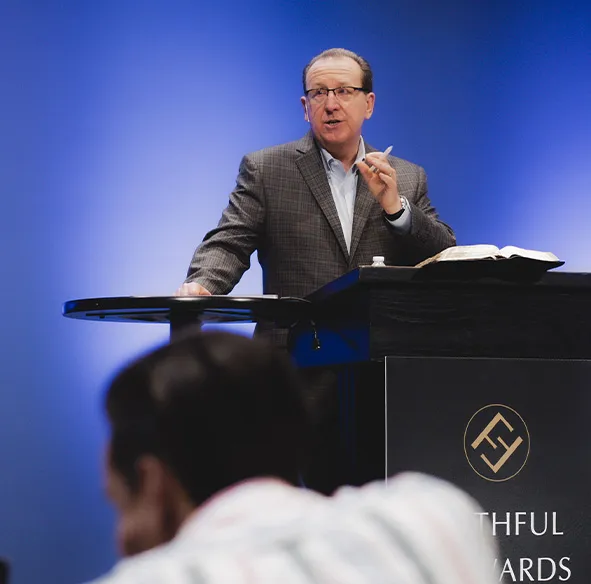
Training
Join courses and workshops designed to deepen your faith and equip you to serve others with biblical wisdom.
.webp)
From the Pastor's Desk
Read pastoral messages that encourage, instruct, and help you apply God’s Word to every part of your life.
.webp)
Hymns
Discover timeless hymns that lift your heart in worship and remind you of God’s abounding grace and faithfulness.
Podcasts
Stay rooted in Scripture through our podcast series.