Sermons That Exalt Christ
The preaching of God’s Word is central to the life of the church. Tom's pulpit ministry is dedicated to providing clear, biblical teaching to equip believers, strengthen faith, and exalt Christ.


Engage with the most recent teaching from God’s Word.
The preaching of God's Word is central to worship and of the utmost importance for the sanctification of every believer in Christ.


Explore messages organized to help you grow in Christ.
Search and filter sermons for quick access.
Voting Your Conscience
In a unique 2016 sermon, Pastor Tom Pennington addressed the "bizarre" presidential election, aiming to guide Christians in making conscience-based voting decisions rather than endorsing a candidate. He began by outlining God's expectations for earthly rulers, even pagan ones. These include crucial character qualities like humility, morality, honesty, justice, and compassion, alongside the skill and wisdom necessary to govern effectively and select wise counselors. Pennington noted that neither major candidate met these divine standards. He then clarified that moral decisions fall into three categories: direct commands, direct prohibitions, or "issues of conscience," categorizing voting as the latter. For such decisions, Christians should pray, research, and choose what they believe best honors Christ. Pennington presented three valid options: not voting (though he found it less desirable due to civic responsibility), voting for a third-party or write-in candidate (which, while good for conscience, might be practically ineffective), or voting for the "lesser of two evils." Criteria for this third option included evaluating candidates' character (acknowledging both were deeply flawed), their agendas, party platforms (e.g., on marriage and abortion), potential Supreme Court nominations, and implications for religious liberty.
The Inerrancy, Preservation, and Translation of Scripture - Part 2
Pastor Tom Pennington's sermon "The Inerrancy, Preservation, and Translation of Scripture (Part 2)" affirms the Bible's total inerrancy, upheld by Jesus and historical church teaching. He then details the miraculous preservation of Scripture, emphasizing that although original autographs are lost, thousands of meticulously copied manuscripts exist. These include an unparalleled number of Old and New Testament copies, dating remarkably close to the originals, with the Dead Sea Scrolls demonstrating near-perfect textual agreement over millennia. Pennington assures listeners that textual variations are overwhelmingly minor (spelling, word order) and do not affect any core Christian doctrine; significant variants are transparently noted in modern formal equivalence translations like the NASB and ESV. He distinguishes between translation philosophies: formal equivalence (word-for-word) is ideal for serious study, dynamic equivalence (idea-for-idea) is less precise, and paraphrase is essentially commentary. He cautions against the "King James Only" view, explaining its historical inaccuracies. Finally, Pennington challenges believers to adopt Jesus� high view of Scripture: read it all, memorize it for temptation, diligently understand it, obey its commands, and make it the central focus of their lives and ministry, recognizing it as God's best and enduring word.
The Inerrancy, Preservation, and Translation of Scripture - Part 1
This sermon emphasizes the crucial doctrine of biblical inerrancy, positing that Scripture, in its original form and correctly interpreted, is entirely true and without error in all it affirms, encompassing spiritual, moral, historical, and scientific matters. The speaker argues that the primary reason for believing in the Bible's inerrancy is Jesus Christ, who affirmed the Old Testament's divine authority and pre-authenticated the New Testament by selecting its writers. Historically, the Church, from early fathers like Augustine through the Reformation and the 1978 Chicago Statement on Biblical Inerrancy, consistently upheld this total inerrancy. Modern challenges, emerging primarily after the 17th century, often distinguish between the Bible being infallible in doctrine but fallible in history or science�a view contrary to traditional Christian belief. Biblically, the speaker highlights that Scripture claims itself to be the infallible "Word of God" and "truth," breathed out by a God who cannot lie. Jesus Christ provided ultimate validation, affirming the entire Old Testament canon from "Abel to Zechariah" (Genesis to 2 Chronicles). He explicitly stated "the Scripture cannot be broken" (John 10:35) and "Your word is truth" (John 17:17).
Paul Proves the Gospel from the Old Testament - Part 3
Tom Pennington's sermon on Romans 4:1-8 highlights Paul's argument for justification by faith alone, rooted in the Old Testament. Paul first cites Abraham, demonstrating that he was made right with God not by works, but by believing God's promise, which led God to "credit" righteousness to him (Genesis 15:6). This underscores justification as a "favor" (grace), not an earned wage, thus precluding human boasting. Paul then supports this with David's example from Psalm 32:1-2, where David, despite severe sins, is "blessed" by God forgiving his lawless deeds, covering his sins, and not "taking into account" his sin. This illustrates that justification is taught throughout the Old Testament, is a personal, gracious act of God, and crucially, involves God crediting *actual* righteousness. This credited righteousness is Christ's perfect obedience, given to believers through their union with Him. Justification resolves two fundamental issues for sinners: legal guilt (sins credited to Christ) and the lack of positive righteousness (Christ's righteousness credited to us). This profound exchange provides complete forgiveness and imputed righteousness to all who repent and believe in Christ.
Paul Proves the Gospel from the Old Testament - Part 2
This text, a sermon on Romans 4:1-8, explains justification by faith alone, using Abraham as a primary example. The speaker begins with an anecdote about a man who received a paycheck for six years without working, drawing a parallel to God's unearned gift of righteousness. Paul argues that Abraham was not justified by works, which would allow boasting before God, but by faith, as stated in Genesis 15:6: "Abraham believed God, and it was credited to him as righteousness." This faith was Abraham's wholehearted trust in God's promise that through one of his descendants�the Messiah�spiritual blessing and salvation would extend to all nations. The term "credited" is an accounting word, meaning God placed actual righteousness into Abraham's account. This righteousness is not a wage earned by work, but a gift of grace to "the one who does not work, but believes in Him who justifies the ungodly." God's profound ability to declare the ungodly righteous is made possible solely through the atoning work of Jesus Christ, whose perfect life and sacrificial death are credited to believers.
Paul Proves the Gospel from the Old Testament - Part 1
This transcript from Tom Pennington's sermon "Paul Proves the Gospel from the Old Testament (Part 1)" introduces Romans 4:1-8, returning to Paul's letter after a four-month break. Pennington reviews the context of Romans: Paul wrote it from Corinth around 57 A.D. to glorify God, establish Roman Christians in the gospel, and gain support for his mission to Western Europe. The letter's central theme is the "gospel of God," specifically justification by faith alone�a gift of righteousness received through faith, not works. Paul's argument in Romans progresses from humanity's universal lack of righteousness to God's gift of imputed righteousness through faith. Chapter 4 provides a biblical defense of this truth, focusing on Abraham and David as Old Testament examples. Paul refutes the idea that Abraham was justified by works, arguing that such a notion allows for human boasting and contradicts Scripture, specifically Genesis 15:6: "Abraham believed God, and it was credited to him as righteousness." This verse, foundational to the doctrine of justification by faith alone, demonstrates that Abraham, an idolater when called, believed God's promise of spiritual blessing and redemption through his descendant (the Messiah), and this faith�not his works�was his means of salvation.
No Results Found.
We couldn’t find anything matching your search.
Explore The Word Unleashed
Our ministry brings together expository preaching, theological precision, and practical application for the good of Christ's church and the daily living of Christ's people.

Sermons
Listen to expository sermons that clearly teach God’s Word and guide you in daily living.

Radio
Tune in to gospel-centered programs that share biblical truth and strengthen your daily walk with Christ.
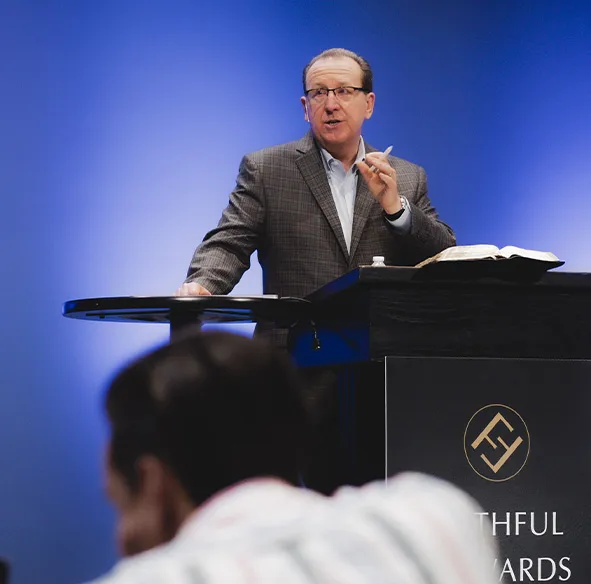
Training
Join courses and workshops designed to deepen your faith and equip you to serve others with biblical wisdom.

From the Pastor's Desk
Read pastoral messages that encourage, instruct, and help you apply God’s Word to every part of your life.

Hymns
Discover timeless hymns that lift your heart in worship and remind you of God’s abounding grace and faithfulness.
Podcasts
Stay rooted in Scripture through our podcast series.