Sermons That Exalt Christ
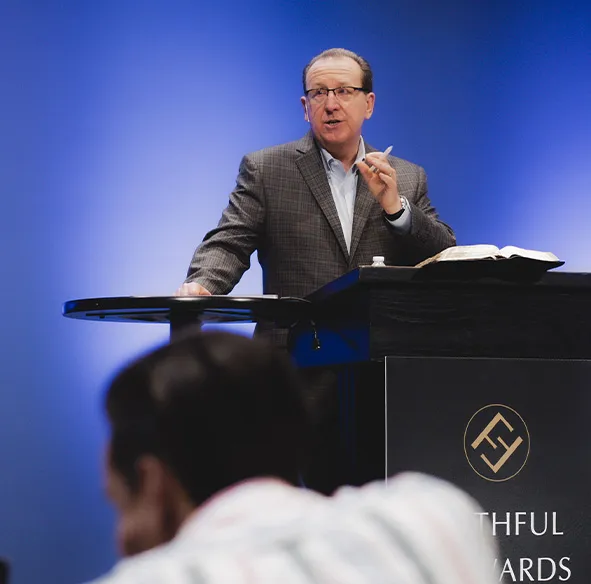
The preaching of God’s Word is central to the life of the church. Tom's pulpit ministry is dedicated to providing clear, biblical teaching to equip believers, strengthen faith, and exalt Christ.


Engage with the most recent teaching from God’s Word.
The preaching of God's Word is central to worship and of the utmost importance for the sanctification of every believer in Christ.

.jpg)
.jpg)

Explore messages organized to help you grow in Christ.
Search and filter sermons for quick access.
Sin Is Not Your Master - Part 3
Pastor Tom Pennington's sermon on Romans 6:1-14 emphasizes that believers are no longer slaves to sin, refuting the idea of continuing in sin. He clarifies that "dying to sin" means dying to its *reign* at salvation, a radical change in our relationship with sin. Pennington argues this "death" to sin occurs through the **baptism of the Holy Spirit**, not water baptism. He debunks the idea of water baptism as salvific or merely a sign in this context, citing scriptural reasons. Instead, the Spirit's baptism immerses us into Christ's body, creating an unbreakable union. This union means we were "baptized into His death" and "buried with Him," signifying the finality of our old self. Crucially, we were also "raised with Him to walk in newness of life," becoming a "new creation" in Christ. Key lessons: foundational knowledge of these truths is paramount for overcoming sin. True Christians cannot perpetually live in unrepentant sin; God will discipline them or even take their lives. Sustained unrepentant sin, if unchecked, signals one was never truly saved. Union with Christ provides security, ensuring grace reigns and leads to increasing righteousness, transforming us into new creations.
Q & A
Pastor Tom Pennington's Q&A session addressed diverse theological and practical inquiries. He clarified that God, not Satan, is sovereign over all things, including adversity, citing Job and 2 Chronicles to emphasize divine control and offer comfort. On Old Testament atonement, Pennington explained that sacrifices were symbolic, accepted by faith as types prefiguring Christ's ultimate, once-for-all sacrifice, which truly atoned for sin. Regarding biblical interpretation, he attributed variations in Old Testament quotes in the New Testament to translation from Hebrew to Greek and the apostles' Spirit-inspired commentary, which affirmed the principle of Bible translation. The canonicity of Hebrews, despite its unknown author, was explained by the early church's acceptance of books written by or under the authority of an apostle. Pennington also defined his "leaky dispensationalism," affirming that Israel is distinct from the Church and has a future in God's plan. He provided guidance on evangelism, advising a compassionate approach with cult members, focusing on authority, Christ's identity, and the true gospel, while for postmodern skeptics, challenging the notion that all beliefs are equally valid by asserting objective truth.
Sin Is Not Your Master - Part 2
Tom Pennington's sermon on Romans 6:1-14 addresses the crucial question: "Can a believer continue to sin after salvation?" Paul's emphatic answer is "absolutely not!" because Christians have "died to sin." This foundational statement is key to living a holy life and understanding Christian security. Pennington clarifies what "dying to sin" does not mean, refuting common misinterpretations such as becoming entirely insensitive to sin (Wesleyan perfectionism), finding a "secret" to instant victory, or simply dying daily to sin. It also doesn't exclusively refer to freedom from sin's guilt and penalty, or merely the act of renouncing sin at repentance. Instead, "we died to sin" signifies a radical, one-time event at conversion: a fundamental change of "realms" or "kingdoms." Before Christ, sin *reigned*, dominating and enslaving individuals. At salvation, believers are transferred into a new kingdom where *grace reigns*. This means we died to sin's *reign*, *dominion*, and *slavery*. While sin's *presence* remains in believers, its *mastery* is definitively broken. This truth has profound implications for all: non-Christians remain slaves to sin, desperately needing Christ's liberating power. For genuine believers, sin is now an anomaly, not a characterizing pattern, demonstrating that grace is actively producing increasing righteousness in their lives.
Sin Is Not Your Master - Part 1
Tom Pennington's sermon "Romans Sin Is Not Your Master - Part 1" clarifies Romans 6:1-14, arguing that this section is often misunderstood as a new topic (sanctification) but is, in fact, a continuation of Romans 5, developing the theme of the believer's security in Christ. Paul's central question in Romans 6:1, "Are we to continue in sin so that grace may increase?", directly stems from Romans 5:20-21, which states that grace abounded where sin increased. Pennington emphasizes Paul's resolute answer: "May it never be!" This strong rejection underscores that the gospel of grace does not promote continued sin. Paul raised this question for four key reasons: to refute opponents who slandered the gospel as encouraging sin, to illustrate the implications of grace and justification for true believers, to confront professing Christians who excused habitual sin (antinomianism), and to demonstrate that the true, grace-focused gospel naturally invites such potential misunderstandings. Central to Paul's argument is Romans 6:2: "How shall we who died to sin still live in it?" Pennington explains that "died to sin" refers to a definitive, past event that occurred at the moment of salvation, signifying a radical change in the believer's relationship to sin.
He Is Risen
Pastor Tom Pennington asserts that Jesus' resurrection is the indispensable foundation of Christian faith, citing 1 Corinthians 15, which outlines the gospel: Jesus died for sins, was buried, raised on the third day, and appeared to many. This was a real historical event, not fiction, evidenced by numerous witnesses. Devoted women, including Mary Magdalene, were the first human witnesses, discovering the empty tomb after arriving to anoint Jesus' body. God also testified through a severe earthquake and an angel who rolled away the stone, allowing witnesses to see Jesus was gone. Roman guards, securing the tomb, were terrified by these supernatural events and the empty tomb. Angels declared, "He is not here, for He has risen," inviting the women to confirm it. The undisturbed grave clothes further negated grave robbery. Jesus himself appeared multiple times�to the women, Emmaus disciples, and eventually over 500 disciples�disproving claims of insufficient evidence. Pennington concludes that if the resurrection is true, believers must respond by confessing Jesus as Lord, worshipping Him as God, and proclaiming Him as Savior, as mere belief in the historical event is insufficient; true faith demands complete submission and obedience to Christ.
No Results Found.
We couldn’t find anything matching your search.
Explore The Word Unleashed
Our ministry brings together expository preaching, theological precision, and practical application for the good of Christ's church and the daily living of Christ's people.
.webp)
Sermons
Listen to expository sermons that clearly teach God’s Word and guide you in daily living.

Radio
Tune in to gospel-centered programs that share biblical truth and strengthen your daily walk with Christ.
Training
Join courses and workshops designed to deepen your faith and equip you to serve others with biblical wisdom.
.webp)
From the Pastor's Desk
Read pastoral messages that encourage, instruct, and help you apply God’s Word to every part of your life.
.webp)
Hymns
Discover timeless hymns that lift your heart in worship and remind you of God’s abounding grace and faithfulness.
Podcasts
Stay rooted in Scripture through our podcast series.