Sermons That Exalt Christ
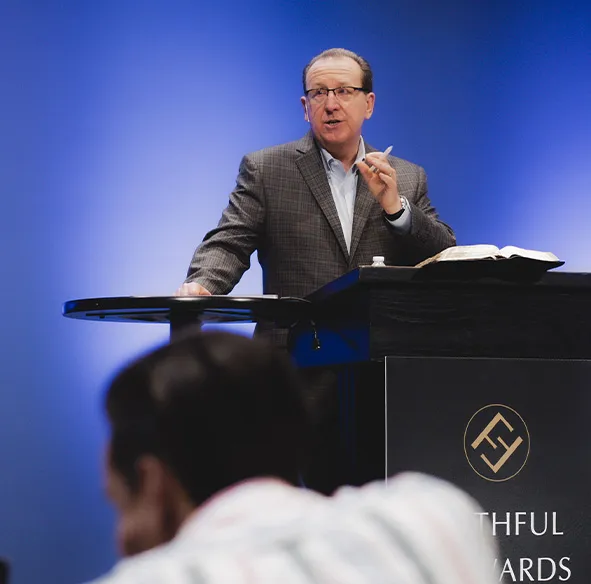
The preaching of God’s Word is central to the life of the church. Tom's pulpit ministry is dedicated to providing clear, biblical teaching to equip believers, strengthen faith, and exalt Christ.


Engage with the most recent teaching from God’s Word.
The preaching of God's Word is central to worship and of the utmost importance for the sanctification of every believer in Christ.

.jpg)
.jpg)

Explore messages organized to help you grow in Christ.
Search and filter sermons for quick access.
Sin Is Not Your Master - Part 8
Pastor Tom Pennington's sermon "Romans Sin Is Not Your Master (Part 8)" explores Romans 6:1-14, addressing the believer's ongoing struggle with sin. He highlights from James 1 that temptation stems from "our own lust" or sinful cravings, not God. For Christians, conversion signifies a "death to sin," meaning sin's *reign* and *domination* are broken, though sin still *dwells* within our unredeemed bodies and minds. Paul then outlines five imperatives for living free from sin's mastery: 1. **Consider yourself dead to sin, alive to God:** Grasp and live by your new identity in Christ. 2. **Do not let sin reign in your mortal body:** Actively refuse to obey sin's cravings, which attempt to control through our physical being and thoughts. 3. **Do not present the members of your body to sin:** Avoid yielding your physical parts, mind, and emotions as "instruments of unrighteousness." This involves practical steps like making no provision for sin, fleeing temptation, giving thanks, walking by the Spirit (obeying God's Word in dependence on Him), and taking radical steps to make sinning difficult. 4. **Present yourself to God:** Continually dedicate your entire being to God's service, acknowledging you are bought by Christ and no longer your own. 5.
Sin Is Not Your Master - Part 7
Pastor Tom Pennington's sermon on Romans 6:1-14 highlights this passage as foundational for understanding the daily battle with sin. He uses Martyn Lloyd-Jones' illustration of being transferred from Satan's domain to grace's realm at salvation, underscoring that believers are no longer slaves to sin. Paul emphatically rejects the idea that increased grace permits continued sin, explaining that regeneration signifies a spiritual "death to sin's rule" and union with Christ's death and resurrection. Pennington presents nine propositions about sanctification: it's doctrine-driven, Christ-enabled, God's complete work, yet demands maximum human effort (a synergistic process). It's a lifelong battle, completed only at death or Christ's return, and must be pursued from motives of gratitude and God's glory, not personal comfort. Ultimately, sanctification is guaranteed by God's purpose to conform us to Christ. The sermon focuses on Romans 6:12, "Do not let sin reign in your mortal body so that you obey its lusts." While sin's *reign* is broken, its *presence* remains, with the "mortal body" and unredeemed brain serving as a base for sinful cravings (lusts). Therefore, Christians must constantly choose not to submit to these desires.
Sin Is Not Your Master - Part 6
Pastor Tom Pennington's sermon on Romans 6:1-14 highlights that believers are no longer slaves to sin, a fundamental change wrought by Christ's death and resurrection. Paul refutes the idea that grace allows continued sin, stressing that Christians have "died to sin," signifying the permanent breaking of sin's dominion in their lives. The central command in Romans 6:11 is to "consider yourselves to be dead to sin, but alive to God in Christ Jesus." This isn't about pretending or wishful thinking, but about factually acknowledging what God has *already done* through regeneration. The Greek word "consider" (logizomai), often used in accounting, means to evaluate and accept as true based on careful calculation. Believers are to firmly post this reality in their minds: their "old self" died with Christ, and they are now alive to God, experiencing peace, grace, and eternal life through their union with Jesus. Practicing this involves diligent study of Romans 6:1-10, believing God's word despite personal feelings, and consistently reminding oneself of this new identity, particularly during temptation.
A Virtual Tour of the Reformation
This "Virtual Tour of the Reformation," delivered on its 500th anniversary, highlights the movement as a recovery of biblical truth from the "darkness" of medieval Roman Catholicism, symbolized by the motto "post tenebras lux" (after darkness, light). Pastor Tom Pennington identifies the Reformation's core as the Five Solas: Sola Scriptura, Solus Christus, Sola Fide, Sola Gratia, and Soli Deo Gloria, which answered fundamental questions about church authority and salvation. The ultimate hero, he asserts, is Jesus Christ building His church. The sermon traces the Reformation's foundations through pre-Reformers like Peter Waldo, John Wycliffe, and Jan Hus, who championed Scripture's accessibility and authority. It then explores the main streams: Martin Luther in Germany, John Calvin in Geneva, and Ulrich Zwingli in Switzerland. Luther's personal struggle led to his understanding of justification by faith, the posting of the 95 Theses, his excommunication, and his pivotal German Bible translation, which influenced William Tyndale's English Bible. Calvin, a second-generation Reformer, wrote the *Institutes* and directed the creation of the influential Geneva Bible. Zwingli, a contemporary of Luther, independently advocated for reform in Zurich through verse-by-verse biblical preaching.
Sin Is Not Your Master - Part 5
In "Romans Sin Is Not Your Master (Part 5)," Tom Pennington critiques non-biblical approaches to sin like monasticism and asceticism, arguing these man-made efforts, such as living as hermits or on columns, are futile and "of no value against fleshly indulgence," as sin resides within. Instead, the sermon grounds the solution in Romans 6, asserting that Christians have received a spiritual "Emancipation Proclamation" from sin's mastery. Through union with Christ at salvation, believers have died to sin's reign, dominion, and slavery. The "old self" was crucified with Christ, rendering the body of sin ineffective. Just as Christ was permanently raised from the dead, believers are spiritually raised to walk in a new, permanent life *now*. This radical heart change means that an ongoing, unrepentant pattern of sin is incompatible with true Christianity. Christ died to sin once for all and now lives to God; similarly, believers have permanently died to the realm of sin and death and now "live forever to God," with sin dethroned from its kingly power.
Sin Is Not Your Master - Part 4
Pastor Tom Pennington critiques the common, flawed view of salvation as a human decision leading to moral self-reliance, arguing it contradicts Scripture. He emphasizes that true salvation requires regeneration�a miraculous, divine act of God imparting new spiritual life. This "spiritual heart transplant" (Ezekiel 36) or "new birth" (John 3) is a radical, instantaneous transformation, not mere reformation. At regeneration, the "old self" (enslaved to sin) is crucified with Christ, dying and being replaced by an entirely new person in Christ. This means believers are no longer slaves to sin, though they still contend with "the flesh"�their unredeemed humanness. This struggle is a "mop-up operation" against a defeated enemy, not a war between two equal natures. Understanding this radical change is crucial: it provides the best evidence of true salvation and forms the foundation for all Christian growth and holiness. Like slaves freed by the Emancipation Proclamation, Christians must grasp their spiritual emancipation from sin's mastery to live in its freedom.
No Results Found.
We couldn’t find anything matching your search.
Explore The Word Unleashed
Our ministry brings together expository preaching, theological precision, and practical application for the good of Christ's church and the daily living of Christ's people.
.webp)
Sermons
Listen to expository sermons that clearly teach God’s Word and guide you in daily living.

Radio
Tune in to gospel-centered programs that share biblical truth and strengthen your daily walk with Christ.
Training
Join courses and workshops designed to deepen your faith and equip you to serve others with biblical wisdom.
.webp)
From the Pastor's Desk
Read pastoral messages that encourage, instruct, and help you apply God’s Word to every part of your life.
.webp)
Hymns
Discover timeless hymns that lift your heart in worship and remind you of God’s abounding grace and faithfulness.

Podcasts
Stay rooted in Scripture through our podcast series.