Sermons That Exalt Christ
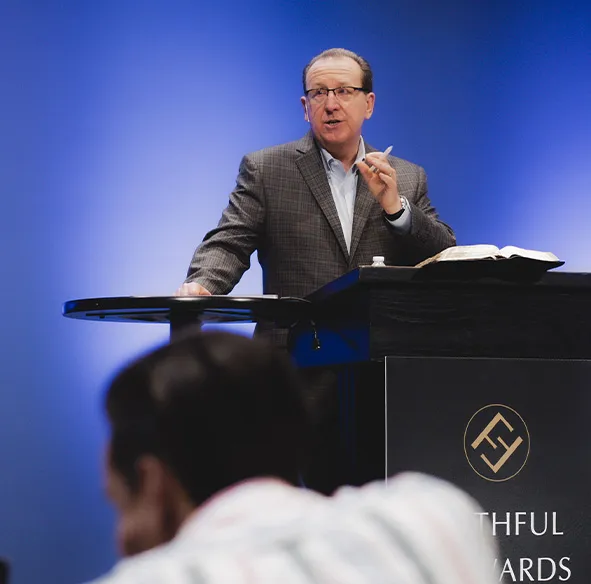
The preaching of God’s Word is central to the life of the church. Tom's pulpit ministry is dedicated to providing clear, biblical teaching to equip believers, strengthen faith, and exalt Christ.


Engage with the most recent teaching from God’s Word.
The preaching of God's Word is central to worship and of the utmost importance for the sanctification of every believer in Christ.

.jpg)
.jpg)

Explore messages organized to help you grow in Christ.
Search and filter sermons for quick access.
Mindful Worship
Pastor Tom Pennington's sermon, "Mindful Worship," distinguishes biblical "mindfulness" from the secular craze, emphasizing that true believers are called to be fully present, especially in corporate worship. He asserts that distraction is a significant problem, and Jesus' teaching in John 4:23-24 defines acceptable worship as being "in spirit and truth." Worship "in truth" means it must be directed to the biblical God, based on the complete revelation of Scripture, and include only elements God explicitly prescribes (the regulative principle), such as singing, praying, giving, reading, teaching, baptism, and the Lord's Table. It must also be grounded in a life of obedience and offered through Jesus Christ. Worship "in spirit" dictates that it must be a matter of the heart, not merely external performance. It must be wholehearted, enthusiastic, and passionate, engaging one's entire immaterial being, reflecting God's nature as Spirit. Critically, true worship is active, not passive; God is the audience, evaluating our sincere, engaged participation in every element. The sermon concludes by highlighting that the capacity for true worship originates from God: "The Father seeks such people to be His worshipers." We become worshipers not by seeking Him, but by His gracious pursuit of us through Christ.
The Deadly Danger of Sexual Lust
Pastor Tom Pennington identifies sexual lust as a particularly deadly sin for believers. He defines it, using terms like 'lust' and 'covetousness,' as a strong, sinful desire for what God forbids, specifically another person sexually. This encompasses looking with intent to lust, creating explicit mental images, and exciting lust in others through actions, words, or attire. He distinguishes it from natural attraction or healthy sexual desire within marriage. Pennington emphasizes lust's severe dangers: it bears the moral guilt of the sinful act (Jesus calls it adultery in the heart), excludes from Christ's kingdom (being idolatry), and condemns one to eternal hell if unrepented. He urges radical steps against it. Seven biblical strategies are offered: 1) Flee temptation, making sin difficult. 2) Cultivate thanksgiving, counteracting craving. 3) Use Scripture for holiness and as a weapon. 4) Pray for God's grace and help. 5) Rehearse lust's tragic consequences (it never satisfies, destroys relationships). 6) Enjoy married love or pursue marriage if single. 7) Crucially, depend on Christ alone for forgiveness, help, and sanctification, as He is the sole source of freedom from this deadly slavery.
The Deadly Danger of a Proud Heart
Tom Pennington's sermon, "The Deadly Danger of a Proud Heart" (1 Peter 5:5-7), highlights pride as a destructive force, illustrating its peril with the Admiral Nakhimov collision caused by human arrogance. He contends that despite cultural affirmations of self-esteem, pride is the soul's greatest enemy, severing us from God's grace. The core biblical principle, "God is opposed to the proud, but gives grace to the humble," underscores this danger. Pride, originating with Satan and pervasive in humanity, manifests in accomplishments, position, and even spiritual acts, leading to self-sufficiency and a superior attitude. God actively opposes the proud, chastening even believers for it, as seen in biblical figures like Uzziah and Hezekiah. Conversely, God continuously bestows grace�His unmerited favor�upon the humble, those who possess a deep sense of their moral littleness. This humility is a prerequisite for receiving God's essential grace for spiritual survival. Pennington outlines a three-step path to cultivate humility: submitting to rightful human authorities, becoming a "slave of everyone" by valuing and serving others (like Christ), and embracing God's providence in all life's circumstances by casting anxieties upon Him. Embracing humility aligns us with God's will and ensures His ongoing grace.
The Deadly Danger of an Unforgiving Spirit
Pastor Tom Pennington's sermon, "The Deadly Danger of an Unforgiving Spirit," from Matthew 18:21-35, stresses Jesus' call for boundless forgiveness. When Peter asked how often to forgive, Jesus replied "seventy times seven," signifying no limit, particularly when someone repents. Jesus illustrates this through the parable of an unforgiving servant. A king, representing God, mercifully forgives a slave an immeasurable debt (symbolizing humanity's vast sin against God). Yet, this forgiven slave then cruelly refuses to pardon a fellow servant's trivial debt, having him imprisoned. Discovering this, the enraged king condemns the unforgiving slave to indefinite torment until his original, impossible debt is repaid. Jesus concludes, "My heavenly Father will also do the same to you, if each of you does not forgive his brother from your heart." This means true believers harboring unforgiveness invite God's severe discipline. Moreover, a habitual refusal to forgive may reveal a person has never truly experienced God's profound forgiveness themselves. Our capacity to forgive others stems from deeply appreciating the immeasurable debt God has graciously canceled for us through Christ.
The Real Worship Center
Pastor Tom Pennington dedicates a new building as a "worship center," clarifying it's not "God's house" or the "church," but a place for the gathered body of believers. He emphasizes that true worship isn't confined to a physical location; it originates in each human heart. Drawing from Isaiah 66:1-2, Pennington outlines God's requirements for acceptable worship. First, worship must be **exclusive**, directed solely to Yahweh, the one true, self-existent God who is unique and shares His glory with no other. Second, it must be **transcendent**, acknowledging God's absolute sovereignty and incomprehensible greatness, recognizing He cannot be contained or manipulated by human constructs. Third, worship must be **dependent**, understanding that God, as Creator of all, needs nothing from humanity but graciously provides everything. Additionally, God only accepts worship from those displaying specific attitudes: **humility**, recognizing His greatness and one's own smallness; a **contrite spirit**, being broken over personal sin and utterly reliant on God's saving grace through Christ; and **submission to God's Word**, trembling at its truth, listening attentively, and striving to obey it. Ultimately, the building becomes a true worship center only when individual hearts are genuine worship centers, embodying these divine requirements.
My Name Is Barabbas
The text details Jesus' six trials�three Jewish and three Roman�all of which affirmed His innocence before His crucifixion. During the third Roman trial, Pontius Pilate, adhering to a Passover custom of releasing a prisoner, presented the crowd with a choice between the innocent Jesus and Barabbas, a notorious insurrectionist and murderer. Pilate, recognizing the chief priests' envy, hoped to free Jesus. However, the religious leaders incited the crowd, who, despite Pilate's repeated declarations of Jesus' innocence, vehemently demanded Barabbas's release and Jesus' crucifixion. This choice highlighted human depravity and sin. The sermon emphasizes this as "the great exchange": Barabbas, the condemned guilty sinner, was pardoned and set free, while Jesus, the perfectly righteous one, was condemned and executed in his place. This was a divine design, symbolizing Jesus' substitutionary atonement. He literally died on the cross intended for Barabbas and his accomplices. The core message is that, like Barabbas, all individuals are guilty of sin, and Jesus' death on the cross serves as a perfect picture of His sacrifice to bear humanity's sins and offer pardon.
No Results Found.
We couldn’t find anything matching your search.
Explore The Word Unleashed
Our ministry brings together expository preaching, theological precision, and practical application for the good of Christ's church and the daily living of Christ's people.
.webp)
Sermons
Listen to expository sermons that clearly teach God’s Word and guide you in daily living.

Radio
Tune in to gospel-centered programs that share biblical truth and strengthen your daily walk with Christ.
Training
Join courses and workshops designed to deepen your faith and equip you to serve others with biblical wisdom.
.webp)
From the Pastor's Desk
Read pastoral messages that encourage, instruct, and help you apply God’s Word to every part of your life.
.webp)
Hymns
Discover timeless hymns that lift your heart in worship and remind you of God’s abounding grace and faithfulness.
Podcasts
Stay rooted in Scripture through our podcast series.