Sermons That Exalt Christ
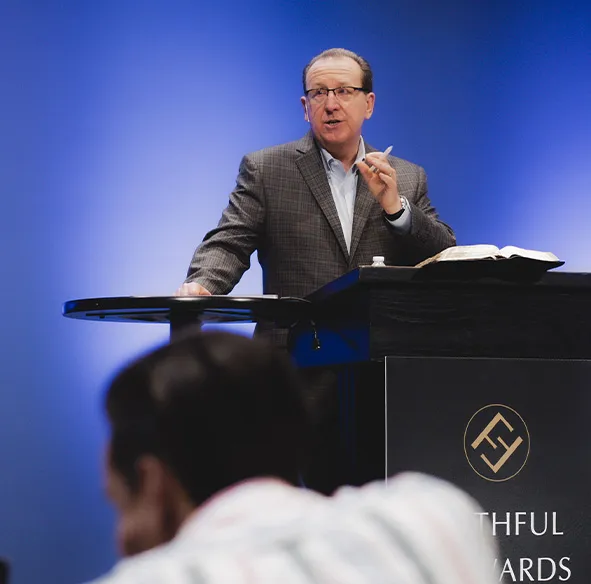
The preaching of God’s Word is central to the life of the church. Tom's pulpit ministry is dedicated to providing clear, biblical teaching to equip believers, strengthen faith, and exalt Christ.


Engage with the most recent teaching from God’s Word.
The preaching of God's Word is central to worship and of the utmost importance for the sanctification of every believer in Christ.

.jpg)
.jpg)

Explore messages organized to help you grow in Christ.
Search and filter sermons for quick access.
Dead to the Law - Part 1
This sermon on Romans 7:1-6 explores the Christian's "death to the Law." Pastor Tom Pennington frames Romans 7 within a larger section (chapters 5-8) about believer's security, clarifying the Law's purpose after discussing freedom from sin in Romans 6. Using a marriage analogy, Paul illustrates that "death ends the law's jurisdiction": a woman is free to remarry after her husband dies. This principle applies to believers: "you also were made to die to the Law through the body of Christ." This "Law" refers to God's moral law (like the Ten Commandments), not its ceremonial aspects. Dying to the moral law does not mean its abolition or that Christians are exempt from obeying it as a guide for living. Instead, it signifies two profound changes: believers no longer seek justification or righteousness by trying to keep the Law, and they are no longer under the Law's condemnation and punishment. Christ perfectly fulfilled its demands and bore its curse on our behalf. This "death" occurred through Christ's crucifixion, uniting believers eternally to Him, much like a new, permanent marriage.
Acts - Revelation - Part 1
Tom Pennington�s sermon introduces the Book of Acts as the continuation of Jesus� work through the Holy Spirit and His apostles after His ascension. Authored by Luke between 60-62 AD for Theophilus, Acts explains how Jesus� initial 500 disciples grew into a massive movement across the Roman Empire. Its purpose is to provide a historically accurate account, detail the gospel's global spread, and offer an apologetic defense for Christianity. The narrative begins with Jesus commissioning the apostles as witnesses and promising the Holy Spirit before His ascension, which confirmed His identity and future return. The apostles then prayed and replaced Judas with Matthias. On Pentecost, the Holy Spirit descended, enabling the apostles to speak in known foreign languages, a miraculous sign confirming their message to a diverse crowd. This speaking in tongues was a specific sign gift for the apostolic era, not a normative mystical experience for today's church. Peter's sermon, quoting Joel 2, proclaimed Jesus' life, death, resurrection, and exaltation, leading 3,000 to repentance and baptism. The early church, characterized by identifiable membership, prioritized the apostles' teaching, fellowship, breaking bread, and prayer, continually adding new believers as Jesus continued to build His church.
From Rome to Reformation: The Key Issues Then and Now
The Protestant Reformation, ignited by Martin Luther's 95 Theses in 1517, challenged the Roman Catholic Church's widespread abuses, particularly the sale of indulgences for sin remission. This movement, occurring 500 years ago, was not an innovation but a "renovation" to recover long-forgotten biblical truths, summarized by the Five Solas. The Reformation grappled with three foundational theological issues. First, the ultimate source of authority: Reformers championed *Sola Scriptura*, affirming Scripture alone as God�s inspired and final standard, distinct from Rome�s equal reliance on Scripture, tradition, and the Magisterium. Second, the head of the church: Reformers asserted *Solus Christus*, declaring Christ alone as the church's sovereign head, contrasting with the Pope�s claimed supremacy, a conviction for which Jan Hus was martyred. Third, how individuals are made right with God (justification): Reformers taught *Solus Christus* and *Sola Fide*, emphasizing that God justifies us by Christ�s righteousness alone, received through faith alone, rejecting Rome�s view that justification is a process involving baptism and good works that increase righteousness. These recovered truths�the unique authority of Scripture, Christ's singular headship, and justification solely by Christ's work through faith�remain vital today, providing the bedrock of Christian faith and hope, which must be preserved.
A Survey of the New Testament - Part 2
This text surveys Jesus' approximately three-and-a-half-year public ministry, likely spanning from 26 AD to His crucifixion in 30 AD. It details four periods, beginning with initial obscurity, His baptism, and first miracles, then His first full year ministering in Judea and Galilee, gathering early disciples. The second full year saw immense popularity but also critical confrontations with religious leaders, culminating in their official rejection and His family's disbelief. This led Jesus to teach in parables and intensify training for the twelve apostles, shifting focus from crowds. The final year involved declining popularity, a move towards Gentile regions, and His first clear prophecy of His death at Caesarea Philippi. The dramatic raising of Lazarus in Bethany solidified the Sanhedrin's resolve to kill Him. The narrative culminates in the Passion Week: His Triumphal Entry on Sunday, cleansing the temple on Monday, denunciation of leaders on Tuesday, and the Last Supper on Thursday. Friday brought illegal Jewish and Roman trials, condemning Him for blasphemy, leading to His crucifixion at 3 PM.
Whose Slave are You? - Part 5
Pastor Tom Pennington's sermon on Romans 6:15-23 challenges the popular notion that all spiritual paths lead to the same divine destination. He asserts that Scripture reveals only two ultimate paths and eternal destinies, likened to two gates: a wide gate leading to death and a narrow gate leading to life. These paths are described as two forms of slavery: one to sin, offering no benefit and culminating in eternal death, and the other to God, resulting in sanctification and eternal life. The central message is encapsulated in Romans 6:23: "For the wages of sin is death, but the free gift of God is eternal life in Christ Jesus our Lord." Pennington emphasizes that "the wages of sin is death" signifies humanity's earned eternal punishment for even a single transgression against God's infinite holiness. This "death" is eternal separation and suffering. Conversely, "the free gift of God is eternal life" means salvation is not earned but graciously bestowed. This "eternal life" is a profound, perpetual relationship with God. This gift is received "in Christ Jesus our Lord," as Jesus, acting as humanity's representative, fully paid the "wages of sin" by His death, satisfying God's justice.
Whose Slave are You? - Part 4
The sermon "Romans Whose Slave Are You?" by Tom Pennington asserts that all humanity walks one of two spiritual roads, leading either to eternal heaven or eternal punishment. Drawing from Romans 6, he frames this choice as either slavery to sin or slavery to God. Before salvation, individuals are slaves to sin, continually obeying its commands. This path yields no lasting benefit, only temporary pleasure and increasing lawlessness, ultimately resulting in eternal death�separation from God and conscious punishment. Unbelievers, despite knowing God's law, are "free in regard to righteousness," meaning they are inherently unable to obey Him acceptably. However, true believers experience a radical transformation: God frees them from sin and enslaves them to Himself. This "slavery to God" brings the benefit of sanctification�a gradual, ongoing process of growing in holiness and obedience to God's Word through the Holy Spirit, producing the fruit of righteousness. This path culminates in eternal life, a present possession and future complete salvation found in knowing God and Christ. While eternal life is a free gift of God's grace, a life demonstrating increasing obedience to Christ is the "road sign" confirming one is on the right path, having entered through faith in Jesus.
No Results Found.
We couldn’t find anything matching your search.
Explore The Word Unleashed
Our ministry brings together expository preaching, theological precision, and practical application for the good of Christ's church and the daily living of Christ's people.
.webp)
Sermons
Listen to expository sermons that clearly teach God’s Word and guide you in daily living.

Radio
Tune in to gospel-centered programs that share biblical truth and strengthen your daily walk with Christ.
Training
Join courses and workshops designed to deepen your faith and equip you to serve others with biblical wisdom.
.webp)
From the Pastor's Desk
Read pastoral messages that encourage, instruct, and help you apply God’s Word to every part of your life.
.webp)
Hymns
Discover timeless hymns that lift your heart in worship and remind you of God’s abounding grace and faithfulness.
Podcasts
Stay rooted in Scripture through our podcast series.