Sermons That Exalt Christ
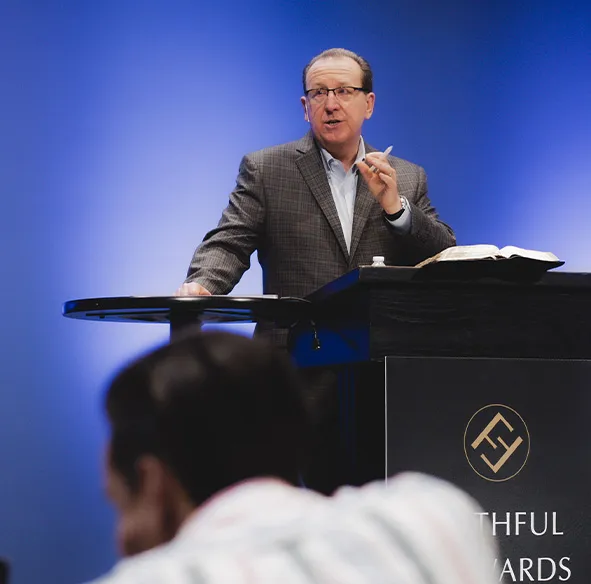
The preaching of God’s Word is central to the life of the church. Tom's pulpit ministry is dedicated to providing clear, biblical teaching to equip believers, strengthen faith, and exalt Christ.


Engage with the most recent teaching from God’s Word.
The preaching of God's Word is central to worship and of the utmost importance for the sanctification of every believer in Christ.

.jpg)
.jpg)

Explore messages organized to help you grow in Christ.
Search and filter sermons for quick access.
Christology: The Atonement - Part 1
This text on Christology emphasizes the unique nature of the atonement in Christianity. Unlike man-made religions where individuals must atone for their own sins, Christianity asserts that God Himself, the offended party, made full and complete atonement for sinners through the substitutionary sacrifice of His Son. While God was not absolutely compelled to save anyone, once He determined to redeem a people, the death of Jesus became absolutely necessary, as there was no other way for a righteous, holy God to reconcile with sinners. The causes of this atonement are rooted in God's character: His justice, demanding every sin be punished; His profound love, which initiated the plan; and His gracious will, all enacted for His own glory. The biblical doctrine of atonement refutes false theories like ransom to Satan or the moral influence view, which deny its necessity. Instead, it defines atonement as Christ's vicarious (substitutionary) sacrifice that satisfied God's justice, paying sin's penalty, bringing forgiveness, imputing righteousness, and reconciling humanity to God.
The Argument of Romans 7
Romans 7:14-25 is a highly debated New Testament passage exploring the intense struggle with sin. Pastor Tom Pennington examines four interpretations of whether it describes an unbeliever or a believer. The first two views, suggesting the passage depicts all unbelievers or those merely under conviction, are refuted by the text's shift to the present tense and the individual's heartfelt desire to obey God's law, a characteristic of a regenerate heart rather than one hostile to God. The third view, attributing the struggle solely to immature believers, is challenged because the present tense contradicts Paul describing his past immaturity, and mature believers often exhibit the deepest hatred and sorrow over their sin. Pennington asserts the fourth view is most compelling: Romans 7:14-25 describes Paul�s ongoing experience as a mature Christian, representing the struggle of all genuine believers until glorification. This is supported by the consistent use of present tense verbs, strong historical consensus (including later Augustine and the Reformers), and expressions unique to believers such as "I joyfully concur with the law of God in the inner man.
Caught in the Act - Part 3
Pastor Tom Pennington's sermon on Romans 7:7-13, "Caught in the Act (Part 3)," defends God's moral law against two common objections. He begins by using a jury duty anecdote to illustrate how people often blame the law rather than themselves for wrongdoing. Pennington explains that Paul addresses the question, "Is the Law sin?" (Romans 7:7). Paul emphatically states, "May it never be!" The law is holy, righteous, and good. Its purpose is not to cause sin, but to identify it and reveal humanity's inherent sinfulness. It awakens dormant sin, making individuals aware of their covetousness and spiritual self-deception, ultimately leading to the "death" of self-righteous confidence. The second objection, "Did that which is good become a cause of death for me?" (Romans 7:13), is also refuted. The law doesn't cause death; rather, it exposes the true, deadly character of inherent sinfulness. Like a mirror or a black light, God's law reveals the profound dirt in the soul, showing how sin, when consciously known, escalates into defiant rebellion against God. This makes sin "utterly sinful.
And The Word Became Flesh - Part 3
The sermon on John 1:14-18 underscores the profound and unique reality of Jesus' incarnation, urging deep reflection beyond mere familiarity. It explains that the eternal Son of God, the Word who created all things, became a real human, adding full humanity (without sin) to His deity and dwelling among us�an unparalleled event. John's text offers crucial insights: the "Word became flesh" meaning the divine Creator assumed human form. Witnesses like the apostles saw His glory, "full of grace and truth," while John the Baptist affirmed His pre-existence and superior rank. The incarnation's central mission had two purposes. First, "to bring grace to all who will believe." Humanity, alienated by sin and beyond the Law's saving power, desperately needed atonement. Jesus, "full of grace," provided salvation and continuous "grace upon grace" for daily life, making God's goodness real for sinners. Second, the mission was "to bring truth to all who will hear." Since no one had fully seen or comprehended God, Jesus, "the only begotten God who is in the bosom of the Father," uniquely explained Him. Through His perfect life and divine teaching, Jesus perfectly "exegeted" God, making the invisible Father known.
The Person of Christ - Part 2
This sermon, "The Person of Christ (Part 2)," deepens the study of Jesus' nature by presenting biblical evidence for His deity, following an earlier discussion of His humanity. Pastor Tom Pennington argues that Jesus' claims to be God necessitate acknowledging Him as either divine, a liar, or a lunatic, dismissing interpretations that only see Him as a good man or prophet. The evidence for Christ's deity is multifaceted. Scripture repeatedly calls Him "God" and "Son of God," even identifying Him as the Old Testament's Yahweh. Jesus manifests divine attributes like self-existence, eternity, omnipresence, omniscience, and omnipotence. He also exercises divine prerogatives, including the authority to forgive sins, execute judgment, and receive worship�a right godly men and angels refuse. Critically, Jesus directly claimed to be Yahweh through His "I AM" statements, particularly in John 8:58 ("before Abraham was born, I AM"), which His Jewish audience understood as a blasphemous claim to deity, prompting attempts to stone Him. The sermon reiterates the Chalcedonian understanding that Christ's human and divine natures are united in one person without confusion, change, division, or separation. This doctrine affirms Jesus as the God-man, fully human yet fully God.
And The Word Became Flesh - Part 2
The sermon "And The Word Became Flesh (Part 2)" from John 1:14-18 examines the profound truth of Jesus' incarnation, a central doctrine frequently attacked by skepticism, secularism, liberalism, postmodernism, false, and cultural Christianity. Pastor Pennington asserts that "the Word became flesh and dwelt among us," meaning the eternal, self-existent God and Creator added full, sinless humanity to His deity without changing His divine essence. This was crucial: only a divine being could save, and only a human substitute could atone for sin. Jesus, the new Tabernacle, "pitched His tent" among us, manifesting God's glory. Eyewitnesses like the Apostles "saw His glory," which was "as of the only begotten from the Father, full of grace and truth." This glory was evident in His miracles, transfiguration, and supremely, at the cross, revealing both God's undeserved kindness and His perfect, absolute truth. John the Baptist also affirmed Jesus' pre-existence and superior rank. The sermon invites non-Christians to embrace this gracious Christ for salvation, emphasizing His willingness to receive them, and calls believers to share this profound love of God.
No Results Found.
We couldn’t find anything matching your search.
Explore The Word Unleashed
Our ministry brings together expository preaching, theological precision, and practical application for the good of Christ's church and the daily living of Christ's people.
.webp)
Sermons
Listen to expository sermons that clearly teach God’s Word and guide you in daily living.

Radio
Tune in to gospel-centered programs that share biblical truth and strengthen your daily walk with Christ.
Training
Join courses and workshops designed to deepen your faith and equip you to serve others with biblical wisdom.
.webp)
From the Pastor's Desk
Read pastoral messages that encourage, instruct, and help you apply God’s Word to every part of your life.
.webp)
Hymns
Discover timeless hymns that lift your heart in worship and remind you of God’s abounding grace and faithfulness.
Podcasts
Stay rooted in Scripture through our podcast series.