Sermons That Exalt Christ
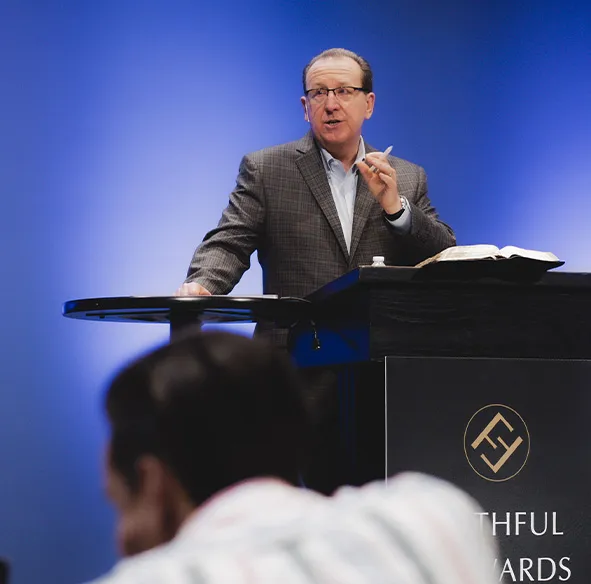
The preaching of God’s Word is central to the life of the church. Tom's pulpit ministry is dedicated to providing clear, biblical teaching to equip believers, strengthen faith, and exalt Christ.


Engage with the most recent teaching from God’s Word.
The preaching of God's Word is central to worship and of the utmost importance for the sanctification of every believer in Christ.

.jpg)
.jpg)

Explore messages organized to help you grow in Christ.
Search and filter sermons for quick access.
Human Responsibility - Part 5
This sermon from Romans 9:30-10:21 explores human responsibility for believing the gospel and the assurance of salvation. Pastor Pennington explains that while God's love is an objective reality, our subjective assurance grows by understanding His commitments. People often reject the gospel due to misunderstanding God's Law, seeing it as a way to earn favor rather than revealing sin, and by refusing salvation through faith alone, clinging to self-righteousness. Saving faith is accessible, requiring belief in one's heart that God raised Jesus from the dead (embracing His claims and saving work) and confessing Him as Lord (acknowledging Him as God and Master, encompassing repentance and trust). This faith has four profound implications: a solid scriptural foundation, ensuring believers "will not be disappointed" at future judgment; a personal application, extending to "everyone" regardless of background or past sins; a universal scope, as Christ is Lord of all, offering boundless grace to Jew and Gentile alike; and a categorical promise that "Whoever will call on the name of the Lord will be saved." This "calling" signifies a repentant plea for forgiveness, guaranteeing immediate and eternal salvation from God's wrath. The sermon concludes with an invitation for all to embrace this life-saving truth.
Human Responsibility - Part 4
This sermon, "Romans Human Responsibility (Part 4)," delves into why many, including God's chosen people, Israel, have rejected the Messiah, focusing on human unwillingness to embrace salvation by faith. Pastor Pennington illustrates the historical gravity of confessing "Jesus is Lord" with the story of Polycarp's martyrdom under Roman persecution. He contrasts two fundamentally opposed ways people seek a right standing with God: 1. **Righteousness based on Law:** This demands perfect, lifelong obedience to God's law, which is humanly impossible and results in a curse (Galatians 3:10). Our own sincere efforts are utterly insufficient. 2. **Righteousness based on Faith:** This path, unlike the law, is easily accessible and does not require superhuman deeds, as Christ has already perfectly accomplished all that is needed. True, saving faith, as explained in Romans 10:9-10, involves two inseparable aspects. First, one must **believe in their heart that God raised Jesus from the dead**. This entails an intelligent comprehension and assent to all of Jesus' claims�His deity, Messiahship, sinless life, substitutionary death, and resurrection�which validates His entire saving work. Second, one must **confess with their mouth Jesus as Lord (Kurios)**.
When Empires Fall - Part 2
This sermon on Daniel 5 underscores God's absolute sovereignty over the rise and fall of human empires and leaders, fulfilling ancient prophecies from Isaiah and Jeremiah regarding Babylon. Despite witnessing God's power through his ancestor Nebuchadnezzar, King Belshazzar blasphemously defied God by hosting a feast using sacred vessels from the Jerusalem temple. A mysterious hand then wrote "Mene, Mene, Tekel, Upharsin" on the wall. Daniel interpreted this divine message: God had numbered Belshazzar's kingdom, weighed him and found him deficient, and decreed its division to the Medes and Persians. That very night, the seemingly impregnable city of Babylon fell as Cyrus's forces, precisely as prophesied, diverted the Euphrates River and entered through open gates, executing Belshazzar. This dramatic event exemplifies that no government, empire, or ruler, regardless of defiance, power, or wickedness, can escape God's sovereign control, reach, or ultimate verdict.
Human Responsibility - Part 3
The text, based on Romans 9:30-10:21, addresses human responsibility in salvation, particularly why many Israelites rejected Christ. It establishes two fundamental realities: God is perfectly righteous and demands righteousness from all who enter His presence, yet humanity is inherently unrighteous (Romans 3:10). This dilemma offers only two paths: attempting to earn righteousness through personal merit and good works, which inevitably fails, or receiving it as a free gift through faith in Jesus Christ. Paul expresses profound sorrow and prays for Israel's salvation, highlighting their personal accountability for unbelief. He identifies their primary errors as a misunderstanding of the Law's purpose�believing it's a means to earn favor rather than a guide to Christ�and an unwillingness to embrace salvation by faith alone. While many possess "zeal for God," it is "not in accordance with knowledge." They fail to comprehend "God's righteousness," which is the divine gift of a right standing through faith in Christ, and instead strive to establish their own righteousness through works. This self-righteous pursuit is futile and condemned by the Law itself.
Q & A
Pastor Tom Pennington opens a Q&A session by reflecting on the Shepherds Conference, highlighting messages from John MacArthur on divine evaluation and Sinclair Ferguson on holiness. He sets ground rules for questions, emphasizing genuine inquiry over challenging the pastor. The session covers several theological questions: 1. **Bible Smuggling:** Asked about lying to smuggle Bibles, Pastor Tom advises against direct contradiction of truth, citing God's inability to lie, while acknowledging Christian liberty and courage. He suggests truthful but benign answers. 2. **Assurance of Salvation:** To balance self-examination with assurance, he recommends "for every look at yourself, take ten looks at Christ." Focus on the *direction* of growth in love, humility, and holiness, not perfection. He encourages using specific Bible verses as a "short sword of the Spirit" against doubt (e.g., Psalm 9:10, John 10:27-29, Philippians 1:6, Jude 24-25). 3. **Fasting:** Fasting is a valid, scriptural practice but should not be a regimented routine or a means to earn favor with God. It should be a heartfelt response to anguish or a deep need for prayer, connected to spiritual earnestness. 4.
Four Soils - Part 2
Pastor Tom Pennington's sermon "Four Soils" from Matthew 13:1-23 explores the Parable of the Sower, highlighting the critical role of the human heart's condition in responding to the gospel. The "seed" is identified as the Word of God, specifically the message of salvation through Jesus Christ. The "sower" is anyone who shares this divine truth. Jesus describes four types of "soil," each representing a different heart. The **hard soil** symbolizes an unreceptive heart that hears the gospel but doesn't genuinely understand it, allowing the evil one to snatch it away. The **rocky soil** signifies a superficial heart that initially receives the word with joy but lacks deep roots; it quickly withers under affliction or persecution, revealing temporary faith. The **thorny soil** illustrates a preoccupied heart where worldly worries, the deceitfulness of wealth, and life's pleasures choke out the gospel, rendering it unfruitful. Finally, the **good soil** represents a heart prepared by God, which hears, understands, and consistently bears fruit�Christian character and good works�demonstrating true, lasting faith. This parable offers crucial insights: there are only four responses to the gospel, three of which are initially favorable but not genuine. True, permanent faith flourishes only in a heart divinely prepared.
No Results Found.
We couldn’t find anything matching your search.
Explore The Word Unleashed
Our ministry brings together expository preaching, theological precision, and practical application for the good of Christ's church and the daily living of Christ's people.
.webp)
Sermons
Listen to expository sermons that clearly teach God’s Word and guide you in daily living.

Radio
Tune in to gospel-centered programs that share biblical truth and strengthen your daily walk with Christ.
Training
Join courses and workshops designed to deepen your faith and equip you to serve others with biblical wisdom.
.webp)
From the Pastor's Desk
Read pastoral messages that encourage, instruct, and help you apply God’s Word to every part of your life.
.webp)
Hymns
Discover timeless hymns that lift your heart in worship and remind you of God’s abounding grace and faithfulness.
Podcasts
Stay rooted in Scripture through our podcast series.