Sermons That Exalt Christ
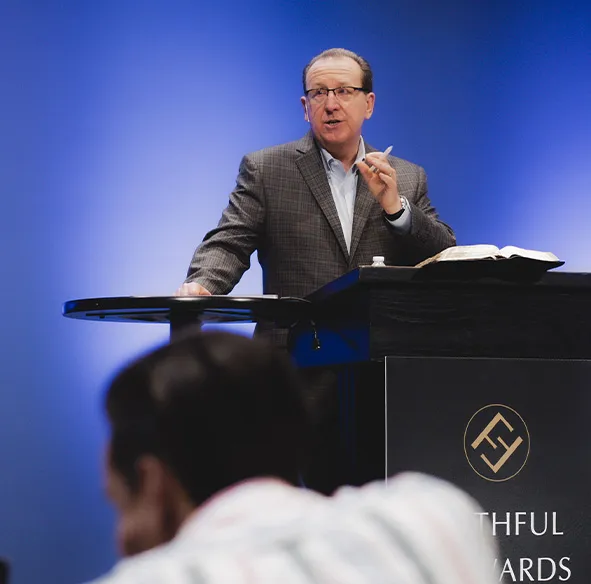
The preaching of God’s Word is central to the life of the church. Tom's pulpit ministry is dedicated to providing clear, biblical teaching to equip believers, strengthen faith, and exalt Christ.


Engage with the most recent teaching from God’s Word.
The preaching of God's Word is central to worship and of the utmost importance for the sanctification of every believer in Christ.

.jpg)
.jpg)

Explore messages organized to help you grow in Christ.
Search and filter sermons for quick access.
The Canon: Why These Sixty-Six Books - Part 5
The sermon "The Canon: Why These Sixty-Six Books (Part 5)" argues that the 66 books of the Bible form God's complete and final revelation, rejecting claims of ongoing revelation from figures like Joseph Smith. The canon is closed because the unique roles of Old Testament prophets and New Testament apostles in delivering new inspired writings have ceased. This closure is affirmed by centuries of church history. Scriptural passages decisively support this: Hebrews 1:1-2 shows God's ultimate word came through His Son, Jude 3 declares "the faith was once for all handed down," and Revelation 22:18-19, from the last apostle's last book, warns against adding to or subtracting from God's word. A closed canon has profound implications: God has provided everything necessary for faith, salvation, and godly living, making Scripture wholly sufficient. Consequently, believers should not seek new personal revelations through subjective impressions or "inner voices." Instead, diligent study of the existing Word provides all direction and wisdom. Scripture's clarity allows individual understanding without relying on external interpretive authorities, and it alone holds ultimate authority, binding the conscience, a principle championed by Martin Luther.
Not From Around Here - Part 2
Pastor Tom Pennington's sermon "Not from Around Here, Part 2" on Philippians 1:27-30 emphasizes that true Christians, as citizens of heaven, must live lives that outwardly reflect their faith. Drawing on Paul's letter, Pennington outlines four essential duties: 1. **Stand for the truth:** Uphold, defend, and teach God's Word. 2. **Seek for unity:** Foster a common purpose and mindset among believers. 3. **Strive for the gospel:** Actively advance the good news of Jesus Christ. 4. **Suffer for Christ:** This is the most challenging duty, and a reality for believers worldwide. Persecution takes many forms, mostly verbal�such as ridicule, slander, threats, and false accusations�though physical harm also occurs. Christians should not be alarmed by this opposition. Instead, they should embrace suffering for three reasons: it serves as proof of their salvation and their opponents' destruction; it is a gracious gift from God, a privilege given for Christ's sake, connecting them to His own suffering; and it places them in the good company of countless believers throughout history, including Paul, the apostles, and prophets. Embracing persecution means trusting God, continuing to do right, and glorifying Him through all trials, reflecting a life truly worthy of the gospel.
Not From Around Here - Part 1
In "Not from Around Here, Part 1," based on Philippians 1:27-30, Pastor Tom Pennington emphasizes that Christians are citizens of heaven and must live in a manner worthy of this divine citizenship. Drawing an analogy to the ancient Greek "polis" (city-state), he explains that citizenship involves not just privileges, but also significant duties and responsibilities. Pennington outlines three core duties for heavenly citizens: First, to **stand for the truth**. This means diligently knowing, obeying, defending, and teaching God's Word, which serves as their spiritual constitution. Second, to **seek for unity**. Believers should cultivate a common spirit and mindset, a unity rooted in the Holy Spirit and shared biblical doctrine, while avoiding both uncritical acceptance of error and internal conflict among genuine Christians. Third, to **strive for the Gospel**. This calls for actively engaging in a collective, "life and death struggle" to proclaim and defend the Good News of Jesus Christ. Sharing the Gospel with lost sinners is highlighted as the unique mission for believers on earth, as it is the one thing they cannot do better in heaven. Our conduct in this world directly reflects our true allegiance and heavenly homeland.
The Canon: Why These Sixty-Six Books - Part 4
This sermon argues that the New Testament canon was established by the intrinsic, apostolic authority of its books, not by later church councils. Contrary to modern challenges like the Jefferson Bible, these books were accepted immediately. Just as Old Testament prophets were authenticated through Moses, Jesus pre-authenticated His apostles as official representatives. He promised them the Holy Spirit would guide their memory and disclose truth (John 14-16) and empowered them with miracles (Acts, 2 Corinthians). Books were included if written directly by an apostle (e.g., Matthew, John, Peter, Paul, and James, who was acknowledged as an apostle), or under an apostle's direct authority. Mark wrote under Peter, Luke and Acts under Paul (Paul even called Luke's writing "Scripture" in 1 Timothy 5:18). Jude, brother of the apostle James, and Hebrews, closely associated with Paul, also gained acceptance this way. Early church worship services read "memoirs of the apostles" alongside Old Testament prophets, confirming their immediate, divine authority. The New Testament books are binding because they convey the words of Christ through His chosen and authorized messengers.
The Real Passion of the Christ
In a 2004 sermon, Pastor Tom Pennington addressed the widespread discussion surrounding Mel Gibson's "The Passion of the Christ," urging his congregation to evaluate it from a biblical perspective. He identified several potential benefits, including the film's ability to confront unbelievers with part of the gospel, encourage believers to share their faith, and prompt deeper contemplation of Christ's death and its centrality. However, he emphasized that any true spiritual benefit comes from God's Word and Spirit, not merely the visual experience. Pennington then outlined numerous inherent dangers. He cautioned against mistaking the film's interpretation for infallible Scripture, allowing visual images of Christ to become objects of worship, or believing that a cinematic "experience" is necessary or superior to God's revelation in a book. He warned that focusing solely on human suffering could neglect the crucial divine transaction of God's wrath poured on Christ. Most significantly, he feared the film could dangerously blur distinctions between biblical Christianity and false religions, especially Roman Catholicism (as espoused by Gibson), thereby undermining the foundational doctrine of justification by faith in Christ alone.
The Canon: Why These Sixty-Six Books - Part 3
The text explores the canon of Scripture, specifically addressing the Apocrypha�14 books written between 200 B.C. and 100 A.D., primarily in Greek, found in the Septuagint but absent from the Hebrew Old Testament. Acknowledging a renewed evangelical interest, the speaker firmly argues against their inclusion in the biblical canon. Key reasons against the Apocrypha's canonicity include their own internal statements implying a cessation of prophecy, the universal rejection by Jewish tradition (attested by Josephus and the Talmud), and the complete absence of authoritative citations by Jesus or New Testament writers, despite their frequent use of the Septuagint. Jesus himself affirmed the Jewish canon, implicitly excluding these books. Furthermore, a thorough review of church history reveals that early Christian lists and influential figures like Jerome, and even popes before the Reformation, regarded the Apocrypha as valuable for edification but not as divinely inspired or canonical. It was only at the Roman Catholic Council of Trent in 1546 that these books were officially decreed canonical, largely for doctrinal expediency, such as supporting purgatory. Consequently, the Apocrypha are human writings, lacking divine inspiration and authority, and should not be considered part of God's inerrant Word.
No Results Found.
We couldn’t find anything matching your search.
Explore The Word Unleashed
Our ministry brings together expository preaching, theological precision, and practical application for the good of Christ's church and the daily living of Christ's people.
.webp)
Sermons
Listen to expository sermons that clearly teach God’s Word and guide you in daily living.

Radio
Tune in to gospel-centered programs that share biblical truth and strengthen your daily walk with Christ.
Training
Join courses and workshops designed to deepen your faith and equip you to serve others with biblical wisdom.
.webp)
From the Pastor's Desk
Read pastoral messages that encourage, instruct, and help you apply God’s Word to every part of your life.
.webp)
Hymns
Discover timeless hymns that lift your heart in worship and remind you of God’s abounding grace and faithfulness.
Podcasts
Stay rooted in Scripture through our podcast series.