Sermons That Exalt Christ
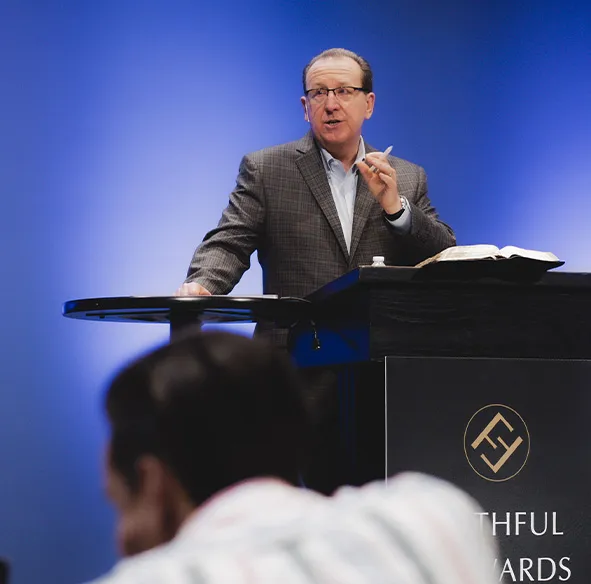
The preaching of God’s Word is central to the life of the church. Tom's pulpit ministry is dedicated to providing clear, biblical teaching to equip believers, strengthen faith, and exalt Christ.


Engage with the most recent teaching from God’s Word.
The preaching of God's Word is central to worship and of the utmost importance for the sanctification of every believer in Christ.

.jpg)
.jpg)

Explore messages organized to help you grow in Christ.
Search and filter sermons for quick access.
The One True God - Part 3
The sermon "The One True God (Part 3)" asserts God's incomprehensibility, meaning He infinitely surpasses human perception and understanding. God is utterly unique; unlike anything else that fits into a category, He *is* a category. Prophets like Ezekiel struggle to describe His glory, using comparative language ("like," "as") to convey something beyond human experience, highlighting the limits of our comprehension. Scripture affirms this truth: Job speaks of knowing only the "fringes" of God's ways, while Isaiah declares God's thoughts and ways are infinitely higher than ours. Only the Spirit knows the "depths of God," revealing what He chooses. Though God dwells in "unapproachable light" and His attributes are infinite, He is knowable because He reveals Himself truthfully in Scripture. However, our finite, creaturely, and sinful minds can never grasp Him perfectly. Scripture uses anthropomorphisms (human characteristics) and anthropopathisms (human emotions) figuratively to help us relate. This profound truth should humble us, recognizing God's immense majesty, and build trust and confidence, assuring us that His inscrutable wisdom guides all things perfectly.
United We Stand - Part 3
This sermon, based on Philippians 2:1-5, underscores the critical importance of humility for achieving Christian unity, contrasting it with a culture that often defends pride. Pastor Tom Pennington illustrates Jesus' humble entry into Jerusalem on a donkey's colt, fulfilling prophecy, as a foundational example. Pride is identified as the "worst viper," deceitful, and the root of sin, manifesting in boasting about accomplishments, wealth, status, spiritual activities, gifts, knowledge, or convictions. True unity, the text argues, can only flourish when pride is replaced by humility. To cultivate genuine humility, believers must first submit to proper human authority, willingly serve others, and humble themselves before God by casting all anxieties upon Him in prayerful dependence, recognizing His character and perfection. Furthermore, individuals are called to sincerely regard others as more important than themselves, not necessarily in gifts, but in deserving honor and respect, a perspective modeled by Paul and fostered by meditating on God's majesty and the cross. Lastly, Christians must actively consider others' interests, prioritizing their welfare, avoiding causing sin, and sharing in their joys and struggles.
The One True God - Part 2
Tom Pennington's sermon "The One True God (Part 2)" argues for a presuppositional understanding of God's existence, asserting that humanity's rejection of God is primarily moral, not rational, as all possess an innate knowledge of Him which they suppress (Romans 1-2). Pennington contrasts the evidentialist approach, which seeks to logically convince unbelievers using shared facts, with presuppositionalism. He contends that unregenerate individuals are "dead in transgressions" (Ephesians 2:1) and cannot be reasoned into faith; spiritual life is only granted through the Holy Spirit using God's Word. He then analyzes four classic rational arguments for God's existence: cosmological (first cause), teleological (design), ontological (idea of God), and moral (conscience). While acknowledging their insights, Pennington highlights their limitations in definitively proving God or His personal nature, as they often make unproven assumptions or fail to address the "dead" spiritual state of man. The sermon emphasizes that the Bible never attempts to prove God's existence but rather assumes it (Genesis 1:1, Hebrews 11:6), stating that human wisdom cannot know God (1 Corinthians 1:21). The ultimate proof of God, according to Scripture, is Jesus Christ Himself (John 1). Therefore, believers should not defensively argue for God's existence with human reason.
United We Stand - Part 2
In "United We Stand, Part 2," Pastor Tom Pennington explores Philippians 2:1-5 to address the critical issue of unity in the church, illustrating disunity's tragedy with a story of a church split over roof shingle color. The essence of unity, Paul teaches, is "being of the same mind"�a deliberate decision to adopt a shared mindset, not necessarily identical opinions. This mindset is defined by three components: a common commitment to "maintain the same love," which is agape love�an unselfish, self-sacrificing desire to meet others' needs, as exemplified in 1 Corinthians 13 and commanded by Christ. Second, a common connection, being "united in spirit" or "together in soul," fostering selfless harmony and transcending unimportant differences. Finally, a common cause, being "intent on one purpose," which for believers is singularly focused on Christ and His gospel. The enemies of unity are identified as "selfishness" and "empty conceit." Selfishness (selfish ambition) involves self-serving motives, power struggles, and divisive factions, often cloaked in spiritual justifications. Empty conceit (empty glory) is arrogant pride, an inflated sense of self-importance where one believes their own convictions, abilities, or preferences are superior, thereby undermining God's glory. Both these sins are rooted in pride, the ultimate enemy of unity.
The One True God - Part 1
Pastor Tom Pennington introduces a study on God's attributes, emphasizing that knowing God is central to eternal life and the heart of faith, or "theology proper." He shares his personal journey, crediting A.W. Tozer's "The Knowledge of the Holy" for profoundly expanding his understanding of God's majesty, which he hopes to impart. The study aims to deepen understanding of God's person and work, encourage further scriptural study focused on God, foster closer fellowship, and ultimately glorify God. Tonight's focus is God's existence, asserting that all humans possess an innate, universal knowledge of God (Romans 1-2). Pennington refutes Sigmund Freud's idea that man invented God out of fear, arguing instead that man suppresses the truth of God's existence. He contrasts two approaches to unbelievers: evidentialism, which uses rational arguments, and presuppositionalism, his preferred method. Presuppositionalism contends that God has revealed Himself, and man, being spiritually dead, willfully denies this known truth. Therefore, rational proofs alone cannot bring saving faith; regeneration by the Spirit through God's Word is essential. The Christian's task is to boldly declare God's self-authenticating Word, as unbelievers already suppress the truth they know.
United We Stand - Part 1
Pastor Tom Pennington's sermon "United We Stand, Part 1" from Philippians 2:1-5 underscores the paramount importance of Christian unity. He illustrates the danger of disunity with a personal anecdote about a church conflict over piano placement, showing how even minor issues can become flashpoints. The Apostle Paul deeply feared disunity, often addressing it first in troubled churches like Corinth, viewing it as a "deadly cancer" stemming from "fleshly hearts" and a focus on personal preferences over core biblical doctrine. God unequivocally detests those who spread strife, and Jesus warned that "any kingdom divided against itself is laid waste." Philippians 2:1 outlines four objective spiritual realities that form the unshakeable basis of Christian unity: 1. **Encouragement in Christ:** The shared comfort and peace experienced through salvation. 2. **Consolation of Love:** The Father's unchanging love, which sustains believers through life's trials and motivates them to love fellow believers. 3. **Fellowship of the Spirit:** Being joined by the Spirit into one body, partnered with God and Christ, and thus with each other. 4. **Affection and Compassion:** God's profound mercy and forgiveness, uniting all who have received it. To receive these immense blessings yet refuse unity with others who share them is profound ingratitude.
No Results Found.
We couldn’t find anything matching your search.
Explore The Word Unleashed
Our ministry brings together expository preaching, theological precision, and practical application for the good of Christ's church and the daily living of Christ's people.
.webp)
Sermons
Listen to expository sermons that clearly teach God’s Word and guide you in daily living.

Radio
Tune in to gospel-centered programs that share biblical truth and strengthen your daily walk with Christ.
Training
Join courses and workshops designed to deepen your faith and equip you to serve others with biblical wisdom.
.webp)
From the Pastor's Desk
Read pastoral messages that encourage, instruct, and help you apply God’s Word to every part of your life.
.webp)
Hymns
Discover timeless hymns that lift your heart in worship and remind you of God’s abounding grace and faithfulness.
Podcasts
Stay rooted in Scripture through our podcast series.