Sermons That Exalt Christ
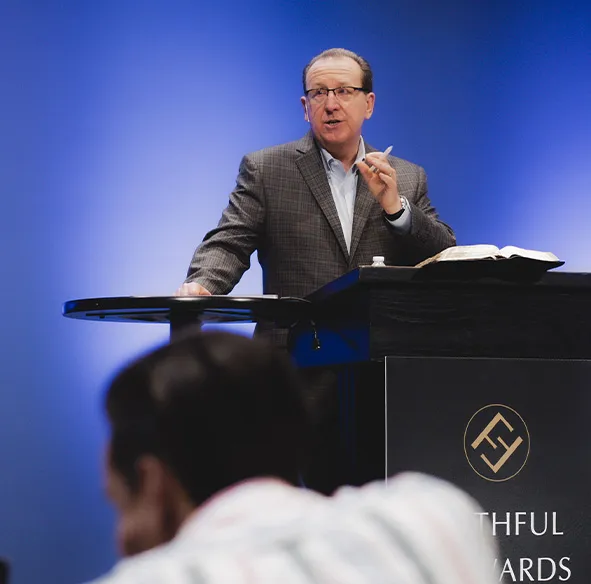
The preaching of God’s Word is central to the life of the church. Tom's pulpit ministry is dedicated to providing clear, biblical teaching to equip believers, strengthen faith, and exalt Christ.


Engage with the most recent teaching from God’s Word.
The preaching of God's Word is central to worship and of the utmost importance for the sanctification of every believer in Christ.

.jpg)
.jpg)

Explore messages organized to help you grow in Christ.
Search and filter sermons for quick access.
The Importance of Baptism
Tom Pennington's sermon, "The Importance of Baptism," examines this often-neglected Christian ordinance, clarifying its meaning and purpose. He explains that baptism, like the Lord's Supper, is a symbol or sign, not the reality itself, but one that points to central truths of the gospel. The sermon traces baptism's background from Jewish proselyte rituals and John the Baptist's call for repentance, leading to Christ's command in the Great Commission (Matthew 28:19-20). Pennington stresses that baptism is for disciples who have already exercised saving faith, advocating for believer's baptism by immersion, as indicated by the Greek word "baptizo" and early church practice. Crucially, he asserts that baptism has no saving efficacy; salvation is by grace through faith alone, separate from the act of baptism. Instead, baptism holds profound significance through three meanings: it is a public identification with Jesus Christ as a disciple, it symbolizes the believer's spiritual identification with Christ's death, burial, and resurrection to new life (Romans 6), and it pictures unity with other believers in the church. All believers are encouraged to embrace and live out the commitments symbolized in their baptism.
Men at Work: Every Believer's Role in Sanctification - Part 1
The sermon "Sanctification Men at Work" addresses common misunderstandings of biblical sanctification, analogizing them to outdated medical practices. Pastor Tom Pennington argues that many Christians create their own deficient versions of spiritual change, rather than embracing God's guaranteed prescription from Philippians 2:12-13. Sanctification, defined as the ongoing process of true biblical change that conforms believers to Christ's image, is often mistaken for superficial practices. It is *not* merely participating in spiritual activities, having emotional experiences, keeping external rules, avoiding overt sins, performing good deeds, or accumulating spiritual knowledge. These actions, the sermon explains, do not equate to genuine inner transformation and can even be practiced by unbelievers. Instead, true sanctification is entirely a work of the triune God, made possible by Christ�s grace, yet it demands maximum human effort. It is a lifelong process, an inner renovation of the entire person, and a constant spiritual conflict, never fully perfected in this life but guaranteed by God as the ultimate goal of salvation. Believers are encouraged to give thanks for God's work, confess sin, and recommit to diligently pursuing holiness, as without it, no one will see the Lord.
The House That God Builds
The provided text, a sermon on Psalm 127, emphasizes that successful parenting hinges on an "attitude of dependence on God." The pastor illustrates the inherent challenges of raising children, noting that despite all practical preparations, one essential quality is recognizing God's ultimate role. This dependence manifests in two ways: first, acknowledging that children are a "gift of the Lord," not merely a physiological outcome. God is intimately involved in giving and withholding life, and all good things come from Him. Children are likened to "arrows" providing future support and protection. Second, parents must affirm that true success in "building" (guiding and instructing) and "protecting" (from physical and spiritual harm) their children comes only from God. Human efforts, however diligent, are "vain" without divine involvement. While not excusing parental effort � indeed, parents are exhorted to diligently teach God's Word and shepherd their children's hearts � the sermon clarifies that hard work alone doesn't guarantee specific outcomes, as children possess free will. This reality should foster even greater prayer and trust in God's providence.
No One Like Him - Part 4
Tom Pennington's sermon, "No One Like Him (Part 4)," emphasizes God's praiseworthiness through the relational nature of the Trinity, contrasting it with modern societal isolation. God, as Father, Son, and Holy Spirit, demonstrates a perfect relationship characterized by unity, mutual interdependence, companionship, and willing submission. This divine model showcases attitudes like a desire to please, humility, profound love (involving full disclosure), honor, and trustworthiness. These qualities manifest through cooperation, perfect communication, thankfulness, and public praise. Crucially, as humans made in God's image, we are designed for relationships�both with God and with others. The intimate knowledge and love within the Trinity provide the pattern for our eternal life with God and our unity with fellow believers. Christ's greatest commandments to love God and neighbor confirm that relationships are life's most important focus, surpassing tasks or possessions. Jesus Himself exemplified a life centered on His Father and people. Therefore, the sermon urges Christians to actively imitate God's relational character, fostering deep, Christ-like connections, starting within families and extending to the broader church community, reflecting the divine relational blueprint.
No One Like Him - Part 3
This sermon, "No One Like Him (Part 3)," delves into the character of God, specifically the doctrine of the Trinity. It defines God as a living, infinite, spirit, and personal being. The Trinity teaches that God is one in essential being but exists as three distinct persons�Father, Son, and Holy Spirit�each fully God with shared attributes. The pastor clarifies the Trinity by refuting common errors: tritheism (three gods), modalism (one God appearing in different modes), and subordinationism (Christ and Spirit being created and inferior). While the Old Testament offers "hints" of the Trinity through plural pronouns ("Let Us make man"), plural forms of "Creator," and distinctions within the Godhead (e.g., "Lord rained from the Lord," the "Angel of the Lord"), the New Testament assumes this doctrine due to Jesus' Incarnation and the sending of the Holy Spirit. Key New Testament passages include Jesus' baptism (Matthew 3:16-17), where Father, Son, and Spirit are simultaneously present and distinct. The Great Commission (Matthew 28:19) further affirms this with its baptismal formula "in the name (singular) of the Father and of the Son and of the Holy Spirit," asserting both divine unity and distinct persons.
Above All Names
Pastor Tom Pennington's sermon "Above All Names" from Philippians 2:9-11 addresses God's divine sovereignty and the unparalleled exaltation of Jesus Christ. Despite human predispositions against sovereignty, the passage reminds us of a sovereign God. Pennington highlights that Christ's voluntary self-humiliation, taking the form of a bondservant and dying on a cross, led to God's dramatic "hyper-exaltation" of Him. This act, occurring at His resurrection and ascension, established Christ as the glorified God-man, fulfilling Old Testament prophecies. God bestowed upon Jesus "the name which is above every name," identified as "Lord" (Kurios), signifying absolute sovereign authority over all. The sermon clarifies this isn't merely the name "Jesus" but the title of ultimate master and owner. The definitive reason for this exaltation is God's purpose that *every* intelligent being�in heaven, on earth, and under the earth�will eventually bow and confess "Jesus Christ is Lord." This universal acknowledgment, whether in willing submission now or in terror and shame later, ultimately brings glory to God the Father. For believers, the application is to live in active submission to Christ's will, demonstrating genuine faith through obedience, and embracing humility as Christ exemplified.
No Results Found.
We couldn’t find anything matching your search.
Explore The Word Unleashed
Our ministry brings together expository preaching, theological precision, and practical application for the good of Christ's church and the daily living of Christ's people.
.webp)
Sermons
Listen to expository sermons that clearly teach God’s Word and guide you in daily living.

Radio
Tune in to gospel-centered programs that share biblical truth and strengthen your daily walk with Christ.
Training
Join courses and workshops designed to deepen your faith and equip you to serve others with biblical wisdom.
.webp)
From the Pastor's Desk
Read pastoral messages that encourage, instruct, and help you apply God’s Word to every part of your life.
.webp)
Hymns
Discover timeless hymns that lift your heart in worship and remind you of God’s abounding grace and faithfulness.
Podcasts
Stay rooted in Scripture through our podcast series.