Sermons That Exalt Christ
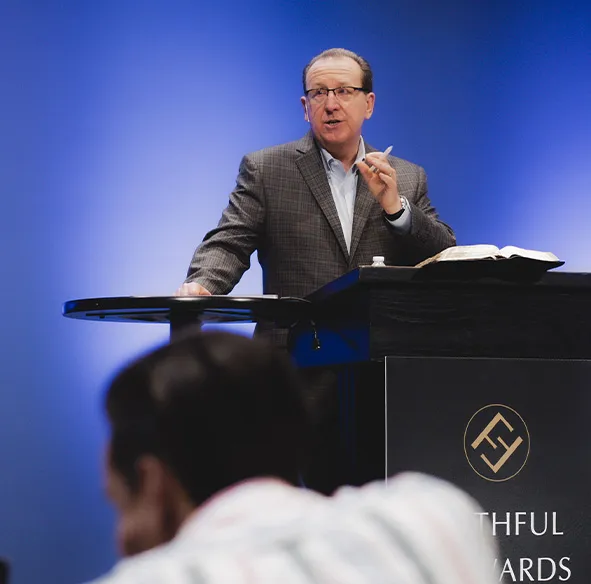
The preaching of God’s Word is central to the life of the church. Tom's pulpit ministry is dedicated to providing clear, biblical teaching to equip believers, strengthen faith, and exalt Christ.


Engage with the most recent teaching from God’s Word.
The preaching of God's Word is central to worship and of the utmost importance for the sanctification of every believer in Christ.

.jpg)
.jpg)

Explore messages organized to help you grow in Christ.
Search and filter sermons for quick access.
In the Beginning God Created! - Part 4
Tom Pennington's sermon, "In The Beginning God Created, Part 4," emphasizes God's immense creative power, visible from the vast universe to the smallest atom. The message primarily focuses on the events of Day 5 and Day 6 of creation. On Day 5, God filled the waters and skies, creating diverse marine life�from microscopic organisms to "great sea monsters"�and birds. Pennington illustrates this divine design with examples like the archerfish and migrating terns, noting that animals possess "living souls" (nephesh), signifying conscious life. Day 6 saw the creation of land animals, including domesticable creatures (cattle, like cows, designed for human benefit), creeping things (such as ants, vital for ecological balance), and wild beasts. Most significantly, humanity was uniquely created "in God's image," distinguishing man from all other creatures. This special status bestows upon humans a mandate to populate, subdue, and rule the earth responsibly. While all life was initially vegetarian, meat consumption was later permitted after the Flood, with an important proviso to respect animal life. The sermon concludes by explaining Day 7, when God rested, signifying the completion of His creation and establishing the seven-day week as a perpetual reminder of His finished work.
The Ultimate Husband - Part 1
This sermon, "The Ultimate Husband (Part 1)," draws from Ephesians 5 to define a husband's role in marriage as a direct reflection of Christ's relationship with the Church. Pastor Tom Pennington emphasizes that every marriage portrays an image of Christ and the Church, for better or worse. Husbands are identified as the "head" of the wife, a God-given leadership position that entails ultimate responsibility for the home and its dynamics. The core command for husbands is to "love your wives, just as Christ also loved the church and gave Himself up for her." This was a radical directive in its original cultural context and remains challenging today. Pennington stresses that no husband is exempt from this command, regardless of common excuses like a wife's perceived changes, lack of attractiveness, or failure to submit or reciprocate love. He argues that if love is lacking, the husband holds primary responsibility. This biblical love, he asserts, is fundamentally a deliberate act of the will�a choice�rather than solely an emotion. Modeling Christ's perfect and sacrificial love, husbands are called to not only be willing to die for their wives but, more practically, to *live* for them.
The Duties and Delights of a Godly Wife - Part 2
The sermon, "The Duties and Delights of a Godly Wife (Part 2)" from Titus 2:4-5, asserts that God's eternal Word, not ever-changing cultural expert advice, provides the true standard for marriage. Paul instructed Titus that older women (likely 60+) are to teach younger women (under 60) to "adorn the doctrine of God" by aligning their daily lives with their professed faith. Six core duties and delights for a godly wife are detailed: 1. **Love their husbands:** This is a self-sacrificing, intentional giving of oneself to meet their needs, transcending mere romantic feelings. 2. **Love their children:** Counteracting innate human selfishness, this involves sacrificially prioritizing children's welfare over personal desires or career ambitions. 3. **Be sensible (self-controlled):** Cultivating a sound mind that governs impulses and emotions, leading to an orderly and disciplined life. 4. **Be pure:** Maintaining moral purity and unwavering fidelity to one's husband in both mind and body, even when societal norms decline. 5. **Be workers at home:** Focusing energy and productivity on the household and family, actively managing and overseeing domestic affairs as a "house despot," a role often devalued by modern culture. 6.
In the Beginning God Created! - Part 3
The sermon "In the Beginning God Created, Part 3" argues the universe's complexity demands an infinitely intelligent designer: God. Using Charles Boyle's Orrery analogy, Pastor Pennington emphasizes Genesis 1 describes literal 24-hour creation days, supported by linguistic evidence. He recaps Day 1 (time, space, matter, light) and Day 2 (breathable atmosphere). Day 3 saw God separate dry land from oceans and instantly create all vegetation, reproducing "after their kind" with unique seeds, contradicting macroevolution. This transformed earth into a green paradise. Day 4, a "spectacular" day, God created the sun, moon, and countless stars to give light, divide day/night, and mark seasons. Pennington details the moon's orbit and sun's immense size. The universe's staggering scale�billions of galaxies and trillions of stars, all instantly created and named by God�underscores His omnipotent power. Drawing from Isaiah 40, the sermon applies this: God's immeasurable power means His people should never doubt His control. He is the tireless Creator, whose understanding is inscrutable, and who gives strength to the weary. Those who "wait for the Lord" will renew their strength, mounting up like eagles. The message concludes by urging listeners to observe the stars and trust in this all-powerful God.
In the Beginning God Created! - Part 2
Tom Pennington�s sermon asserts that Genesis 1 is a historical, eyewitness account of God's creation, rejecting metaphorical interpretations. He critiques various views on the "creation days"�including the outdated Gap Theory, the implausible Pictorial Day Theory, the popular Day-Age Theory (often linked to theistic evolution), and the metaphorical Framework Hypothesis�arguing these often stem from accommodating evolutionary science rather than robust biblical exegesis. Pennington strongly defends the view of literal 24-hour days, citing overwhelming linguistic evidence. The Hebrew word "yom," especially when used with cardinal numbers ("first day") or with "morning and evening," consistently denotes ordinary days throughout the Old Testament. He highlights Exodus 20:11's plural "six days" as further proof, noting Moses could have used a word for "age" if intended otherwise. Describing the initial creative acts, Genesis 1:1 details God's *ex nihilo* (out of nothing) creation of the space-mass-time universe, estimated between 4000-10000 B.C. Day one saw light created, establishing distinct day and night cycles. Day two involved God forming the "expanse," a breathable atmosphere, separating waters above and below. Ultimately, the sermon emphasizes creation as a profound call to worship.
The Duties and Delights of a Godly Wife - Part 1
Pastor Tom Pennington's sermon "The Duties and Delights of a Godly Wife (Part 1)" explores a wife's submission in marriage, acknowledging its counter-cultural status and feminist opposition. He asserts this role reflects God's divine design, rooted in the Trinity, and doesn't imply inferiority. True submission flows from being "filled with the Spirit," meaning a life controlled by God's Word. Pennington clarifies that submission is *not* tolerating abuse, sinning at a husband's command, ignoring his sin, or accepting inferiority. Rather, it's a voluntary, constant command for a wife to take a subordinate role to *her own* husband, an attitude she cultivates "as to the Lord," with genuine respect, as if serving Christ. The reason for submission is the husband's divinely ordained headship, mirroring Christ's headship over the church, and to avoid dishonoring God's Word. The scope is "in everything," meaning aligning her life with his desires, barring moral compromise. While wives can graciously appeal, ultimately, they submit their will. Overcoming fear in this command comes from deep trust in God's sovereign power and His plan, viewing submission as a test of faith in His control and promise of reward.
No Results Found.
We couldn’t find anything matching your search.
Explore The Word Unleashed
Our ministry brings together expository preaching, theological precision, and practical application for the good of Christ's church and the daily living of Christ's people.
.webp)
Sermons
Listen to expository sermons that clearly teach God’s Word and guide you in daily living.

Radio
Tune in to gospel-centered programs that share biblical truth and strengthen your daily walk with Christ.
Training
Join courses and workshops designed to deepen your faith and equip you to serve others with biblical wisdom.
.webp)
From the Pastor's Desk
Read pastoral messages that encourage, instruct, and help you apply God’s Word to every part of your life.
.webp)
Hymns
Discover timeless hymns that lift your heart in worship and remind you of God’s abounding grace and faithfulness.
Podcasts
Stay rooted in Scripture through our podcast series.