Sermons That Exalt Christ
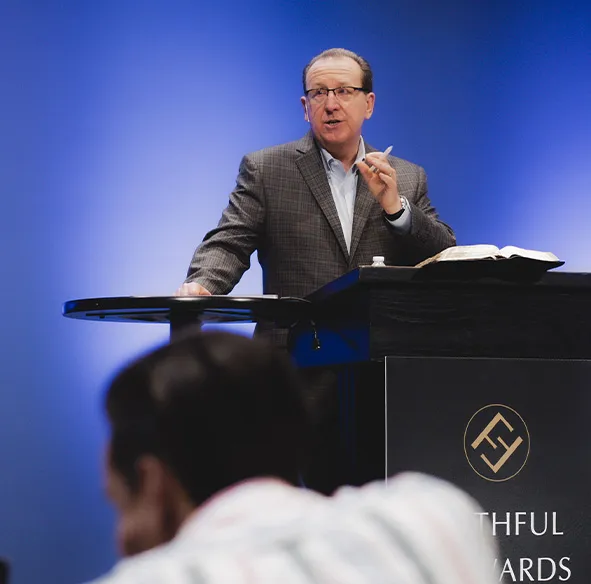
The preaching of God’s Word is central to the life of the church. Tom's pulpit ministry is dedicated to providing clear, biblical teaching to equip believers, strengthen faith, and exalt Christ.


Engage with the most recent teaching from God’s Word.
The preaching of God's Word is central to worship and of the utmost importance for the sanctification of every believer in Christ.

.jpg)
.jpg)

Explore messages organized to help you grow in Christ.
Search and filter sermons for quick access.
In the Beginning God Created! - Part 1
Pastor Tom Pennington contrasts naturalism with creationism, arguing that naturalism, a contemporary "religion," fosters unethical behavior, racial discrimination, and ultimate hopelessness, exemplified by figures like Carl Sagan. He outlines various theories of origins�materialism, pantheism, dualism, polytheism, and theistic evolution�asserting that materialism is a "huge leap of faith." Pennington posits that Genesis 1:1, "In the beginning God created the heavens and the earth," succinctly refutes these alternative views by establishing God as the transcendent Creator of time, force, energy, space, and matter. He vigorously defends the historicity of Genesis 1-11, noting its narrative Hebrew style, use of specific names and places, and unanimous acceptance as factual history by early church fathers, reformers, and all Old and New Testament writers, including Jesus Christ Himself. Discrediting Genesis 1-11, Pennington argues, fundamentally undermines Christ's trustworthiness. The sermon's central message is that God's role as Creator grants Him ownership and sovereign authority over His creation, making Him our moral lawgiver. Pennington contends that the rejection of creationism is not an intellectual challenge but a moral one, as individuals desire to live without accountability to a divine authority.
What God Has Joined: A Biblical View of Marriage - Part 2
This sermon, "What God Has Joined; A Biblical View of Marriage (Part 2)," by Pastor Tom Pennington, derives its core principles from Genesis 2:18-25, asserting their universal relevance for all believers, married or single. It outlines three fundamental biblical convictions about marriage. First, marriage has a **divine purpose**. It fulfills God's design for relationship, addressing man's solitude; provides help, as the woman is created as a "suitable helper"; and ensures completion, with man and woman complementing each other to form a whole. Second, marriage deserves the **highest priority**, expressed through the commands to "leave" and "be joined." "Leaving" signifies a comparative forsaking of parents, establishing the spouse as the primary relationship, shifting authority and dependence, and fostering a new adult dynamic with parents. "Being joined" denotes a passionate and permanent bond, resulting in becoming "one flesh"�a profound physical, spiritual, and emotional unity. Distractions like career, busyness, in-laws, and children can undermine this priority. To maintain it, couples should commit to Christ, cultivate a "we" mindset, and consistently spend time together. Third, marriage possesses an **inherent permanence**, understood as a sacred covenant.
The Evidence for the Resurrection
Pastor Tom Pennington argues for Jesus's resurrection as Christianity's cornerstone, citing the transformation of skeptic Frank Morrison and the convictions of legal scholars. He presents four "unassailable arguments" from John's Gospel. First, Jesus was **certifiably dead**, confirmed by Roman soldiers who pierced his side, precluding any "swoon" theory. Second, his **body was carefully secured** by Joseph of Arimathea and Nicodemus, wrapped in seventy pounds of spices and linen, placed in a sealed tomb with a massive stone, and guarded by Roman soldiers, making theft impossible. Third, his **grave was clearly empty**, witnessed by angels, soldiers, women, Peter, and John, with undisturbed grave clothes indicating a miraculous departure. Even Jesus's enemies, by bribing guards to lie about theft, implicitly acknowledged the empty tomb. Fourth, Jesus was **certainly alive**, making at least fourteen post-resurrection appearances to over five hundred people, including Mary Magdalene, the apostles (Thomas touching his wounds), his half-brother James, and Paul. These numerous, diverse eyewitness accounts offer powerful historical validation. Pennington concludes that historical belief in the resurrection is not enough; one must confess Jesus as Lord and believe God raised him from the dead for salvation, strengthening faith and inviting others to Christ.
In Defense of Sinners
Pastor Tom Pennington's Easter sermon, "In Defense of Sinners," confronts the Christian's deepest challenge: personal sinfulness. He offers profound comfort from 1 John 2:1, revealing Jesus Christ's crucial, yet often underestimated, current ministry as our "Advocate with the Father." In this role, Christ serves as our divine defense attorney and intercessor in heaven. Christ's ongoing advocacy includes constantly reminding God of His atonement, countering Satan's accusations against us (Romans 8:33), purifying our imperfect worship and service, providing aid in temptation and suffering (Hebrews 4:14-15), and interceding for our spiritual protection and sanctification (Luke 22:31, John 17:17). The basis for Christ's powerful arguments for our forgiveness lies not in our merit, but entirely in God's character and actions: our status as His children, His nature as a Savior, His redemptive plan, Christ's perfect righteousness, and His complete satisfaction of divine wrath through propitiation. These divine foundations ensure His advocacy is always heard and effective. On earth, believers must respond to sin by confessing it�agreeing with God's judgment (1 John 1:9)�and actively forsaking it to pursue holiness, never trivializing their transgressions. This understanding of Christ's constant, perfect intercession offers immense assurance and solace to all who struggle with their sin.
The Dying Theory of Evolution - Part 2
Pastor Tom Pennington argues that the theory of evolution is a "bankrupt system" with numerous foundational problems. Citing figures like Philip Johnson and Michael Behe, he emphasizes the concept of "irreducible complexity," exemplified by the bacterium flagellum and the human blood clotting system, which evolution cannot adequately explain. Pennington asserts that evolution relies on the unproven theory of uniformitarianism, ignoring catastrophic events and failing to resolve the question of primary origins, instead proposing illogical ideas like the universe spontaneously arising from nothing. He further contends that evolution violates the second law of thermodynamics by positing increasing order, and that vast amounts of time cannot make statistically impossible events, such as the formation of complex proteins, more likely. The fossil record, often cited as evidence for evolution, actually lacks transitional forms, shows sudden life explosions (Cambrian), and fixed species boundaries, discrediting gradual evolution. Most importantly, Pennington states evolution directly contradicts biblical accounts of creation (Genesis 1), the direct formation of man (Genesis 2), the creation of distinct species "after their kind," and the origin of death (Romans 5, 8), which entered all creation through Adam's sin, meaning animal death could not have predated man by millions of years.
The Promise of Paradise
In "Luke: The Promise of Paradise," Pastor Tom Pennington explores the account of the repentant thief on the cross (Luke 23:39-43) to illustrate the accessibility of God's grace. He outlines four conditions for securing Christ's promise of Paradise. First, a **sinful life** is a universal condition, as all humanity, like the violent criminals crucified with Jesus, stands guilty before God and "on death row" (Romans 3:19-20). Second, a **repentant heart** is crucial. The repentant thief, through divine inspiration, recognized Jesus' innocence and claims as Messiah, while acknowledging his own deserved punishment, choosing to turn from his sinful life toward God's kingdom. Third, a **genuine faith** is demonstrated by his plea, "Jesus, remember me when You come in Your kingdom!" This expressed his belief in Christ's kingship, his unworthiness, and his reliance on Jesus alone for eternal hope. This combination of repentance and faith is essential for salvation. Finally, the fourth condition is **Christ's unchanging promise**: "Truly I say to you, today you shall be with Me in Paradise." This promise is certain, immediate, personal, and specific, offering heaven to those who repent and believe.
No Results Found.
We couldn’t find anything matching your search.
Explore The Word Unleashed
Our ministry brings together expository preaching, theological precision, and practical application for the good of Christ's church and the daily living of Christ's people.
.webp)
Sermons
Listen to expository sermons that clearly teach God’s Word and guide you in daily living.

Radio
Tune in to gospel-centered programs that share biblical truth and strengthen your daily walk with Christ.
Training
Join courses and workshops designed to deepen your faith and equip you to serve others with biblical wisdom.
.webp)
From the Pastor's Desk
Read pastoral messages that encourage, instruct, and help you apply God’s Word to every part of your life.
.webp)
Hymns
Discover timeless hymns that lift your heart in worship and remind you of God’s abounding grace and faithfulness.

Podcasts
Stay rooted in Scripture through our podcast series.