Sermons That Exalt Christ
The preaching of God’s Word is central to the life of the church. Tom's pulpit ministry is dedicated to providing clear, biblical teaching to equip believers, strengthen faith, and exalt Christ.

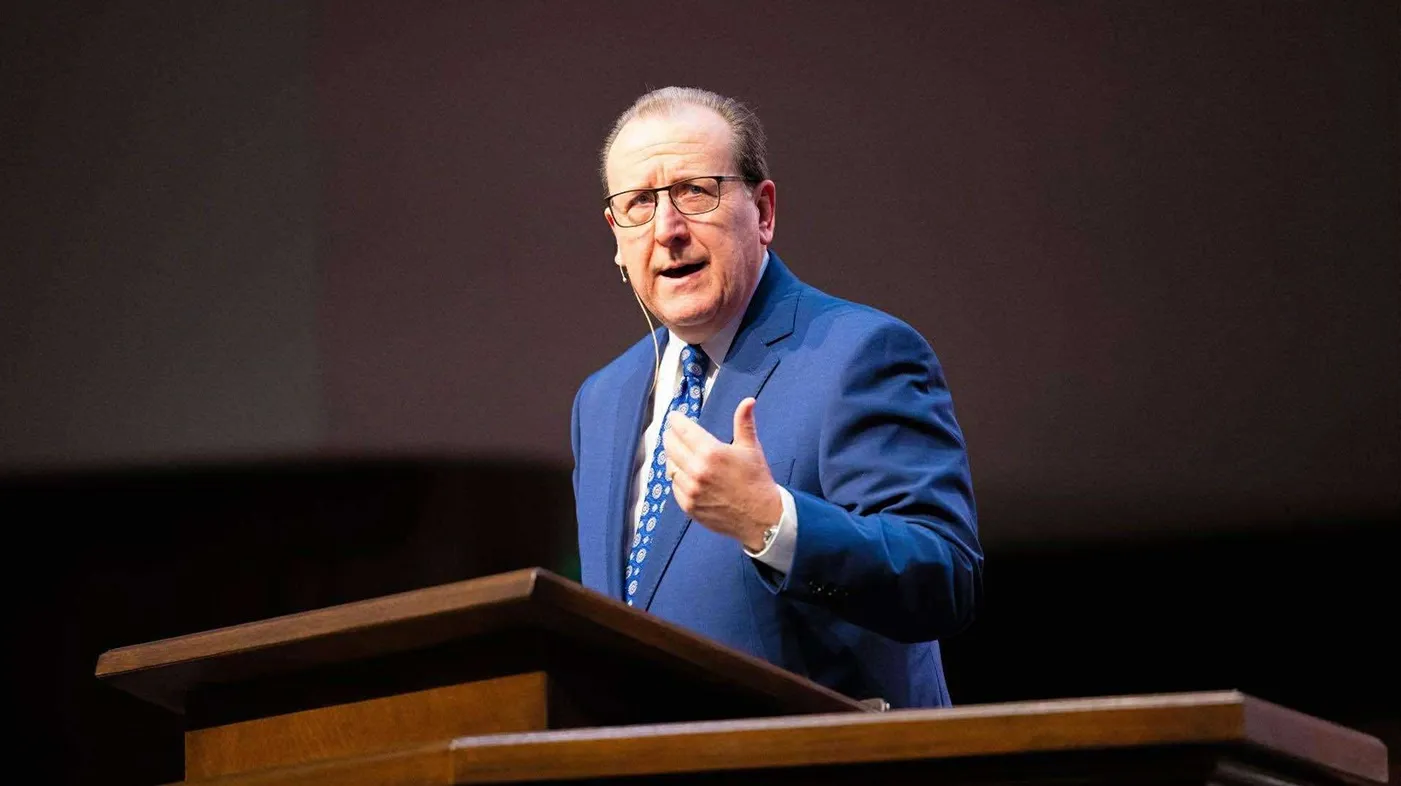
Engage with the most recent teaching from God’s Word.
The preaching of God's Word is central to worship and of the utmost importance for the sanctification of every believer in Christ.

.jpg)
.jpg)

Explore messages organized to help you grow in Christ.
Search and filter sermons for quick access.
Church Government: Monarchy, Anarchy, or Democracy? - Part 1
Pastor Tom Pennington's sermon, "Systematic Theology Church Government: Monarchy, Anarchy, or Democracy?", asserts that a God of meticulous order, evident even in the smallest biological cells, must have a divine blueprint for His church's structure, countering the view that such organization is unimportant. He explores three primary historical models of church government. The Episcopalian model features rule by bishops in a hierarchical structure, defended by historical precedence and certain scriptural interpretations, but countered by the New Testament's synonymity of "bishop" and "elder." The Presbyterian model establishes rule by elders over local, regional, and national churches, justified by arguments for gifted men serving beyond local congregations and the unity of the body, yet challenged by the lack of scriptural evidence for elders' authority beyond their local flock. The congregational model posits that ultimate authority rests within each autonomous local church, manifesting in diverse forms such as single-pastor leadership, corporate boards, pure democracy, or even anarchy. Pennington advocates for a "plural, local elder board" as the biblically prescribed pattern.
Filthy Rich
Pastor Tom Pennington's sermon, "Filthy Rich James 5:1-6," unpacks James's condemnation of the ungodly wealthy, illustrating with modern examples of jet-setters and historical accounts from Psalm 73. While James primarily addresses wealthy unbelievers facing impending judgment, the message serves to guard believers against materialism and envy. Pennington highlights four key sins of the "filthy rich": 1. **Hoarding:** Amassing wealth, garments, and precious metals beyond reasonable use, allowing them to rot or "rust" metaphorically. This disuse testifies against them at judgment. Believers are encouraged to invest in heavenly treasures and give generously. 2. **Fraud:** Withholding the rightful wages of laborers, an act whose "outcry" reaches God. Christians must pay employees fairly and promptly, avoiding exploitation or delaying payments to others for personal gain. 3. **Self-indulgence:** Living in excessive luxury and "wanton pleasure," oblivious to the needy, akin to "fattening hearts in a day of slaughter" before God's judgment. Believers should shun conspicuous consumption. 4. **Injustice:** Condemning and oppressing the righteous, often through legal manipulation or abuse of power, leaving victims helpless. Christians must not advance themselves by harming others or through unfair practices. Concluding with insights from 1 Timothy 6, Pennington reminds listeners that most Americans are globally wealthy.
All We Like Sheep
Pastor Tom Pennington's sermon, "All We Like Sheep," from Isaiah 53:6, prepares the congregation for the Lord's Table by focusing on Christ's death. He explains that Old Testament prophets, though not knowing the Messiah's exact identity or timing, foresaw a suffering Messiah who would bring salvation and glory, a truth most thoroughly revealed in Isaiah 53. The core verse, Isaiah 53:6, reveals two reasons for Christ's suffering: humanity's universal sin and His substitutionary death. "All of us like sheep have gone astray, each of us has turned to his own way" highlights that humanity's problem is not intellectual or biological, but sin�a conscious choice to rebel and deviate from God's standard, leading to destruction. Christ's death was a voluntary substitution, meaning He took our place, bearing the penalty for our sins and living the perfect life we couldn't. This act of imputation�our sins credited to Him, and His righteousness credited to us�is the heart of the gospel and springs from the Father's loving plan. The sermon offers an invitation for non-believers to turn from their sinful ways and be reconciled to God.
Q & A
Pastor Tom Pennington's Q&A session clarified several theological points and offered practical guidance, emphasizing Scripture as the ultimate authority. He first addressed the Judgment Seat of Christ, asserting that for believers, sins were completely judged on the cross (Romans 8:1); thus, the Bema Seat is not about condemnation. Instead, referencing 1 Corinthians 3 and 2 Corinthians 5, it's an evaluation of a believer's service and works, determining rewards or loss of rewards, but not salvation itself. Motives will also be disclosed. Live questions covered diverse topics. Pennington advised against debating the order of divine decrees (supralapsarianism) as unproductive. He interpreted 1 Peter 3:18-20 as Christ, pre-incarnate or through Noah, proclaiming the gospel to people *during* Noah's time, whose spirits are now imprisoned. Regarding Jesus' state after death, his human body was in the grave, his divine nature omnipresent, and his human spirit likely with God. He also suggested Eve wasn't surprised by the talking serpent due to her newness in creation. He explained "righteousness" in Ezekiel 33 as a combination of declared righteousness in Christ and a comparative growth in godliness.
The One Anothers - Part 5
Pastor Tom Pennington introduces his sermon by recounting John Calvin's providential call to ministry in Geneva in 1536, where William Farel's fiery challenge redirected him from a quiet academic life. Their subsequent deep, challenging friendship exemplifies the New Testament's "One Anothers" commands, particularly regarding Christian conversation. Pennington elaborates on three crucial conversational commands for believers, following a previous discussion on truthfulness. First, Christians are to encourage one another, which takes two forms: appealing, pleading, and exhorting. This involves urging others to apply biblical truth, springing from genuine personal concern, grounded in Scripture, delivered with humility and patience, and aimed at affecting their will to obey. The second aspect of encouragement is to comfort and cheer up those in trial and difficulty. This true comfort comes from God and is mediated through His Word, compassionately applied. Second, believers are commanded to admonish one another. To admonish means to show someone their sin or error, warn them of its danger, and appeal to them to repent and choose the right path. This responsibility extends to all Christians, not just leaders, and should be done with tears and deep concern, helping others overcome spiritual blindness.
The One Anothers - Part 4
In "The One Anothers (Part 4)," Tom Pennington addresses the pervasive human tendency to lie, beginning with a "test" to illustrate common deceptions and grounding lying as a fundamental sin in human depravity (Romans 3). He emphasizes that while the tongue can be destructive, believers are called to use it constructively, to "build others up" spiritually through their words, as commanded in Ephesians 4:29. The foundational instruction for this edification is to "be truthful," laying aside falsehood and making truth-telling a continuous habit (Ephesians 4:25). This involves confessing lies and addressing their underlying sins, such as fear or pride. Pennington warns that truthfulness must always be expressed "in love" and is not an excuse for brutal honesty, breaking confidences, or inappropriately revealing private sins. He presents five biblical arguments against lying: God commands against it, especially hates it, the righteous abhor it, liars face punishment, and no liars will enter heaven (Revelation 21:8). The sermon highlights temptations to lie within the church, including avoiding offense, seeking approval, sidestepping conflict, or fear. Ultimately, our hope rests in God, who is truth and cannot lie, whose unwavering promises in Christ provide the power for transformation.
No Results Found.
We couldn’t find anything matching your search.
Explore The Word Unleashed
Our ministry brings together expository preaching, theological precision, and practical application for the good of Christ's church and the daily living of Christ's people.
.webp)
Sermons
Listen to expository sermons that clearly teach God’s Word and guide you in daily living.

Radio
Tune in to gospel-centered programs that share biblical truth and strengthen your daily walk with Christ.
Training
Join courses and workshops designed to deepen your faith and equip you to serve others with biblical wisdom.
.webp)
From the Pastor's Desk
Read pastoral messages that encourage, instruct, and help you apply God’s Word to every part of your life.
.webp)
Hymns
Discover timeless hymns that lift your heart in worship and remind you of God’s abounding grace and faithfulness.
Podcasts
Stay rooted in Scripture through our podcast series.