Sermons That Exalt Christ
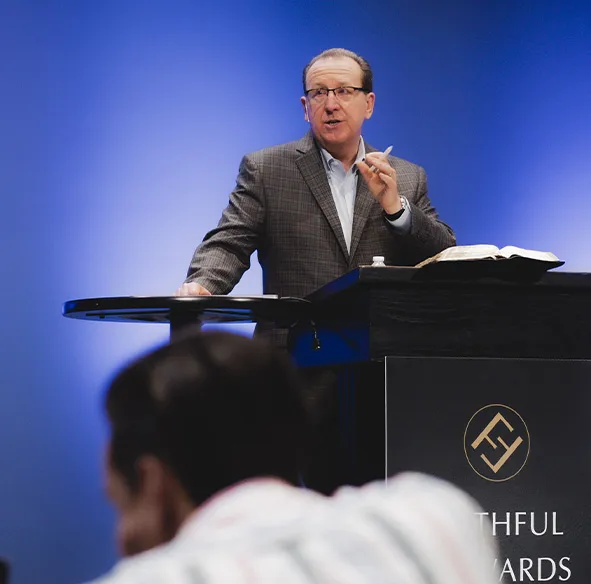
The preaching of God’s Word is central to the life of the church. Tom's pulpit ministry is dedicated to providing clear, biblical teaching to equip believers, strengthen faith, and exalt Christ.


Engage with the most recent teaching from God’s Word.
The preaching of God's Word is central to worship and of the utmost importance for the sanctification of every believer in Christ.


Explore messages organized to help you grow in Christ.
Search and filter sermons for quick access.
The Heart of Worship - Part 7
Tom Pennington's sermon, "The Heart of Worship (Part 7)," explains Jesus' teaching in John 4:24 that true worship must be "in spirit," meaning it is not superficial but arises from our inner being. Because "God is spirit"�an immaterial being�He desires worship from our spirits, not merely physical actions. This requires the complete participation of our entire being, making worship: 1. **Internal**: Engaging our minds and hearts, not just external motions. 2. **Authentic**: Sincere and genuine, never hypocritical or for show. 3. **Passionate**: Wholehearted, enthusiastic, and fervent. 4. **Active**: Where we are the "actors," and God is the "audience," not passive spectators. This principle applies to all aspects of worship, including singing and prayer. While certain physical displays like dancing, clapping, or lifting hands are mentioned in Scripture, their corporate practice should avoid drawing attention or distracting others. Preparing for such spiritual worship involves a transformed heart from God, confessing sin, restoring relationships, and actively choosing to worship, ensuring our worship is a profound and complete response to God's nature.
The Rapture - Part 2
The sermon "The Rapture (Part 2)" stresses that while studying Christ's return is important, the destination�being with Christ�outweighs obsessing over its exact timing. Pastor Pennington advocates for a balanced approach, avoiding both ignoring scripture and being dogmatic. He explains the Pre-Tribulation Rapture view, held by his church, as Christ's return in two stages. First, the Rapture, where Christ comes *for* His saints before the seven-year Tribulation, taking them to Heaven. Second, the Second Coming, where He returns *with* His saints after the Tribulation to establish His earthly kingdom. Pennington defends this view by citing biblical teachings of Christ's imminent return and the promise that believers are protected *from* God's wrath (e.g., Revelation 3:10). He also points to the absence of the church on earth during much of Revelation and passages like John 14, 1 Corinthians 15, and 1 Thessalonians 4, which describe believers being "caught up" to meet Christ. He addresses criticisms regarding the view's perceived recent origin, showing its core concepts predate popularization. Though acknowledging no view is perfect, he argues against Mid- and Post-Tribulation perspectives.
The Rapture - Part 1
This sermon introduces the biblical doctrine of eschatology, focusing on the Rapture, a term derived from the Latin "rapio" meaning "to snatch or seize," which translates the Greek "caught up" in 1 Thessalonians 4:17. While all true Bible students believe in the Rapture, the debate centers on its timing. The core difficulty lies in reconciling two apparent streams of biblical data. Firstly, many scriptures emphasize Christ's "imminent" return, meaning He could come at any moment, urging believers to live in constant expectation without needing preceding signs. Secondly, other passages, notably Matthew 24, detail specific signs�false Messiahs, wars, famines, persecution, the Great Tribulation, and cosmic disturbances�that must precede Christ's return. Scholars propose three main solutions to this "exegetical dilemma": some deny imminency (Mid- and Post-Tribulational views), others redefine the signs to maintain imminency, and a third, the Pre-Tribulational view (held by the speaker's church), posits two distinct aspects of the Second Coming. In this view, the church is raptured before the Tribulation without prior signs, followed later by Christ's Second Coming to earth after the Tribulation, which is preceded by specific signs. The speaker notes that no view is definitively stated in Scripture or without its difficulties.
The Heart of Worship - Part 6
Pastor Tom Pennington's sermon, "The Heart of Worship (Part 6)," highlights that genuine worship is scarce, often replaced by self-worship or erroneous divine concepts. Referencing John 4, he stresses that true worship must be "in spirit and truth," meaning it stems from the heart, is rooted in knowledge, and is guided by God's truth. Worship is defined as "seeing and savoring the supreme value and worthiness of God and responding in humble submission, thankful praise and adoration, and Godly fear." To worship God truthfully, one must understand both the nature of worship and the truth about God Himself. This understanding is primarily obtained through God's revelation: while general revelation (nature, conscience) is often distorted by human sin, special revelation�God's direct communication through prophets, culminating in His Son Jesus Christ, and recorded in Scripture�provides clear, infallible truth. Jesus reveals God as a Father who embraces believers through adoption, and as a Savior who actively seeks and draws us to Himself as a profound love gift to the Son. Critically, Jesus *is* the truth, representing the pinnacle of God's self-revelation. Consequently, authentic worship of the Father is only possible through the Son.
The Heart of Worship - Part 5
Tom Pennington's sermon "The Heart of Worship (Part 5)" explores the essential nature of true worship, emphasizing it as the only reasonable response to God's self-revelation, as taught by Jesus in John 4:20-26. Building on previous lessons that established worship as an internal, knowledgeable act, this part focuses on worship being directed by God's truth, specifically understanding *how* and *whom* to worship. Pennington defines worship fundamentally as a "response" to God. He identifies three primary, inseparable responses that characterize true biblical worship: 1. **Humble Submission:** Rooted in the biblical words meaning "to prostrate oneself," this involves a heart willing to obey God's Word and accept His sovereign will. It's an acknowledgment of God as King and our humble place as His subjects. 2. **Thankful Praise and Adoration:** This is the spontaneous outflow of a heart that truly knows God, proclaiming His worth, goodness, and grace through words, song, and thanksgiving. Without it, one does not truly know God. 3. **Godly Fear (Awe and Reverence):** This signifies standing in wonder and awe at God's infinite majesty and holiness, trembling before Him, recognizing He is not to be taken lightly. Irreverence is antithetical to worship.
What Happens After Death? - Part 2
Tom Pennington's sermon, "What Happens After Death? (Part 2)," details the "intermediate state" between death and resurrection. He refutes common false views such as soul sleep (unconsciousness), purgatory (cleansing for temporal sins), and limbo (a holding place, though the Vatican recently rejected "limbus infantum"). Pennington clarifies biblical terms "Sheol" and "Hades," noting their dual meaning as both the generic grave and the place of the wicked dead (hell), with context determining usage. Scriptural evidence from passages like Luke 16 (Rich Man and Lazarus) demonstrates that in the intermediate state, souls are conscious, aware, possess memory and rational thought, and can communicate. Paul's desire in 2 Corinthians 5 and Philippians 1 to be "absent from the body and at home with the Lord" directly contradicts soul sleep, while Revelation 6 shows conscious souls communicating with God. The intermediate state is temporary and bodiless. For the unsaved, it is a time of suffering; for believers, it signifies immediate transportation into Christ's joyful presence.
No Results Found.
We couldn’t find anything matching your search.
Explore The Word Unleashed
Our ministry brings together expository preaching, theological precision, and practical application for the good of Christ's church and the daily living of Christ's people.

Sermons
Listen to expository sermons that clearly teach God’s Word and guide you in daily living.

Radio
Tune in to gospel-centered programs that share biblical truth and strengthen your daily walk with Christ.
Training
Join courses and workshops designed to deepen your faith and equip you to serve others with biblical wisdom.
From the Pastor's Desk
Read pastoral messages that encourage, instruct, and help you apply God’s Word to every part of your life.
Hymns
Discover timeless hymns that lift your heart in worship and remind you of God’s abounding grace and faithfulness.
Podcasts
Stay rooted in Scripture through our podcast series.