Sermons That Exalt Christ
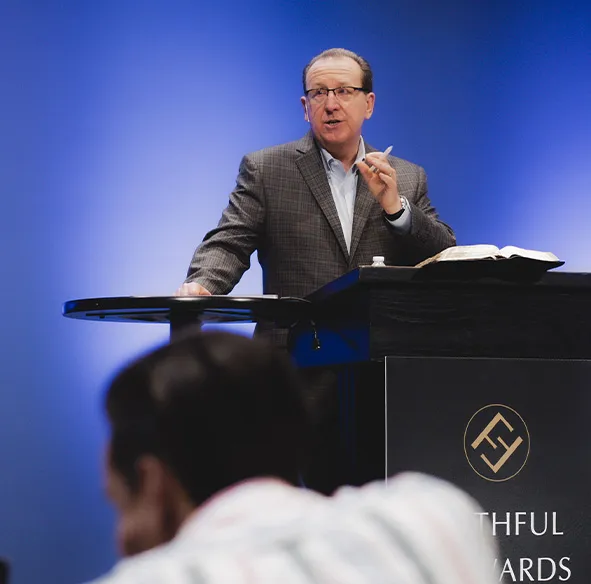
The preaching of God’s Word is central to the life of the church. Tom's pulpit ministry is dedicated to providing clear, biblical teaching to equip believers, strengthen faith, and exalt Christ.


Engage with the most recent teaching from God’s Word.
The preaching of God's Word is central to worship and of the utmost importance for the sanctification of every believer in Christ.

.jpg)
.jpg)

Explore messages organized to help you grow in Christ.
Search and filter sermons for quick access.
Praying For the Person Who Has Everything - Part 4
Drawing from the analogy of Steven Marsh, who lived in poverty unaware of money hidden in his inherited Bible, this sermon emphasizes that Christians often fail to fully grasp the spiritual wealth they possess. Preaching on Ephesians 1:18, Pastor Tom Pennington explores Paul's prayer for believers to understand "the riches of the glory of His inheritance in the saints." He clarifies that "His inheritance," referencing Old Testament usage, refers to *God's* inheritance, meaning believers are God's cherished possession, His greatest treasure. Supporting this interpretation with passages from Exodus, Deuteronomy, Malachi, Titus, and 1 Peter, the sermon illustrates that God's redeemed people are His special possession. The parables in Luke 15, along with Zephaniah 3:17 and Isaiah 62:5, highlight God's profound delight and rejoicing over believers, comparing His joy to a bridegroom's over his bride. This astonishing value is not based on human merit but because God sees us "in Christ." The sermon urges believers to pray for spiritual illumination to comprehend this life-transforming truth, fostering deeper love for God and others.
Praying For the Person Who Has Everything - Part 3
Tom Pennington's sermon "Praying for the Person Who Has Everything (Part 3)" uses the anecdote of William Randolph Hearst searching for art he already owned to illustrate how Christians often seek spiritual resources they already possess in Christ. He explains that Paul's prayer in Ephesians 1:15-19 models how to pray for spiritual growth, focusing on "illumination" � the Holy Spirit granting a deep, spiritual understanding of truth, beyond mere intellectual knowledge. Pennington contrasts this with the "darkened understanding" of unbelievers, explaining that while conversion initiates spiritual sight, true comprehension is a lifelong process. He emphasizes five points: spiritual understanding is slow, cannot be self-produced, requires prayer for the Spirit's illumination, is never outgrown, and is essential for spiritual growth. The sermon then details the first of three blessings Paul highlights: "the hope of His calling." God's "calling" refers to His "effectual" call, which draws individuals to saving faith, leading to justification and glorification. "Hope" in the New Testament signifies "desire and certainty" � a sure expectation of future blessings like salvation, righteousness, and eternal life, anchored firmly in God's promises and Christ.
An Aerial View of the Old Testament - Part 2
This sermon, "An Aerial View of the Old Testament," outlines nine major historical movements, beginning with universal dealings and concluding with the restoration, but primarily focuses on the period from the Exodus through the early monarchy. At Mount Sinai, God established two crucial systems for Israel: the sacrificial system and the Law. The elaborate sacrificial system, involving daily, communal, and individual offerings, was commanded by God as a means to approach Him. These sacrifices, which had to come from a sincere heart and were substitutionary (an innocent animal dying for the guilty), were not the ultimate basis for forgiveness but rather "pictures of the coming human sacrifice of Christ," the only true way for sinful humanity to approach a holy God. Administered by priests, this system's profound message still points to Jesus. God�s Law, categorized as moral, civil, and ceremonial, revealed His character and expectations. While the ceremonial law was fulfilled by Christ and He provides righteousness, the moral law (Ten Commandments) remains binding for believers, guiding obedience and exposing sin in all people. Israel�s journey often exemplified unfaithfulness, such as their refusal to enter Canaan, which led to forty years of wilderness wandering.
An Aerial View of the Old Testament - Part 1
Tom Pennington's sermon, "An Aerial View of the Old Testament," introduces a series designed to provide a high-level understanding of this often-neglected yet vital part of Scripture. He explains structural differences between English and Hebrew Bibles, then outlines the Old Testament's historical flow. The survey begins with "Universal Dealings" (Genesis 1-11), covering creation, the fall, the flood, and the nations, detailing humanity's rebellion. God then shifts to the "Patriarchal Period" (Genesis 12-50), choosing Abraham and his family (Isaac, Jacob, Joseph) to form a unique "witness nation." This decision provided a powerful testimony to God's character, setting His people apart. Next, the sermon covers Israel's "Bondage in Egypt" and the "Exodus" led by Moses. God sent ten plagues to demonstrate His sovereignty over false Egyptian gods and redeem His people. At Mount Sinai, God established the Mosaic covenant, instructing Israel to be a "kingdom of priests" and a "holy nation," essentially a living display of His glory and grace. This overarching purpose of being God's witness, redeeming people from spiritual slavery, remains central to the New Testament church today.
Praying For the Person Who Has Everything - Part 2
This sermon emphasizes the critical importance of spiritual "illumination," the Holy Spirit's work enabling believers to grasp and love God's revealed truth. Drawing from Ephesians 1, Pastor Tom Pennington explains that unregenerate minds are spiritually blind due to sin and Satan's influence, requiring a divine miracle�like God speaking light into creation�for understanding to dawn. Illumination is vital for both initiating and advancing the Christian life. Paul's prayer for the Ephesians is for "a spirit of wisdom and of revelation in the knowledge of Him," signifying a deep, experiential understanding (epignosis) of God Himself and His work in their lives. The natural man cannot comprehend spiritual truths; only the same Spirit who inspired Scripture can illumine hearts to truly know God. The text outlines three stages of spiritual growth�children, young men, and fathers�each marked by an increasing, intimate knowledge of God, not merely facts about Him. To grow, believers should engage with theological resources, listen to teaching on God's attributes, and diligently study Scripture, focusing on God's self-revelation, while continually praying for divine illumination to deepen their relationship with God.
Praying For the Person Who Has Everything - Part 1
The sermon emphasizes that humanity's greatest spiritual problem is not a lack of resolve or spiritual resources, but a failure to truly know God and understand what He has accomplished through Christ. Paul's prayer in Ephesians 1:15-23 offers a divine model for intercessory prayer, instructing believers on how to pray for their own and others' spiritual growth. Paul's motivation for praying for the Ephesians stems from their genuine faith in Jesus, visibly demonstrated by their love for other Christians, and his desire for them to fully appreciate and appropriate the immense spiritual blessings they already possess in Christ. His prayer exhibits a distinct pattern: it is individual, persistent, balanced between heartfelt thanksgiving and specific petitions, unselfish, and regular. The core of Paul's request for the Ephesians is "illumination"�a Spirit-given disposition of wisdom and revelation in the knowledge of God. This illumination signifies the Holy Spirit's work in enabling believers to deeply grasp, love, and apply biblical truth, thereby transforming God's Word into a vibrant, beautiful, and transformative reality in their lives. This essential insight requires both fervent prayer for the Spirit's work and diligent study of Scripture.
No Results Found.
We couldn’t find anything matching your search.
Explore The Word Unleashed
Our ministry brings together expository preaching, theological precision, and practical application for the good of Christ's church and the daily living of Christ's people.
.webp)
Sermons
Listen to expository sermons that clearly teach God’s Word and guide you in daily living.

Radio
Tune in to gospel-centered programs that share biblical truth and strengthen your daily walk with Christ.
Training
Join courses and workshops designed to deepen your faith and equip you to serve others with biblical wisdom.
.webp)
From the Pastor's Desk
Read pastoral messages that encourage, instruct, and help you apply God’s Word to every part of your life.
.webp)
Hymns
Discover timeless hymns that lift your heart in worship and remind you of God’s abounding grace and faithfulness.
Podcasts
Stay rooted in Scripture through our podcast series.