Sermons That Exalt Christ
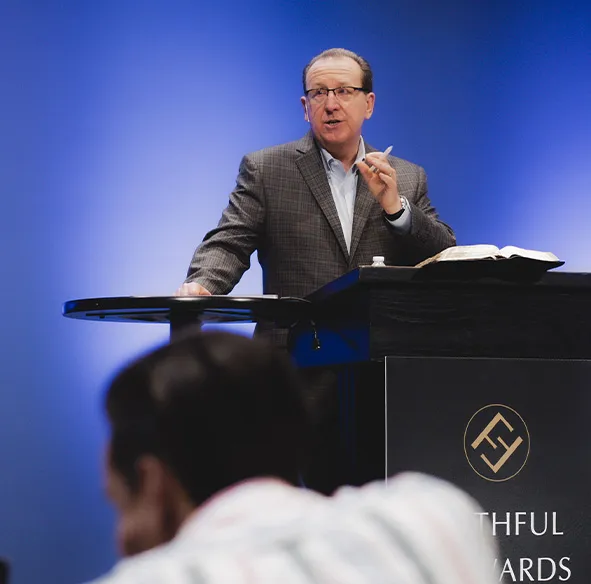
The preaching of God’s Word is central to the life of the church. Tom's pulpit ministry is dedicated to providing clear, biblical teaching to equip believers, strengthen faith, and exalt Christ.


Engage with the most recent teaching from God’s Word.
The preaching of God's Word is central to worship and of the utmost importance for the sanctification of every believer in Christ.

.jpg)
.jpg)

Explore messages organized to help you grow in Christ.
Search and filter sermons for quick access.
In Search of the Biblical Jesus - Part 1
Pastor Tom Pennington's sermon, "In Search of the Biblical Jesus (Part 1)," underscores the necessity of understanding Christ's true nature against historical and modern attacks. He highlights how rationalist movements and groups like the Jesus Seminar have sought to demythologize Jesus by rejecting the supernatural and scriptural authority. The sermon details early church heresies concerning Christ: Ebionism denied His deity, Gnosticism denied His humanity, and Arianism (like Jehovah's Witnesses) claimed He was a created being, not fully God. The Council of Chalcedon (451 AD) countered these, defining Christ as one person, truly God and truly man, with two unmixed natures. Biblical evidence confirms Jesus' full humanity: His human birth, development, body, soul, sinless weaknesses (hunger, thirst, sleep), and consistent identification as a man. His "emptying" (kenosis) in Philippians 2 signifies He veiled His glory and voluntarily restricted the *use* of divine attributes, not His deity itself, becoming a humble slave in appearance. Jesus' humanity is crucial for revelation (explaining God), salvation (as our perfect sacrifice and High Priest), illustration (setting a sinless example), and association (sympathizing with us eternally). These truths provide a robust defense against distortions of the biblical Jesus.
An Aerial View of the New Testament - Part 6
The sermon, "An Aerial View of the New Testament (Part 6)," provides a historical overview of the early church's growth, fulfilling Jesus' promise to build His church against all opposition. Using the book of Acts as its primary framework, the talk traces Christianity's expansion from Jerusalem to Judea, Samaria, and eventually the remotest parts of the earth. Key events include Pentecost, marking the church's birth and Peter's powerful sermon, the martyrdom of Stephen, and the transformative conversion of Saul (later Paul). A significant turning point is Peter's encounter with Cornelius, signaling God's embrace of Gentiles into the church. The Jerusalem Council is highlighted as crucial for defending salvation by faith alone against legalistic "Judaizers." The sermon then outlines Paul's three missionary journeys, detailing how the gospel spread across Asia Minor and into Europe, establishing numerous churches and serving as the context for many New Testament epistles. After the events of Acts, the overview briefly touches on Paul's later ministry, his final imprisonment, and the writings of other apostles like Peter, John, James, and Jude, culminating with Revelation. The central message is that Christ's church continues its unhindered growth, a mission believers are called to participate in until His ultimate return.
Foreigners to God & His People
Tom Pennington's sermon on Ephesians 2:11-13 reveals the enduring relevance of Paul's message regarding the reconciliation of Jews and Gentiles through Christ. He explains that God initially chose Israel as His witness nation, entrusting them with His divine oracles, which created a profound advantage over other peoples. Before Christ, Gentiles were entirely alienated from God and His people. They were considered "uncircumcision" by the Jews, excluded from the commonwealth of Israel, strangers to God's covenants of promise, without hope, and literally "without God in the world." They were spiritually "far off" from any knowledge or relationship with the true God. However, "now in Christ Jesus," those who were once far off "have been brought near by the blood of Christ." Through Christ's sacrificial death, both Jews and Gentiles are united into a completely new entity: the church. This spiritual union means all believers are equally connected to God. This truth carries significant practical implications: Christians must always remember their past alienation from God's grace, eradicate all forms of ethnic pride and prejudice, and understand that salvation is not just individual but also corporate.
This Is Your Life - Part 9
Tom Pennington�s sermon on Ephesians 2:1-10 culminates by identifying God's greatest work not as the vast cosmos or intricate human body, but as the new believer in Jesus Christ. He explains that God�s spiritual rescue, detailed in this passage, is entirely His doing, moving from humanity's dead state (v. 1-3) to God making us alive (v. 4-6). The "why" of salvation (v. 7-10) involves three goals: displaying God's glorious grace, eradicating all human boasting (as salvation is by grace through faith alone), and guaranteeing our good works. Focusing on verse 10, Pennington interprets "we are His workmanship" (Greek: *poiema*) as believers being God�s "work of art" or "masterpiece." This implies God's ownership, sovereignty, and intentional design. We are "created in Christ Jesus for good works," meaning these works are not the *cause* of salvation but its *result* and *purpose*. God prepared these good works beforehand, predestining us to be conformed to Christ's image, and we are called to "walk in them" as a habitual way of life.
An Aerial View of the New Testament - Part 5
In Part 5 of an "Aerial View of the New Testament," Pastor Tom Pennington provides historical context for the New Testament, focusing on the book of Acts. His goal is to show how the epistles fit into Acts' narrative, bridging Jesus' earthly ministry and the early church's expansion. Acts, written by Luke around 60-62 A.D. for a Gentile official named Theophilus, chronicles Christianity's remarkable growth from 120 disciples to a widespread movement across the Roman Empire. The book's primary purpose is to offer historical certainty for what believers were taught and to demonstrate Jesus' continuing work through the Holy Spirit and His apostles. Acts 1 details Jesus' post-resurrection commissioning of His apostles as witnesses, His ascension, and the replacement of Judas. Acts 2 recounts Pentecost, where the Holy Spirit descended, empowering apostles to speak in diverse, known foreign languages ("tongues") to confirm their message. Pennington argues this miraculous gift was for the apostolic period to confirm the message and messengers, and is not the normative experience for the church today. Peter's sermon in Acts 2 proclaims that God made Jesus, whom they crucified, both Lord and Messiah, initiating the church's rapid growth.
This Is Your Life - Part 8
Tom Pennington�s sermon on Ephesians 2:1-10 emphasizes that salvation is entirely God's work, contrasting sharply with humanity's innate pride and cultural messages promoting self-reliance (illustrated by a frog churning milk into butter to escape). Paul aims to dismantle this "horribly flawed" view, revealing God's rescue of those spiritually dead and deserving of wrath (v. 1-3). God intervened (v. 4-6) with two primary goals: to display the "surpassing riches of His grace" (v. 7) and to "destroy all human boasting" (v. 8-9). We must affirm salvation as a spiritual rescue accomplished by God, a past event with continuing results, entirely by grace, and received *through* faith. This saving faith involves knowledge, assent, and trust in Christ alone, acting as the means to receive salvation, not its cause or a meritorious work (like a cup holding water). Conversely, we must deny that anything in us�our works, heritage, or even faith originating from ourselves�is the source or cause of our salvation. God meticulously designed salvation so "no one may boast," ensuring every ounce of credit and glory belongs solely to Him. True believers, recognizing their spiritual bankruptcy, offer gratitude and praise to God, not self-congratulation, for His unmerited gift.
No Results Found.
We couldn’t find anything matching your search.
Explore The Word Unleashed
Our ministry brings together expository preaching, theological precision, and practical application for the good of Christ's church and the daily living of Christ's people.
.webp)
Sermons
Listen to expository sermons that clearly teach God’s Word and guide you in daily living.

Radio
Tune in to gospel-centered programs that share biblical truth and strengthen your daily walk with Christ.
Training
Join courses and workshops designed to deepen your faith and equip you to serve others with biblical wisdom.
.webp)
From the Pastor's Desk
Read pastoral messages that encourage, instruct, and help you apply God’s Word to every part of your life.
.webp)
Hymns
Discover timeless hymns that lift your heart in worship and remind you of God’s abounding grace and faithfulness.
Podcasts
Stay rooted in Scripture through our podcast series.