Sermons That Exalt Christ
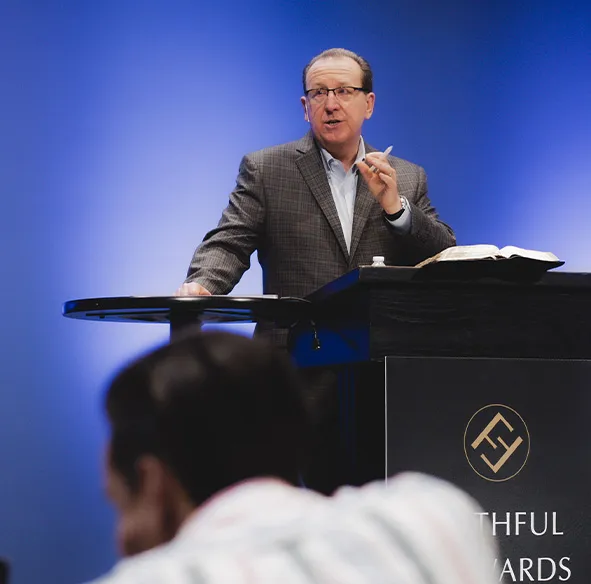
The preaching of God’s Word is central to the life of the church. Tom's pulpit ministry is dedicated to providing clear, biblical teaching to equip believers, strengthen faith, and exalt Christ.


Engage with the most recent teaching from God’s Word.
The preaching of God's Word is central to worship and of the utmost importance for the sanctification of every believer in Christ.

.jpg)
.jpg)

Explore messages organized to help you grow in Christ.
Search and filter sermons for quick access.
Jesus' Own Evidence for the Resurrection
In a sermon based on Luke 24:36-49, Pastor Tom Pennington presents Jesus' own compelling evidence for His resurrection. He categorizes this evidence into three types. First, **empirical evidence** involved Jesus' physical appearance to His disciples in a locked room, proving He was not an apparition. He invited them to touch His hands and feet, showing the marks of crucifixion, and ate broiled fish, demonstrating He had "flesh and bones" and was truly alive, not a spirit or impostor. Second, **biblical evidence** came as Jesus "opened their minds to understand the Scriptures." He explained that His suffering, death, and resurrection on the third day, along with the global proclamation of repentance for forgiveness of sins, were all foretold in the Old Testament (Law, Prophets, Psalms), confirming His identity and mission. Third, **testimonial evidence** was established for future generations. Jesus commissioned His apostles as "handpicked witnesses" who had seen, touched, and eaten with Him after His resurrection. They were to spread this message, and their written accounts in the New Testament continue to serve as the unassailable witness to His triumph over death, urging all to repent and embrace Him as Lord and Savior.
An Aerial View of the New Testament - Part 4
"An Aerial View of the New Testament (Part 4)" provides a detailed account of Jesus' final week, known as Passion Week, emphasizing His sovereign control over these pivotal events. Leading up to the week, Jesus' public ministry faced increasing opposition, culminating in the Sanhedrin's decision to kill Him after He raised Lazarus. Jesus then purposefully made His way to Jerusalem. On Sunday, His Triumphal Entry proclaimed Him Messiah and the true Passover fulfillment. Monday was the "Day of Authority," as Jesus cursed a fig tree (symbolizing Judaism's lack of fruit) and cleansed the temple. Tuesday, the "Day of Conflict," saw Jesus confront Jewish leaders with parables and denunciations in the temple, asserting His authority. Wednesday was a "Day of Silence" for Jesus but a day of plotting for the Sanhedrin, where Judas agreed to betray Him for 30 pieces of silver, fueled by Mary's anointing. Thursday, the "Day of Preparation," involved Peter and John secretly arranging the Passover meal. That evening, Jesus celebrated the Last Supper, instituting the Lord's Table, predicting His betrayal and Peter's denial, and offering profound teachings before agonizing in prayer in Gethsemane. Friday, the "Day of Crucifixion," began with Judas's betrayal and Jesus' arrest around midnight.
Pierced For Our Transgressions
Pastor Tom Pennington's sermon from Isaiah 53:4-6 explains Christ's death as a divine transaction, refuting false atonement theories like 'ransom to Satan,' 'example,' and 'moral influence' which misrepresent its purpose. He asserts the biblical truth: Christ's death was a profound substitution with three key characteristics. First, it was **voluntary**, demonstrating Jesus' immense love as He willingly bore our 'sicknesses' (sin) and 'pains' (consequences), not as a tragic accident. Second, it was **penal**, meaning Christ endured the full divine penalty for our 'transgressions' (willful rebellion) and 'iniquities' (moral perversion). This suffering, primarily spiritual, involved being pierced, crushed, chastened, and scourged, resulting in the complete payment of our sins, establishing peace with God, and providing spiritual wholeness. Third, it involved **divine imputation**: 'the Lord has caused the iniquity of us all to fall on Him.' God credited all humanity's sin to Christ, treating His innocent Son as if He had lived our sinful lives, thereby fully satisfying divine justice on our behalf. This amazing grace frees believers from sin's penalty, prompting a response of dying to sin, living righteously, and faithfully following Christ as our Shepherd.
An Aerial View of the New Testament - Part 3
Tom Pennington's sermon surveys Jesus' three-and-a-half-year public ministry, emphasizing His sovereign control and intentional march towards the cross. Beginning around AD 26/27 and culminating at Passover AD 30, the ministry is structured around four Passovers mentioned in John's Gospel. Pennington first briefly addresses the "synoptic problem," affirming divine inspiration accounts for the Gospels' similarities and differences without contradiction. John the Baptist, a prophet after 400 years, preceded Jesus, announcing the coming King. Jesus' early ministry included His baptism (fulfilling righteousness), temptation (proving authority over Satan), gathering first disciples, and performing His first miracle at Cana, which validated His deity. The first full year brought increasing popularity, His first temple cleansing, Nicodemus' interview, and the start of the Galilean ministry. The second full year saw immense popularity, confrontations with the Pharisees, the selection of the twelve apostles, and the Sermon on the Mount. A pivotal moment was the Jewish leaders' official rejection of Jesus' deity, attributing His miracles to Beelzebub, which Jesus called the unpardonable sin. This led Him to teach publicly in parables. The final year was marked by sinking popularity, mass defection among disciples, and focused training of the twelve.
This Is Your Life - Part 7
In "This is Your Life, Part 7," Tom Pennington addresses the prevalent cultural philosophy of humanism�the idea that "man is the measure of all things" and life is "all about me." Contrasting this with biblical truth, Pennington, speaking on Ephesians 2:7, asserts that God's ultimate purpose is His own glory, not human happiness. He breaks down Ephesians 2:1-10 into three parts: what humanity *was* (dead in sin, objects of wrath), what God *did* (made us alive, raised us, and seated us with Christ), and *why* He did it. The "why" is profoundly revealed in verse 7: "so that in the ages to come He might show the surpassing riches of His grace in kindness toward us in Christ Jesus." This "grand demonstration" of God's immeasurable, incomparable grace, extended as kindness to those who deserved wrath, began with Christ and will continue eternally. It serves as an exhibition for all humanity, the redeemed, and even the angelic host. This truth instills humility, reminding us we are part of God's cosmic, eternal plan. It also provides assurance, as our salvation, central to this divine display, cannot fail.
An Aerial View of the New Testament - Part 2
Tom Pennington's "Aerial View of the New Testament (Part 2)" examines Jesus' "silent years" from conception to His public ministry. He reconciles Matthew's (Joseph's, legal claim) and Luke's (Mary's, physical claim) genealogies, both establishing Jesus' Davidic lineage, with Luke bypassing Jeconiah's curse. The birth narrative details Mary's miraculous pregnancy, Joseph's righteous response, and an angel's command for him to marry Mary, remaining a virgin until after Jesus' birth. His infancy included circumcision (8 days, named "Jesus," meaning "Yahweh saves"), presentation at the Temple (40 days, indicating poverty), the Magi's visit, flight to Egypt to escape Herod, and settling in Nazareth. Jesus' childhood involved rigorous study, learning Aramaic, Hebrew, and Greek. At 12, during His first Passover, He showed profound awareness of His divine identity. From ages 12 to 30, Jesus grew in wisdom, worked as a carpenter (likely after Joseph's death), and observed religious feasts. He had several younger siblings, born to Mary and Joseph, who initially disbelieved His divine claims. Pennington emphasizes these years were crucial: Jesus lived an ordinary, sinless life, serving as an eternal example. More significantly, He lived the perfect life humanity should have, acting as our substitute.
No Results Found.
We couldn’t find anything matching your search.
Explore The Word Unleashed
Our ministry brings together expository preaching, theological precision, and practical application for the good of Christ's church and the daily living of Christ's people.
.webp)
Sermons
Listen to expository sermons that clearly teach God’s Word and guide you in daily living.

Radio
Tune in to gospel-centered programs that share biblical truth and strengthen your daily walk with Christ.
Training
Join courses and workshops designed to deepen your faith and equip you to serve others with biblical wisdom.
.webp)
From the Pastor's Desk
Read pastoral messages that encourage, instruct, and help you apply God’s Word to every part of your life.
.webp)
Hymns
Discover timeless hymns that lift your heart in worship and remind you of God’s abounding grace and faithfulness.
Podcasts
Stay rooted in Scripture through our podcast series.