Sermons That Exalt Christ
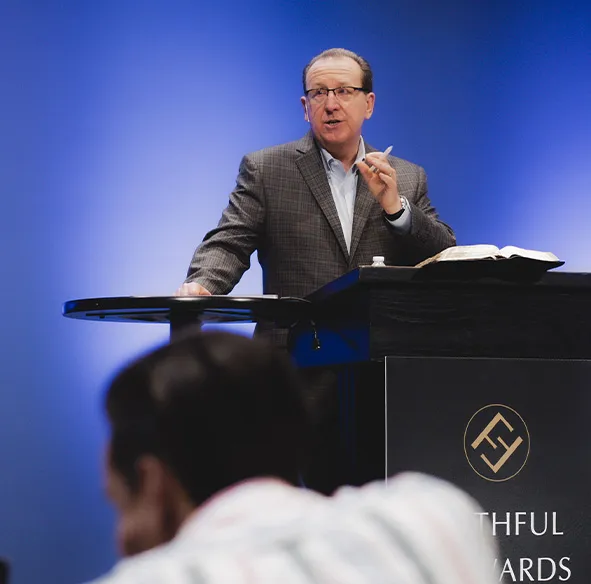
The preaching of God’s Word is central to the life of the church. Tom's pulpit ministry is dedicated to providing clear, biblical teaching to equip believers, strengthen faith, and exalt Christ.


Engage with the most recent teaching from God’s Word.
The preaching of God's Word is central to worship and of the utmost importance for the sanctification of every believer in Christ.

.jpg)
.jpg)

Explore messages organized to help you grow in Christ.
Search and filter sermons for quick access.
Attitudes: the Petri Dish of Unity
The sermon "Attitudes: The Petri Dish of Unity" from Ephesians 4:2-16 addresses the common problem of disunity in churches, exemplified by a chaotic Welsh congregation. It argues that unity is not something Christians create, but a gift already established by the Holy Spirit at salvation; our task is to diligently preserve it. Disunity is largely unacceptable to God, with only two justifiable exceptions: confronting unrepentant sin or correcting false doctrine. Any other disunity is sinful, stemming from a lack of specific attitudes. To preserve unity, believers must "put on the attitudes of unity," creating the right "environment" for it to flourish. These four essential attitudes are: 1. **Humility**: Regarding others as more important than oneself (Philippians 2:3-4), cultivated by comparing oneself to Christ, honest self-assessment, and meditating on the cross. Pride is unity's primary enemy. 2. **Gentleness**: Maintaining a calm, controlled manner in interactions, even when provoked, as opposed to harshness. 3. **Patience**: A slowness to anger or avenge wrongs, reflecting God's own long-suffering character. 4. **Tolerance in love**: Graciously "putting up with" others' faults and weaknesses, not grudgingly, but out of genuine affection.
Preserving the Unity of the Church
Pastor Tom Pennington's sermon, drawing from Ephesians 4:2-16, emphasizes the crucial importance of Christian unity. Contrasting disunity, like brawling monks, with Paul's call to "walk worthy," he asserts unity is not artificial ecumenism but an *existing* spiritual oneness among believers. This organic unity is illustrated through three biblical metaphors: the church as a human body with Christ as its head, a holy temple built with interconnected living stones, and God's family, where Christians are adopted and born. The Holy Spirit is the source, producing this unity at salvation. Therefore, believers are commanded to be "diligent to preserve" this unity, not create it. This endeavor is vital because unity was central to Jesus' prayer (John 17), Paul's teachings, and God's eternal plan to reunite all things in Christ, showcasing His glory. The Lord's Table serves as a crucial reminder and celebration of this shared unity, symbolizing believers' collective participation in Christ's sacrifice.
Authority to Forgive - Part 1
Pastor Tom Pennington�s sermon on Mark 2:1-12 examines the beginning of intense hostility from Israel�s religious leaders toward Jesus. Driven by envy and a fear of losing influence, these leaders closely watched Jesus as He returned to Capernaum to teach. The narrative centers on four men who, unable to reach Jesus through a packed house, dismantle the roof to lower their paralyzed friend before Him. Pennington highlights that while the crowd obstructed access, the men�s persistence demonstrated genuine, active faith. In response, Jesus unexpectedly declared, "Son, your sins are forgiven," prioritizing spiritual cleansing over physical healing. This act asserted His divine authority to absolve guilt instantly. The sermon concludes by drawing three key implications: Jesus responds to faith with sovereign grace, true faith is always accompanied by action, and believers must be willing to expend great effort to bring others to Christ. Ultimately, this account illustrates that Jesus is the object of saving faith who addresses humanity's deepest need�the forgiveness of sin.
Unclean!
Tom Pennington's sermon "Sermons Unclean!" from Mark 1:40-45 emphasizes Jesus' healing of a leper as a "visual parable" revealing deep spiritual truths. Leprosy, a terrifying and incurable nervous system disease, rendered sufferers societal outcasts and ceremonially unclean, a condition akin to a living death. An advanced leper, desperate but confident in Jesus' power, approached Him. Moved by deep compassion, Jesus defied social and religious taboos by touching the man, immediately and completely cleansing him. Jesus instructed the man to tell no one but to present himself to the priests and offer the Mosaic sacrifices, validating his healing and testifying to Jesus' divine power. However, the man disobeyed, widely proclaiming his cure, which ironically forced Jesus to minister in unpopulated areas. The sermon highlights Jesus' compassion and power to heal the body. Most importantly, leprosy serves as a powerful metaphor for sin: it begins subtly, grows, isolates, desensitizes, and is humanly incurable. The sermon's greatest lesson is Jesus' "contagious holiness." Unlike anything else, which becomes defiled by contact with uncleanness, Jesus' touch makes the unclean clean, imparting His holiness and transforming those who come to Him.
Walk Worthy!
The sermon unpacks Ephesians 4:1, marking the transition from theological doctrine (chapters 1-3) to practical Christian living (chapters 4-6). Pastor Pennington uses Prince Philip's public gaffes as an analogy for how Christians often fail to live appropriately for their high calling as God's children. The pivotal word "therefore" in 4:1 implies six truths: the Bible must be read in context, good works are the *fruit* of salvation, Christ is central to *sanctification*, right doctrine is foundational to Christian living, doctrine is empty without practice, and sanctification is a continuous process, not a one-time experience. Ephesians 4:1 introduces the overarching command to "walk in a manner worthy of the calling with which you have been called." This "worthy walk" has four elements. First, the **motives** are Paul's self-sacrifice as a "prisoner of the Lord" (signifying divine commands) and his heartfelt plea. Second, the **mandate** to "walk" denotes a purposeful, progressive, and personally active lifestyle toward Christ-likeness. Third, the **meaning** of "worthy" is about balancing one's conduct with spiritual privileges and matching behavior to one's identity in Christ, not earning merit. Finally, the **measure** of a worthy walk is "the calling," referring to God's *effectual call* to salvation.
The Compelling Priorities of Jesus
In his sermon on Mark 1:35-39, Tom Pennington highlights two "compelling priorities" from Jesus' life that should also guide believers. First is **the private practice of prayer**. Despite a profoundly busy day of ministry in Capernaum, Jesus rose early, while still dark, to withdraw to a secluded place and pray. This consistent, deliberate communion with the Father was vital for His humanity, not a need of His divine nature. Pennington emphasizes that if Jesus, the Son of God, prioritized solitary prayer, believers, who face less demanding schedules, must likewise make prayer a non-negotiable and consistent part of their lives, often setting aside dedicated time and seeking solitude. Second is **the public preaching of the Word of God**. When Jesus� disciples found Him, urging Him to return to the clamoring crowds in Capernaum who sought healing, Jesus refused. He declared, "Let us go somewhere else to the towns nearby, so that I may preach there also; for that is what I came for." His miracles authenticated His message, but His core mission was the proclamation of God's truth.
No Results Found.
We couldn’t find anything matching your search.
Explore The Word Unleashed
Our ministry brings together expository preaching, theological precision, and practical application for the good of Christ's church and the daily living of Christ's people.
.webp)
Sermons
Listen to expository sermons that clearly teach God’s Word and guide you in daily living.

Radio
Tune in to gospel-centered programs that share biblical truth and strengthen your daily walk with Christ.
Training
Join courses and workshops designed to deepen your faith and equip you to serve others with biblical wisdom.
.webp)
From the Pastor's Desk
Read pastoral messages that encourage, instruct, and help you apply God’s Word to every part of your life.
.webp)
Hymns
Discover timeless hymns that lift your heart in worship and remind you of God’s abounding grace and faithfulness.
Podcasts
Stay rooted in Scripture through our podcast series.