Sermons That Exalt Christ
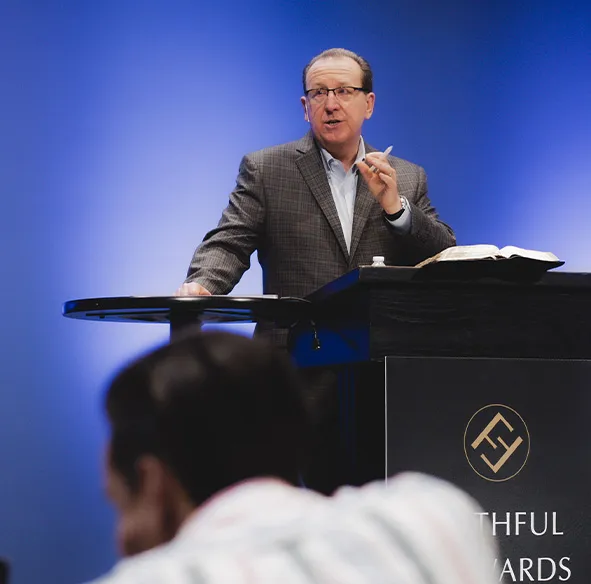
The preaching of God’s Word is central to the life of the church. Tom's pulpit ministry is dedicated to providing clear, biblical teaching to equip believers, strengthen faith, and exalt Christ.


Engage with the most recent teaching from God’s Word.
The preaching of God's Word is central to worship and of the utmost importance for the sanctification of every believer in Christ.

.jpg)
.jpg)

Explore messages organized to help you grow in Christ.
Search and filter sermons for quick access.
New Wine, Old Wineskins
Tom Pennington's sermon on Mark 2:18-22 examines Jesus' teachings on fasting and its profound implications. He critiques modern attempts to make Jesus culturally palatable, asserting that Jesus' first-century ministry was inherently counter-cultural. The passage features John's disciples and Pharisees questioning why Jesus' followers don't fast. Pennington explains Jewish fasting was intended for humbling oneself, not earning God's favor. Jesus responds by identifying Himself as the "bridegroom," signifying a time of celebration, not mourning. He states that fasting will be appropriate only when He is "taken away" (referring to His crucifixion), a sorrow that will eventually transform into joy following His resurrection. Jesus further illustrates this through the parables of new patches on old garments and new wine in old wineskins. These parables underscore that His teachings represent a radical, fundamentally new system, incompatible with the rigid, legalistic framework of first-century Judaism. He wasn't a reformer to mend an outdated system but the initiator of something entirely distinct. Pennington concludes that this principle applies today: Jesus cannot be merely integrated into or contained by false religions, works-based systems, or modern ideologies like humanism or feminism.
Our God & General
The sermon critiques modern evangelical attempts to portray Jesus as a "comfortable, non-threatening" figure, arguing that this overlooks His biblical depiction as a powerful "Lion" and "Warrior King," not merely a gentle "Lamb." Using examples like driving money changers from the temple, the speaker emphasizes Jesus' strength and authority alongside His tenderness. The sermon focuses on Ephesians 4 and the imperative to preserve church unity. This is achieved through adopting attitudes of unity, focusing on shared doctrinal bases (one body, Spirit, hope, Lord, faith, baptism, God/Father), and working on Christ's plan for unity. Ephesians 4:8-10 provides the biblical defense for Christ's right to orchestrate this unity and distribute spiritual gifts to His church. Referencing Psalm 68:18, Paul portrays Christ's ascension as a victorious General leading captive His enemies�sin, the curse of the law, and demonic powers�and distributing spoils (spiritual gifts) to His people. This triumphant conquest, from His descent to earth to His ascent into heaven, grants Christ absolute lordship over His church and ensures believers need not fear these defeated foes, enabling them to live in the victory of their warrior King.
A Friend of Sinners - Part 2
Pastor Tom Pennington�s sermon, "Mark A Friend of Sinners (Part 2)," examines Mark 2:13-17, addressing how Christians should interact with unbelievers. He identifies five flawed approaches: viewing unbelievers as enemies, complete separation, external distinctiveness that alienates, exclusive fellowship with Christians, or complete assimilation to worldly lifestyles. All these diverge from Jesus' example. Jesus demonstrated His mission by calling Levi (Matthew), a reviled tax collector, and then dining at Levi's house with many "tax collectors and sinners." When criticized by the Pharisees, Jesus declared, "It is not those who are healthy who need a physician, but those who are sick; I did not come to call the righteous, but sinners." This clarifies His purpose: to seek the repentance and salvation of sinners. Pennington extracts four key lessons: Jesus' mission was to purposefully pursue sinners; the gospel is for those who recognize their own sinfulness; Christians must emulate Jesus by actively interacting with unbelievers to seek their repentance, avoiding both isolation and assimilation; and this meal prefigures the eternal feast where redeemed sinners will dine with Christ. Believers are called to engage their personal circles, using resources and social opportunities to share the gospel, just as Matthew did.
The Parable of the Soils - Part 2
Tom Pennington's sermon delves into Jesus's Parable of the Soils (Matthew 13:1-23), highlighting its foundational importance for understanding responses to the Gospel. He explains that the "seed" is the Word of God, the "sower" is anyone sharing it, and the "soil" represents four types of human hearts. The "hard soil" symbolizes an unreceptive heart that refuses to understand the Gospel, allowing Satan to snatch it away. The "rocky soil" depicts a superficial heart that initially receives the Word with joy but lacks deep roots, withering under affliction or persecution, indicating temporary, not saving, faith. The "thorny soil" illustrates a preoccupied heart where worldly worries, the deceitfulness of wealth, or life's pleasures choke out spiritual growth, rendering it unfruitful despite initial reception. Lastly, the "good soil" represents a heart prepared by God, which hears, understands, and bears abundant fruit through obedience to Christ. The sermon concludes by emphasizing that only a heart prepared by God leads to genuine, permanent faith, urging listeners to self-examine and repent to become good soil.
The Parable of the Soils - Part 1
Pastor Tom Pennington introduces Jesus' Parable of the Soils (Matthew 13) to explain the varying responses people have to the gospel. He sets the context, noting that earlier that day, Israel's leaders had accused Jesus of casting out demons by satanic power and demanded a sign, while even Jesus' own family thought He had "lost His senses." This marked a turning point, leading Jesus to teach in parables. From a boat on the Sea of Galilee, Jesus shared the parable with a large crowd, focusing on the condition of the soil where a sower's seed falls. He describes four types: "hard soil" (footpaths) where birds quickly ate the seed; "shallow soil" (over bedrock) where seeds sprouted quickly but withered due to lack of roots; "thorny soil" where thorns choked out the good plants; and finally, "good soil" that yielded abundant crops (hundredfold, sixty, or thirty). Jesus concluded this public teaching simply, "He who has ears, let him hear," without explanation. Later, He revealed to His disciples two reasons for speaking in parables: to reveal truth to those "granted to know" (the disciples), and to conceal it from those "not granted" (the crowds), fulfilling Isaiah's prophecy.
No Results Found.
We couldn’t find anything matching your search.
Explore The Word Unleashed
Our ministry brings together expository preaching, theological precision, and practical application for the good of Christ's church and the daily living of Christ's people.
.webp)
Sermons
Listen to expository sermons that clearly teach God’s Word and guide you in daily living.

Radio
Tune in to gospel-centered programs that share biblical truth and strengthen your daily walk with Christ.
Training
Join courses and workshops designed to deepen your faith and equip you to serve others with biblical wisdom.
.webp)
From the Pastor's Desk
Read pastoral messages that encourage, instruct, and help you apply God’s Word to every part of your life.
.webp)
Hymns
Discover timeless hymns that lift your heart in worship and remind you of God’s abounding grace and faithfulness.
Podcasts
Stay rooted in Scripture through our podcast series.