Sermons That Exalt Christ
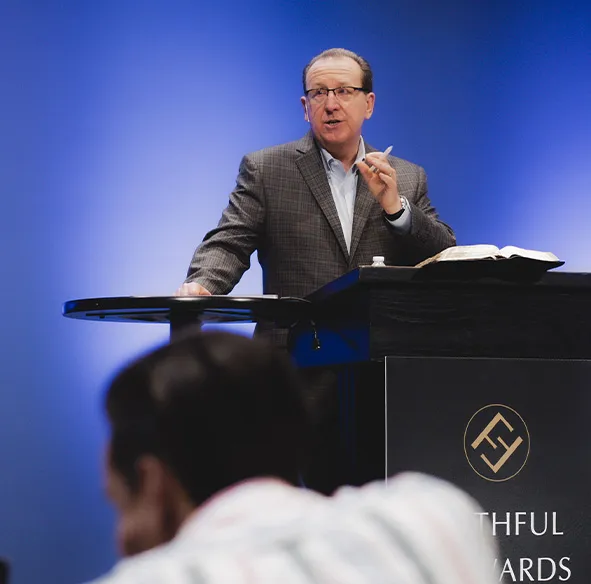
The preaching of God’s Word is central to the life of the church. Tom's pulpit ministry is dedicated to providing clear, biblical teaching to equip believers, strengthen faith, and exalt Christ.


Engage with the most recent teaching from God’s Word.
The preaching of God's Word is central to worship and of the utmost importance for the sanctification of every believer in Christ.

.jpg)
.jpg)

Explore messages organized to help you grow in Christ.
Search and filter sermons for quick access.
God's Text to Children
Tom Pennington's sermon "Ephesians God�s Text to Children" centers on Ephesians 6:1-3, urging children to obey and honor their parents. "Obey" means to willingly follow parental directives without delay, argument, or a grumbling heart, applying to dependent children. "Honor" involves valuing, respecting, and caring for parents throughout life. God views disobedience to parents with extreme seriousness, evidenced by Old Testament laws and its inclusion in Romans 1's list of sins worthy of death. Children must obey "in the Lord," meaning their obedience is an act of discipleship to Christ, acknowledging parents as God's representatives. Motivations for this include its inherent righteousness, pleasing God, it being a divine command, and a promise of well-being and long life. The sermon extends these lessons, noting that as God's children, we are called to obey and honor Him. Most profoundly, the passage reveals humanity's universal failure to perfectly obey and honor parents, underscoring our desperate need for Jesus Christ. Christ perfectly fulfilled this command, and His perfect obedience is credited to us, providing salvation from the eternal judgment deserved by our disobedience.
Following Jesus Will Cost You Everything
Pastor Tom Pennington's sermon on Mark 8:34-37 emphasizes that following Jesus demands everything, directly contrasting with prevalent "health, wealth, and easy-believism" gospels. Addressed to both unbelievers and believers, Jesus' call to "come after Me" signifies becoming a true disciple, which is synonymous with salvation and receiving eternal life. The cost of this discipleship is threefold: 1. **Deny oneself**: Renouncing one's own desires, ambitions, and self-worth, approaching God as a spiritual "beggar." 2. **Take up one's cross**: Valuing Jesus more than one's own life, willing to face physical death or, more commonly, bear the shame, insults, and ostracism associated with Christian faith. 3. **Follow Jesus**: Submitting to His will by prioritizing His kingdom in all decisions, serving Him wherever and however He leads, and cultivating a heart of obedience to His commands. Jesus explains this high cost is supremely worth it because it is the only way to save one's eternal soul, as all worldly gains are worthless in comparison. Our soul has supreme value, Jesus will be our judge, and critically, Christ Himself is infinitely valuable�a treasure for which one should willingly sacrifice everything. Ultimately, true discipleship is a radical, costly, yet eternally rewarding commitment.
Government: God's Gift to All Men
This sermon, "Government: God�s Gift to All Men," establishes that human government is divinely ordained by a sovereign God, pre-determining nations' inception, lifespans, and boundaries. All governmental authority originates from God, making submission to it a divine ordinance. While Christians should obey laws and use citizenship privileges, civil disobedience is permissible only when government commands actions contrary to God�s explicit Word. God instituted government for seven specific purposes: to express His common grace to all humanity, restrain evil by punishing wrongdoers, promote and protect good behavior, and punish those who practice evil. Furthermore, government is designed to protect the afflicted and oppressed, serve its people, and ultimately reveal God�s perfect rule. Though earthly governments are imperfect reflections due to human fallenness, they are a vital illustration of God�s ultimate governance, justice, and mercy. Christians are called to live faithfully under these authorities, anticipating Christ�s future, perfect reign.
The Lord's Table - Part 2
This sermon on 1 Corinthians 11:17-34 defines the Lord's Table as one of two church ordinances, meant to be repeated frequently. Pastor Pennington first highlights the Corinthian church's corruption of the Supper through divisions and selfish feasting, which shamed the poor. He clarifies that the elements�bread and cup�are visible signs, not the literal body and blood of Christ (rejecting transubstantiation and consubstantiation), nor is it a repetition of Christ's "once for all" sacrifice. Instead, the Lord's Table is a profound remembrance of Christ, serving as a confession of faith, a means of spiritual nourishment, a symbol of fellowship among believers and with Christ, and a seal of the New Covenant. This remembrance calls to mind Christ's incarnation, His substitutionary death, His resurrection, and the future consummation when He returns. Participation is reserved for true believers who must engage in self-examination, confessing sin and seeking reconciliation with others, to partake worthily and avoid God's discipline.
The Shocking Mission of the Messiah
This sermon, "The Shocking Mission of the Messiah" from Mark 8:31-33, examines Peter's accurate confession of Jesus as the Christ, contrasted with his flawed understanding of the Messiah's true purpose. Following Peter's declaration, Jesus plainly reveals His "divine necessity" to suffer many things, be rejected by the Jewish elders, chief priests, and scribes, be killed, and rise again after three days in Jerusalem. This prophecy, explicitly stated and foreseen in Old Testament scriptures, directly challenged popular first-century Jewish expectations of a political king who would conquer Rome. Peter, unable to reconcile Jesus' words with his own preconceived notions, privately rebukes Jesus, expressing that such a fate must never befall Him. Jesus responds with His strongest rebuke to a disciple, calling Peter "Satan" because Peter was setting his mind on human interests rather than God's. Jesus emphasizes that Peter's well-intentioned but human-centric thinking was tempting Him away from His ordained mission. The sermon concludes with crucial implications for believers: we must never substitute human reasoning for divine revelation, prioritizing what the Bible says above personal or cultural thoughts. The cross must remain the absolute center of our lives, as Peter himself eventually realized.
Who Do You Think I Am?
Tom Pennington's sermon "The Memoirs of Peter Who Do You Think I Am?" delves into Jesus' profound question to his disciples in Mark 8:27-30: "Who do people say that I am?" followed by "But who do you say that I am?" This pivotal moment, set in the pagan region of Caesarea Philippi, is framed as the most crucial question for one's eternal destiny. The sermon highlights that popular opinion at the time, much like today, saw Jesus as a significant prophet or teacher (John the Baptist, Elijah, Jeremiah), but ultimately, only a man. This view is presented as fundamentally deficient. In contrast, Peter, speaking for the disciples, correctly confesses Jesus as "the Christ" (Messiah) and, as Matthew records, "the Son of the living God." Jesus affirms this divine revelation but warns them against public disclosure. This secrecy was crucial because the public held a mistaken, political understanding of the Messiah's role, whereas Jesus was about to reveal his true mission of suffering, death, and resurrection. For disciples, understanding Jesus' true identity means submitting to His agenda, even when it involves personal suffering and self-denial.
No Results Found.
We couldn’t find anything matching your search.
Explore The Word Unleashed
Our ministry brings together expository preaching, theological precision, and practical application for the good of Christ's church and the daily living of Christ's people.
.webp)
Sermons
Listen to expository sermons that clearly teach God’s Word and guide you in daily living.

Radio
Tune in to gospel-centered programs that share biblical truth and strengthen your daily walk with Christ.
Training
Join courses and workshops designed to deepen your faith and equip you to serve others with biblical wisdom.
.webp)
From the Pastor's Desk
Read pastoral messages that encourage, instruct, and help you apply God’s Word to every part of your life.
.webp)
Hymns
Discover timeless hymns that lift your heart in worship and remind you of God’s abounding grace and faithfulness.
Podcasts
Stay rooted in Scripture through our podcast series.