Sermons That Exalt Christ
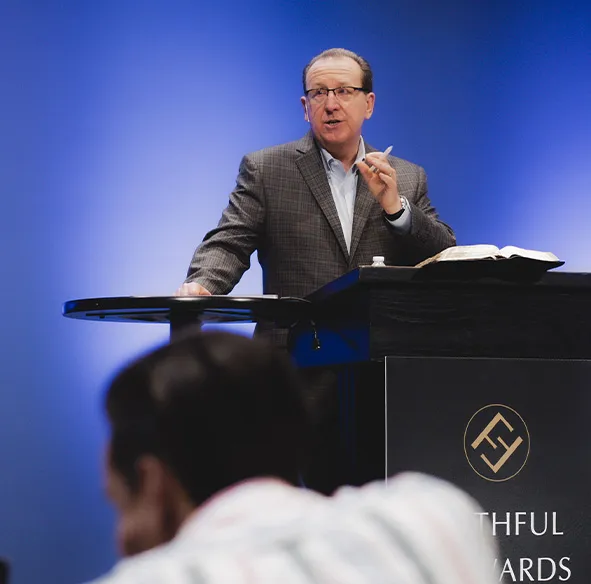
The preaching of God’s Word is central to the life of the church. Tom's pulpit ministry is dedicated to providing clear, biblical teaching to equip believers, strengthen faith, and exalt Christ.


Engage with the most recent teaching from God’s Word.
The preaching of God's Word is central to worship and of the utmost importance for the sanctification of every believer in Christ.

.jpg)
.jpg)

Explore messages organized to help you grow in Christ.
Search and filter sermons for quick access.
The Problem of Evil
This sermon addresses "The Problem of Evil," examining why an all-powerful, all-good God allows suffering. It defines evil as morally wrong or harmful, categorizing it as natural (e.g., disasters, disease) or moral (e.g., human actions, demonic influence). The common question, "Why do bad things happen to good people?" is reframed biblically, as humanity is not inherently good; the true query is why good things happen to evil people. The biblical solution, a "theodicy," asserts that God is not obligated to justify His ways, yet He reveals enough. God is perfect in power, goodness, and justice, so evil doesn't stem from His limitations or character flaws. Instead, moral evil originates from Satan, Adam's sin, and human hearts, while natural evil is primarily a consequence of God's just curse on a fallen world. God permits evil for a greater good: to promote His glory and His people's good, supremely demonstrated through Christ's redemptive suffering on the cross. God directs all evil for these purposes, illustrating His perfect justice in past judgments and future eternal punishment for the unrepentant. For believers, Christ bore the full judgment for their sins.
A Thanksgiving Textbook
This sermon traces the origins of the American Thanksgiving holiday to the 1621 Plymouth Pilgrims, who, having survived sickness and scarcity, gave thanks to God for a bountiful harvest, embodying their strong Christian faith. It asserts that the holiday's ultimate roots lie in biblical revelation, particularly in Psalm 100, titled "A Psalm for Thank Offering." This Old Testament concept involved expressing gratitude to God through specific sacrifices and fellowship. Psalm 100 serves as a "textbook" for God-honoring thanksgiving, structured around two core reasons: God's greatness and His goodness. The first stanza (verses 1-3) commands expressions like joyful shouting, serving with gladness, and singing, all stemming from understanding God's greatness. Reasons include His self-existence as Yahweh, His creative power, His providential care for His people, and especially His sovereign grace in redeeming them. The second stanza (verses 4-5) calls for approaching God with gratitude and praise, articulating thanks for all things, and blessing His character. These expressions are inspired by God's goodness�His inherent desire to deal bountifully with all creatures�His everlasting steadfast love, and His unwavering faithfulness across all generations. The sermon emphasizes that these reasons for thanksgiving are tied to God's character, not our fluctuating circumstances.
The Annunciation of Messiah's Birth - Part 3
This sermon, based on Matthew 2:1-12, posits that the Magi's visit to Jesus foreshadowed His crucifixion, akin to T.S. Eliot's poem "The Journey of the Magi." Pastor Tom Pennington highlights that God used the Magi to formally announce and identify Jesus as the Messiah, revealing His identity in three ways: a surprising annunciation from powerful Persian Magi, a startling confirmation by Israel's religious leaders and scriptural prophecy of His birth in Bethlehem, and crucially, a supernatural authentication. This divine authentication manifested first through a miraculous star, likely the Shekinah glory, which led the Magi directly to Jesus' house, leaving no ambiguity about His identity. Second, God used the Magi themselves�unlikely pagan idolaters�who identified Jesus as the Messiah, worshiped Him as God, and acknowledged Him as King. Their lavish gifts of gold (for kingship), frankincense (for divinity), and myrrh (for His destined atoning death) symbolized His role as Savior. God sent the Magi for several reasons: to announce the Messiah's arrival, provide a powerful lesson in sovereign grace by actively seeking and saving them, illustrate a clear invitation to saving faith through their repentance and belief, and exemplify profound devotion to Jesus.
The Annunciation of Messiah's Birth - Part 2
The text analyzes Matthew 2:1-12, detailing God's orchestrated annunciation and confirmation of Messiah Jesus' birth. The initial, surprising announcement came from the magi, pagan astrologers from the East, who, guided by a supernatural star and ancient prophecies, arrived in Jerusalem seeking the "King of the Jews." They intended to worship Him, arriving weeks or months after His birth. Jesus' identity as Messiah receives startling confirmation from three sources. First, Israel's religious leaders (chief priests and scribes), when questioned by a troubled King Herod, correctly identified Bethlehem as the Messiah's birthplace from Old Testament prophecy (Micah 5:2). Second, the inspired Scripture itself provided this explicit confirmation. Third, even the conniving political leader, Herod, despite feigning worship and secretly plotting to kill the child, was convinced of the Messiah's birth, thus unwittingly confirming the magi's message. The passage offers crucial lessons: Jesus was unequivocally qualified as the Messiah, born in Bethlehem as prophesied, addressing future doubts. Furthermore, it serves as a mirror, revealing common human responses to Jesus. These include: settled indifference (the people of Jerusalem), religious distraction (leaders knowing scripture but not acting), and selfish defiance (Herod's hypocrisy and murderous intent).
The Annunciation of Messiah's Birth - Part 1
This text, based on Matthew 2:1-12, details the magi's arrival and the formal annunciation of Jesus as the Messiah. The speaker emphasizes that Jesus, the eternal Son of God, had appeared throughout the Old Testament, but His birth in Bethlehem marked His full incarnation as human. Matthew included this account to prove Jesus' identity as Israel's promised, divine King. The magi, dispelling common myths, were not kings but influential Persian priestly scholars ("king-makers") involved in science and religion. They journeyed from the East, arriving in Jerusalem between 40 days and two years after Jesus' birth, guided by a supernatural phenomenon resembling a star, likely the Shekinah glory. Their knowledge of a coming King of the Jews derived from Daniel's significant influence over Babylonian wise men centuries earlier, a prophecy passed down through generations. God's purpose for sending the magi was to publicly declare Jesus as the Messiah to Israel's political and religious leaders.
The Birth of Jesus the Messiah - Part 3
This sermon on Matthew 1:18-25 asserts Jesus' undeniable historicity and Matthew's purpose in proving Jesus as the divine Messiah. It details five unique characteristics of Jesus' birth that serve as evidence: 1. **His Virgin Conception:** Jesus was supernaturally conceived by the Holy Spirit in Mary's womb. 2. **His Saving Mission:** His name, "Jesus," signifies "Yahweh saves," indicating His purpose to rescue His people from their sins through His life, death, and resurrection. 3. **His Biblical Credential:** His virgin birth fulfilled Isaiah 7:14's prophecy of a virgin bearing a son, "Immanuel" ("God with us"). The text argues extensively that the Hebrew word "Almah" unequivocally refers to a virgin, supported by the miraculous context and the child's divine attributes prophesied in Isaiah. 4. **His Divine Nature:** Named "Immanuel," Jesus is both fully human and fully divine. This dual nature was essential for Him to serve as a human substitute and possess the divine capacity to pay the infinite debt of humanity's sin. 5. **His Legal Adoption:** Joseph's act of naming Jesus legally adopted Him, providing Jesus with the royal right to David's throne through Joseph's lineage.
No Results Found.
We couldn’t find anything matching your search.
Explore The Word Unleashed
Our ministry brings together expository preaching, theological precision, and practical application for the good of Christ's church and the daily living of Christ's people.
.webp)
Sermons
Listen to expository sermons that clearly teach God’s Word and guide you in daily living.

Radio
Tune in to gospel-centered programs that share biblical truth and strengthen your daily walk with Christ.
Training
Join courses and workshops designed to deepen your faith and equip you to serve others with biblical wisdom.
.webp)
From the Pastor's Desk
Read pastoral messages that encourage, instruct, and help you apply God’s Word to every part of your life.
.webp)
Hymns
Discover timeless hymns that lift your heart in worship and remind you of God’s abounding grace and faithfulness.
Podcasts
Stay rooted in Scripture through our podcast series.