Sermons That Exalt Christ
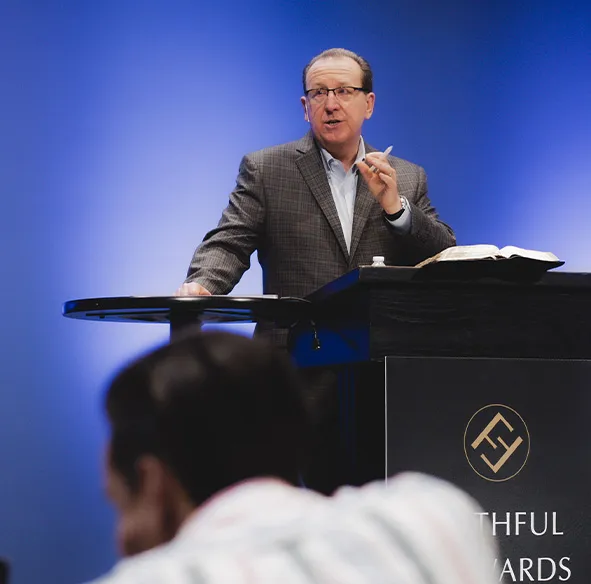
The preaching of God’s Word is central to the life of the church. Tom's pulpit ministry is dedicated to providing clear, biblical teaching to equip believers, strengthen faith, and exalt Christ.


Engage with the most recent teaching from God’s Word.
The preaching of God's Word is central to worship and of the utmost importance for the sanctification of every believer in Christ.

.jpg)
.jpg)

Explore messages organized to help you grow in Christ.
Search and filter sermons for quick access.
The Birth of Jesus the Messiah - Part 2
Pastor Tom Pennington's sermon on Matthew 1:18-25 presents Jesus' birth as the greatest rescue mission. Contrasting with a WWII POW rescue, he asserts Jesus came to save sinners, proving Him as the promised Messiah. The first proof is Jesus' **Virgin Conception** by the Holy Spirit. This supernatural event was essential for the eternal Son of God to add human nature while remaining one person, a testament to God's creative power. The second, and primary, proof is Jesus' **Saving Mission**, revealed in His name. "Jesus," derived from "Yahweh saves," identifies God as the mission's author and Jesus Himself as the agent. As God incarnate, "He Himself will save" "His people"�those the Father gave Him, encompassing both Jews and Gentiles who believe. The mission's aim is to save them comprehensively "from their sins." Jesus achieves this by perfectly keeping God's law, fully paying the legal debt for sin through His substitutionary death, breaking sin's enslaving power, and eventually delivering believers from the capacity to sin eternally. The sermon concludes by calling for repentance and faith in Jesus alone for this spiritual rescue.
The Birth of Jesus the Messiah - Part 1
The provided text emphasizes that the virgin birth of Jesus is a frequent target of attacks on Christianity, even encountering skepticism among clergy today. Pastor Tom Pennington argues there are only three possibilities for Jesus' conception: normal offspring of Mary and Joseph, illegitimate, or miraculously conceived by a virgin as the Bible states. Matthew�s Gospel aims to prove Jesus is the Messiah, highlighting His unique conception. Joseph, finding his betrothed Mary pregnant before their marriage, initially planned a private divorce to spare her public disgrace. However, an angel appeared to Joseph in a dream, confirming the child was conceived by the Holy Spirit and instructing him to marry Mary and name the baby Jesus, for He would save people from their sins, fulfilling the prophecy of Immanuel ("God With Us"). The virgin conception is crucial not because it made Jesus divine or sinless, but because it was the only way the preexistent Son of God could add a complete human nature without becoming two separate persons. This ensured Jesus remained one person with both divine and human natures.
Jesus' Legal Right to Messiah's Throne - Part 2
Tom Pennington's sermon "Matthew Jesus' Legal Right to Messiah's Throne (Part 2)" highlights the ancient importance of genealogies for legal status and establishing Messianic lineage. Matthew 1:1-17 presents Jesus' ancestry, structured into three 14-generation periods, demonstrating God's sovereign historical orchestration and establishing Jesus' legal right to David's throne as Messiah. Key spiritual lessons emphasize God's individual care, His control over all events, and humanity's universal need for the Gospel due to sin and death. God is sovereign in salvation, judging parents on faithfulness. Matthew's genealogy confirms Jesus' legal claim through adoptive father Joseph (Solomon's line), complemented by Mary's physical descent (Nathan's line), solidifying His Messianic qualifications. The inclusion of women with controversial pasts (Tamar, Rahab, Ruth, Bathsheba) powerfully illustrates Jesus' mission to save sinners and extend divine grace, offering a robust historical foundation for faith.
Jesus' Legal Right to Messiah's Throne - Part 1
Tom Pennington's sermon, "Matthew Jesus� Legal Right to Messiah�s Throne (Part 1)," introduces Matthew's Gospel, asserting its theme: Jesus of Nazareth is the promised Messiah, the divine Savior and King. He explains that Matthew, writing for a Jewish audience, immediately builds his case by presenting Jesus' genealogy in the first two chapters. Pennington outlines his approach to Matthew's Gospel, beginning with "The Messiah's Arrival." Focusing on Matthew 1:1, "The record of the genealogy of Jesus the Messiah, the son of David, the son of Abraham," he dissects its purpose. The phrase "biblos genesis" (book of genealogy/origin) serves as a title introducing both Jesus' ancestral record and the entire Gospel as a new "genesis" or creation event centered on Jesus. Matthew�s objective, as argued by Pennington, is to prove Jesus' historical identity as a real man named Jesus (meaning "Yahweh saves"), His official title as "the Messiah" (the Anointed One), and His crucial biblical credentials. As the "Son of David," Jesus fulfills the Davidic Covenant, establishing His right to David's eternal throne. As the "Son of Abraham," He fulfills the Abrahamic Covenant, bringing spiritual blessing to all nations by saving them from sin.
The Memoirs of Matthew: An Introduction
This text introduces a study of Matthew's Gospel, highlighting its crucial placement as the first New Testament book and its contribution to the Bible's overarching theme: God redeeming humanity through His Son. It positions Matthew as a "formal portrait" among the four Gospels, collectively providing a comprehensive view of Jesus Christ. The author, Matthew (also known as Levi), was an Apostle, personally discipled by Jesus, a witness to His resurrection, and divinely authorized to record His teachings. Formerly a wealthy, despised tax collector in Capernaum, Matthew immediately abandoned his lucrative life to follow Jesus. His sources included his own eyewitness accounts, the testimonies of other Apostles, various written documents, and crucially, the inspiration of the Holy Spirit. Matthew is believed to have first penned his Gospel in Aramaic for Jewish believers around 50 A.D., later revising it into Greek for a broader audience of Jews and Gentiles, likely between the mid-50s and mid-60s A.D. The central theme of Matthew's Gospel is that Jesus of Nazareth is undeniably the promised Messiah, the divine Savior and King of Hebrew Scripture, the rightful heir to David's throne.
A High View of Scripture - Part 2
In "A High View of Scripture (Part 2)," Pastor Tom Pennington critiques entertainment-driven church trends, contrasting them with a biblical approach to worship. He argues that a true high view of Scripture is demonstrated through seven specific church commitments. First, the Bible must remain central to corporate worship, prioritizing the reading, teaching, and application of the text. Second, the church must adhere to the "regulative principle," employing only worship elements explicitly prescribed by God. Additionally, Pennington emphasizes that Scripture must be handled with diligence, utilizing specific biblical terminology rather than secular language. He advocates for "consecutive exposition" as the standard preaching method, modeled by Jesus and Ezra, to ensure context is respected. Interpretation requires a "literal, grammatical, historical" approach to discover the author's original intent rather than subjective meaning. Consequently, Scripture serves as the final authority on contemporary issues, including creation, gender, and marriage, regardless of cultural pressure. The sermon concludes by challenging believers to personally adopt this high view by studying, loving, and obeying God�s Word daily.
No Results Found.
We couldn’t find anything matching your search.
Explore The Word Unleashed
Our ministry brings together expository preaching, theological precision, and practical application for the good of Christ's church and the daily living of Christ's people.
.webp)
Sermons
Listen to expository sermons that clearly teach God’s Word and guide you in daily living.

Radio
Tune in to gospel-centered programs that share biblical truth and strengthen your daily walk with Christ.
Training
Join courses and workshops designed to deepen your faith and equip you to serve others with biblical wisdom.
.webp)
From the Pastor's Desk
Read pastoral messages that encourage, instruct, and help you apply God’s Word to every part of your life.
.webp)
Hymns
Discover timeless hymns that lift your heart in worship and remind you of God’s abounding grace and faithfulness.
Podcasts
Stay rooted in Scripture through our podcast series.