Sermons That Exalt Christ
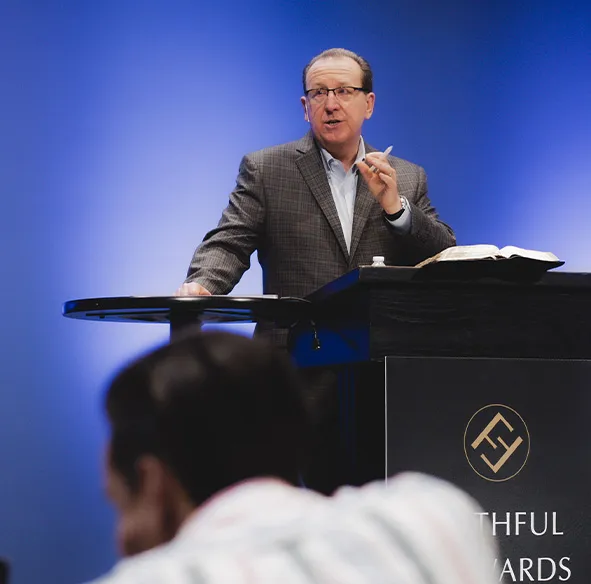
The preaching of God’s Word is central to the life of the church. Tom's pulpit ministry is dedicated to providing clear, biblical teaching to equip believers, strengthen faith, and exalt Christ.


Engage with the most recent teaching from God’s Word.
The preaching of God's Word is central to worship and of the utmost importance for the sanctification of every believer in Christ.

.jpg)
.jpg)

Explore messages organized to help you grow in Christ.
Search and filter sermons for quick access.
Messiah's Messenger - Part 2
Pastor Tom Pennington�s sermon, "Matthew Messiah�s Messenger (Part 2)," examines John the Baptist's ministry as a divine prelude to Jesus. He asserts that salvation begins with God's regeneration, enabling conversion through simultaneous repentance from sin and faith in Christ. John's ministry, prophesied in Isaiah and Malachi, served to prepare people for the Messiah's arrival. His austere lifestyle, characterized by camel hair and a diet of locusts and wild honey, underscored his role as a Nazirite, rebuking religious hypocrisy and embodying the spirit of Elijah. John's widespread public ministry drew thousands to the Judean wilderness for a unique "baptism of repentance." This immersion, distinct from Christian baptism, was a proselyte baptism for Jews, signifying their spiritual bankruptcy and the urgent need for a new beginning to enter Messiah's kingdom. It required confessed sins and was a powerful illustration of the forgiveness made possible by Jesus. Pennington concludes with four crucial implications: John confirmed Jesus as the promised Messiah and God; repentance is absolutely necessary for salvation; genuine repentance is a test of true faith; and the Christian life demands continual, relational repentance.
The Christian Virtue of Hospitality
Pastor Tom Pennington encourages making a New Year's resolution to pursue Christian hospitality, defining it as "a love of strangers"�receiving and treating unknown Christians warmly and generously. He emphasizes this virtue for three reasons: to maintain the church's distinctiveness amidst growth, to counteract culture's drift towards selfish isolation, and to adhere to clear biblical teaching, unlike pragmatic churches. Hospitality is crucial because it is rooted in God's character as a gracious host, was powerfully demonstrated throughout Christ's ministry, and is explicitly commanded in the New Testament (Romans 12:13, Hebrews 13:2, 1 Peter 4:9). It is also a qualification for elders and a test of Christian character, signifying spiritual maturity. Motivations for hospitality include imitating God, expressing love for Christ (by serving "the least of these"), showing love for God's people, and advancing the gospel. Practical applications involve hosting church ministries or travelers, intentionally interacting with strangers on Sundays, introducing oneself to unknown church members, and regularly sharing meals with diverse believers. Ultimately, practicing hospitality now reflects the character of God, whose eternal hospitality we will forever enjoy, with Jesus Himself serving us.
Celebrating the Incarnation
The text encourages refocusing Christmas celebrations on the Incarnation, encompassing *that* Jesus came as both fully God and fully man, *how* He came miraculously through a virgin, and profoundly, *why* He came. Central to Christian faith, 1 Timothy 1:15 declares, "Christ Jesus came into the world to save sinners." The sermon emphasizes humanity's universal need for salvation, as everyone is a sinner incapable of self-rescue, exemplified by Paul, who saw himself as the "foremost" of sinners. Jesus, the exclusive divine-human Savior, accomplishes this salvation through "penal substitution," suffering the legal penalty for our sins as our substitute on the cross. This act frees us from sin's power, legal guilt, and eternal wrath. Responding to the Incarnation involves recognizing God's willingness to save, acknowledging personal sinfulness through repentance, accepting Christ's work by faith, and adoring the God of grace with doxology. This Christmas, believers should celebrate not merely the event, but the profound purpose of Christ's coming to rescue us from our sins.
Jesus’ Contemptible Hometown
Tom Pennington's sermon, "Jesus� Contemptible Hometown," explores Matthew 2:19-23, focusing on why Jesus grew up in Nazareth, a small, despised town. After Herod the Great's death, an angel instructed Joseph to return to Israel from Egypt. Joseph initially intended to settle in Bethlehem but feared Herod's cruel successor, Archelaus, who ruled Judea. A divine dream then confirmed Joseph's decision to move his family to the region of Galilee. They settled in Nazareth, Joseph and Mary's hometown, despite its insignificance and poor reputation�a place from which people questioned if "any good thing" could come. Matthew states this move fulfilled prophetic words: "He shall be called a Nazarene." This isn't a direct quote but a summary, linking Jesus to Old Testament "Branch" prophecies (Isaiah 4, 11; Jeremiah 23, 33), as Nazareth could be interpreted as "Branch-town." Crucially, it signifies that the Messiah would be despised and rejected, much like Nazareth itself. For believers, this reminds us that God saves and uses "nothings and nobodies," just as the despised Nazarene Jesus was. We should expect scorn and willingly bear His reproach, recognizing that our true and honored home awaits us in the New Jerusalem.
An Attempted Assassination of the King
The sermon details Matthew 2:13-18, focusing on King Herod�s infamous failed attempt to assassinate the infant Jesus, showcasing "His Divine Preservation." God intervened, warning Joseph in a dream to flee with Mary and Jesus to Egypt. Joseph�s immediate obedience saved the Christ Child from Herod�s murderous wrath, which was fueled by paranoid rage after the Magi "tricked" him. Herod then ordered the massacre of all male infants two years and under in Bethlehem. These events fulfilled Old Testament prophecies: Hosea 11:1, where Jesus� flight from Egypt is seen as an analogy to Israel�s Exodus, and Jeremiah 31:15, depicting mothers mourning their lost children. The sermon highlights that this atrocity was motivated by Herod�s selfish pride and satanic defiance, as Satan sought to prevent Christ�s saving work. Ultimately, the text teaches that Christianity fulfills Old Testament Judaism, God preserves souls through trials, human schemes cannot thwart God's sovereign plans, and Jesus� life was not taken by force, but voluntarily laid down for humanity's salvation at the divinely appointed time.
No Results Found.
We couldn’t find anything matching your search.
Explore The Word Unleashed
Our ministry brings together expository preaching, theological precision, and practical application for the good of Christ's church and the daily living of Christ's people.
.webp)
Sermons
Listen to expository sermons that clearly teach God’s Word and guide you in daily living.

Radio
Tune in to gospel-centered programs that share biblical truth and strengthen your daily walk with Christ.
Training
Join courses and workshops designed to deepen your faith and equip you to serve others with biblical wisdom.
.webp)
From the Pastor's Desk
Read pastoral messages that encourage, instruct, and help you apply God’s Word to every part of your life.
.webp)
Hymns
Discover timeless hymns that lift your heart in worship and remind you of God’s abounding grace and faithfulness.
Podcasts
Stay rooted in Scripture through our podcast series.