Sermons That Exalt Christ
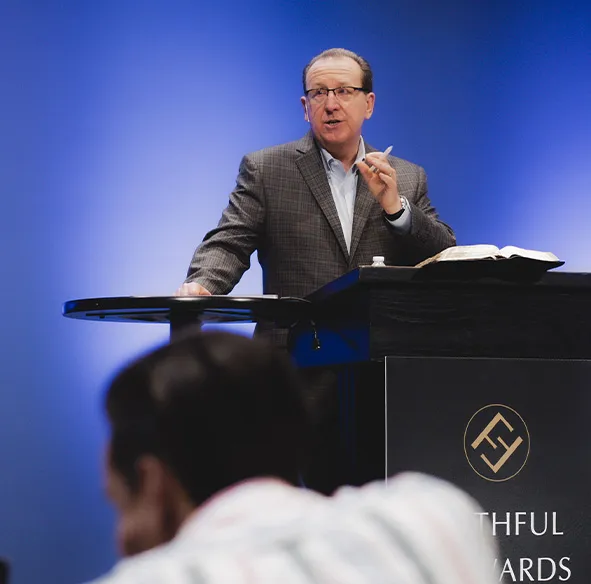
The preaching of God’s Word is central to the life of the church. Tom's pulpit ministry is dedicated to providing clear, biblical teaching to equip believers, strengthen faith, and exalt Christ.


Engage with the most recent teaching from God’s Word.
The preaching of God's Word is central to worship and of the utmost importance for the sanctification of every believer in Christ.

.jpg)
.jpg)

Explore messages organized to help you grow in Christ.
Search and filter sermons for quick access.
The House That God Builds
Tom Pennington's sermon on Psalm 127 emphasizes that successful parenting hinges on an "attitude of dependence on God," not solely on parental effort. He highlights two ways this dependence manifests: First, parents must acknowledge children are a gift from the Lord (Psalm 127:3-5). Children are not merely a physiological outcome but a divine reward, serving as "arrows in the hand of a warrior" for future defense. This principle extends universally: every good gift, including children, comes from God's grace. If God withholds children, it's still part of His wise plan. Second, parents must recognize that any success in parenting comes from God (Psalm 127:1-2). The phrase "Unless the Lord builds the house" refers to raising a family, encompassing both "building" (teaching and positive preparation) and "protecting" (guarding children from physical and spiritual dangers, like unchecked internet access). While parents must diligently teach and train their children, their efforts are "vain" without God's direct work in their children's hearts. God "gives to His beloved even in His sleep," signifying the peace of trusting God's sovereignty over outcomes.
The Practice of Biblical Fasting
This sermon on Matthew 6:16-18 warns against hypocrisy in spiritual practices, focusing specifically on fasting. The core message emphasizes pursuing God's glory rather than human praise. Biblical fasting is primarily defined as abstaining from food (or luxuries) to humble oneself and seek God in prayer during times of personal or national crisis. In the Old Testament, fasting was largely voluntary, called for during events like sickness, mourning, repentance, or impending danger, and always accompanied by prayer with a sincere heart. Jesus indicated that while His disciples didn't fast during His earthly ministry (a time of joy), it would be a natural response to distress after He was "taken away." True biblical fasting is never commanded for Christians nor seen as meritorious, but it is expected to occur naturally when individuals are overwhelmed and desire to humble themselves before God. This contrasts sharply with the hypocritical Pharisees, who disfigured their appearance and fasted publicly to be noticed by men, thereby receiving their only reward from human acclaim. Disciples, however, are instructed to fast privately, maintaining a normal appearance, with God as their sole audience. The Father, who sees what is done in secret, will reward genuine devotion.
Forgiveness: A Spiritual Diagnostic
Pastor Tom Pennington's sermon "Forgiveness: A Spiritual Diagnostic," based on Matthew 6:14-15, emphasizes that forgiving others is a crucial indicator of one's spiritual health. Citing a local revenge-driven murder, he illustrates humanity's natural sinful responses to being wronged: anger, bitterness, and retaliation. Jesus's teaching establishes a direct correlation: God forgives our transgressions *if* we forgive others; conversely, He will not if we refuse. This isn't about earning God's grace, but rather a vital condition and evidence of genuine repentance and comprehending our own immense spiritual debt to Him. Biblical forgiveness has two dimensions: first, cultivating a merciful spirit towards *everyone*, even the unrepentant, which means abandoning malice, seeking no revenge, and actively doing good to those who have wronged us. Second, it involves a deliberate decision to extend full forgiveness and reconciliation upon an offender's repentance. This includes choosing not to dwell on past sins, not bringing them up again, and, as much as possible, treating the person as if the offense never occurred, mirroring God's own forgiveness. The Parable of the Unforgiving Slave (Matthew 18) starkly illustrates the immense debt God forgives us versus our often-trivial unwillingness to forgive others.
The Kingdom, the Power, and the Glory
This sermon concludes a study of the Lord�s Prayer, focusing on its doxological ending: �For Yours is the kingdom and the power and the glory forever. Amen.� Pastor Tom Pennington notes that while the conclusion's presence in original manuscripts is debated, its concepts are deeply biblical, appearing in other Scriptures like Revelation and 1 Chronicles. Its inclusion in early Christian practice likely stemmed from Jewish prayer traditions. Pennington argues that this conclusion is vital for several reasons. Firstly, it ensures that praise is a crucial part of our prayers. Secondly, the word "for" indicates that we are providing arguments to God for why He should answer our prayers, arguments based solely on His inherent character, not our worthiness. Thirdly, it encourages us to pray by affirming not only God's willingness (from the preface) but also His unlimited ability to act. The doxology provides three core arguments for God to answer: 1. **"Yours is the kingdom"**: God alone holds the sovereign right to rule, meaning nothing we bring before Him is outside His authority or control. 2. **"Yours is the power"**: God alone possesses unlimited power to accomplish whatever He decides; nothing is too difficult for Him. 3.
The Crucifixion
The text details the crucifixion of Jesus, highlighting its profound nature as not merely capital punishment but a process of public humiliation and degradation, often referred to as "The Tree of Shame." Despite countless crucifixions by Rome, the gospels offer the most comprehensive accounts, revealing God's paradoxical wisdom in using such a despicable act for redemption. Jesus' journey to Golgotha, the "Place of a Skull," was short but grueling. After being mocked and brutalized, he collapsed under the crossbeam, leading to Simon of Cyrene being conscripted to carry it, an event that likely led Simon and his family to faith and illustrated Christ's substitutionary role. Jesus refused an anesthetic drink, choosing to bear the full agony of sin with clear senses. The crucifixion was a slow, excruciating death, typically by asphyxiation, with nails driven through the wrists. Soldiers gambled for Jesus' garments, fulfilling Psalm 22:18. The inscription above his head, "THE KING OF THE JEWS," served as Pilate's jab at Jewish leaders but was divinely intended to proclaim Jesus' true identity and innocence.
Lead Us Not Into Temptation - Part 2
Pastor Tom Pennington's sermon on Matthew 6:13, "Lead us not into temptation, but deliver us from evil," frames it as a prayer for personal holiness, illustrating temptation's power with the Jose Rivera story. Temptation, defined as an internal solicitation to sin, originates from three sources: our unredeemed flesh, the world's evil system (lust of flesh, eyes, pride), and direct satanic attacks. The petition "Lead us not into temptation" asks God to providentially protect us from sin-inducing circumstances, strengthen us to endure temptation, and even use our struggles for good by revealing our sinfulness and dependence on Him. God permits temptation for His sovereign purposes, though He never directly tempts. "Deliver us from evil" is a prayer for both present sanctification (gradual, increasing holiness by loosening Satan's influence) and future glorification (complete deliverance from sin's presence). Victory over temptation is found in Christ, who, though tempted, never sinned, died to free us, and intercedes for our holiness. Practically, cultivate a hatred for sin, desire holiness, depend on God, ask for divine protection, avoid tempting situations, and study God's Word. This daily prayer expresses profound dependence on God for spiritual victory and ultimate Christ-likeness.
No Results Found.
We couldn’t find anything matching your search.
Explore The Word Unleashed
Our ministry brings together expository preaching, theological precision, and practical application for the good of Christ's church and the daily living of Christ's people.
.webp)
Sermons
Listen to expository sermons that clearly teach God’s Word and guide you in daily living.

Radio
Tune in to gospel-centered programs that share biblical truth and strengthen your daily walk with Christ.
Training
Join courses and workshops designed to deepen your faith and equip you to serve others with biblical wisdom.
.webp)
From the Pastor's Desk
Read pastoral messages that encourage, instruct, and help you apply God’s Word to every part of your life.
.webp)
Hymns
Discover timeless hymns that lift your heart in worship and remind you of God’s abounding grace and faithfulness.
Podcasts
Stay rooted in Scripture through our podcast series.