Sermons That Exalt Christ
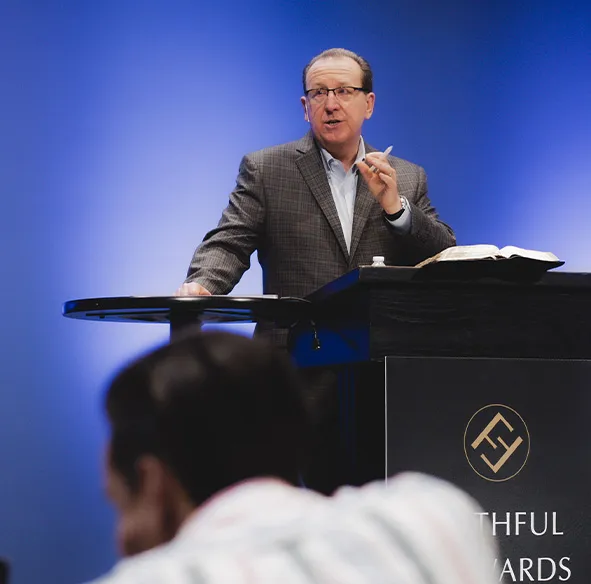
The preaching of God’s Word is central to the life of the church. Tom's pulpit ministry is dedicated to providing clear, biblical teaching to equip believers, strengthen faith, and exalt Christ.


Engage with the most recent teaching from God’s Word.
The preaching of God's Word is central to worship and of the utmost importance for the sanctification of every believer in Christ.

.jpg)
.jpg)

Explore messages organized to help you grow in Christ.
Search and filter sermons for quick access.
Not Even One! - Part 5
In "Not Even One! (Part 5)," Pastor Tom Pennington argues that the absence of the "fear of God" is the fundamental root of all human depravity, as stated in Romans 3:18: "'THERE IS NO FEAR OF GOD BEFORE THEIR EYES.'" He contrasts this with genuine biblical encounters where individuals like Moses, Peter, and John reacted with profound awe, reverence, and even terror in God's presence. Pennington explains that the "fear of God" has three senses: denoting true believers, encompassing reverence and awe, and signifying terror or dread. Romans 3:18, drawing from Psalm 36:1, specifically implies that fallen humanity lacks any sense of terror or dread towards God. This deficiency in unbelievers stems from their ignorance of God's revelation, greatness, power, and impending judgment. Without this crucial fear, people fail to seek God, leading to widespread sin, destructive relationships, and a life unchecked by divine authority. While Christ perfectly exemplified the fear of God, believers are called to cultivate a healthy, reverent fear of God, living in awe and obedience to their Creator.
A Bold Proposal - Part 1
Pastor Tom Pennington's sermon on Ruth 3:1-18 highlights how ancient Scripture offers instruction and hope. He reviews Ruth's story: Act 1 saw Naomi's family make a "disastrous, rebellious choice" to leave famine-stricken Bethlehem for Moab, leading to loss. Act 2 details Naomi's repentance and Ruth's conversion to Yahweh, demonstrating God's sovereign grace as the true Hero. Act 3 illustrates God's provision for those who seek refuge in Him through Boaz's kindness. Act 4, "A Bold Proposal," begins with Naomi orchestrating a "radical but biblical plan." After the harvest, she instructs Ruth to wash, anoint herself, and go to the threshing floor, where she is to uncover Boaz's feet and lie down. This action, interpreted as a marriage proposal ("spread your covering over your maid"), invoked Boaz's duty as a kinsman-redeemer under the Mosaic law of levirate marriage (Deuteronomy 25:5). Naomi, having learned from past self-reliant choices, now models trusting God's providence and Boaz's integrity, with Ruth responding in faith.
Not Even One! - Part 4
In his sermon "Not Even One!" on Romans 3:9-20, Tom Pennington highlights humanity's universal depravity, asserting that all people are "under sin" and devoid of inherent righteousness. He illustrates this with the tragic 1941 Jedwabne massacre, where Polish neighbors, given Nazi permission, brutally murdered their Jewish neighbors, epitomizing human depravity. This biblical passage, drawing heavily from Old Testament quotes, details mankind's fallen state: darkened minds, enslaved wills, rebellious lifestyles, and toxic speech. The sermon particularly focuses on verses 15-17, identifying three reasons for humanity's pervasive destructive relationships. First, there's a deep predisposition to violent anger, manifesting in wars, murders (even over trivial matters), physical violence, and the hatred Jesus equates to murder. Second, humans leave a consistent "path" of "destruction and misery," evident in broken marriages, families, and friendships�a consequence of our "deeds of the flesh." Third, fallen individuals have "not known" the path of peace, lacking any true perception or experience of it. Ultimately, Romans 3:9-20 unequivocally demonstrates that without Christ, all hope in self is futile, as only through His grace can reconciliation with God and genuine peace in relationships be found.
Not Even One! - Part 3
The sermon on Romans 3:9-20, "Not Even One!", expounds Paul's universal indictment of mankind's total depravity. It asserts that "there is none righteous," with human sinfulness affecting darkened minds, enslaved wills, rebellious lifestyles, and all behavior, which consistently falls short of God's standard. A significant focus is on "toxic speech" (Romans 3:13-14) as a profound revelation of the heart's corruption. Our words, flowing from an "open grave," reveal decay, are "filled with deceit" (lies, manipulation), and "kill and destroy" like "poison of asps," inflicting pain, tempting to sin, and spreading false teaching. They are also "full of cursing and bitterness," reflecting hateful hearts. Jesus warns that every careless word will be judged and condemn unbelievers. The only hope is the Gospel�repentance and faith in Jesus Christ, whose death atones for sin. Believers are urged to abandon toxic speech, instead speaking truth, edifying others, and imitating God in their words.
The Manifesto of the Reformation
The sermon "The Manifesto of Reformation" highlights that while Protestant churches celebrate Reformation Sunday commemorating Luther's 95 Theses and the five *solas* (*Sola Scriptura*, *Solus Christus*, *Sola Fide*, *Sola Gratia*, and *Soli Deo Gloria*), the true "flashpoint" of the Reformation was the seminal question of man's free will. This issue, specifically how original sin affects human will, was debated historically between Augustine and Pelagius (and semi-Pelagianism), and later between Martin Luther and Erasmus. Pelagius and Erasmus contended that man's will is inherently good or free to choose God, while Augustine and Luther vehemently argued that man's will is in "bondage" to sin. Scripture, particularly Romans 3, affirms this total depravity, stating "there is none who seeks for God" and "none who does good." Further "categorical negatives" throughout the New Testament show man's inability to act contrary to his sinful nature, enter God's kingdom, do spiritual good, understand God's truth, obey God, please God, or come to Christ without divine intervention. Therefore, understanding the bondage of the will underscores that salvation must be a sovereign act of God, entirely by His grace, making it solely a work that brings all glory to God alone.
Predestined to Adoption
In a sermon on Ephesians 1:4-6, Pastor Tom Pennington examines Paul�s twelve-verse outburst of praise for God�s redemptive plan, focusing on the Father's initiating role through sovereign election. This election is characterized as sovereign, individual, "in Christ," unconditional, and intentional. Pennington highlights three key purposes behind God's election: to make us holy, to bring glory to His grace, and to adopt us as His children. Concentrating on adoption, he explains that "predestined to adoption" means God decided our destiny beforehand. Drawing on Roman family law, where adopted children held the same legal rights and status as natural-born offspring without exception, Pennington emphasizes that God legally adopts Christians as His own, becoming their compassionate, providing, and loving Father. This adoption is motivated by God's profound love, made possible "through Jesus Christ's" atoning sacrifice, is deeply personal ("to Himself"), and brings God "supreme delight." Those wishing to become God�s children must repent and believe in Jesus Christ. For believers, the proper response to this amazing reality is to imitate God, walking in love and reflecting His character, just as Christ loved us and gave Himself for us.
No Results Found.
We couldn’t find anything matching your search.
Explore The Word Unleashed
Our ministry brings together expository preaching, theological precision, and practical application for the good of Christ's church and the daily living of Christ's people.
.webp)
Sermons
Listen to expository sermons that clearly teach God’s Word and guide you in daily living.

Radio
Tune in to gospel-centered programs that share biblical truth and strengthen your daily walk with Christ.
Training
Join courses and workshops designed to deepen your faith and equip you to serve others with biblical wisdom.
.webp)
From the Pastor's Desk
Read pastoral messages that encourage, instruct, and help you apply God’s Word to every part of your life.
.webp)
Hymns
Discover timeless hymns that lift your heart in worship and remind you of God’s abounding grace and faithfulness.

Podcasts
Stay rooted in Scripture through our podcast series.