Sermons That Exalt Christ
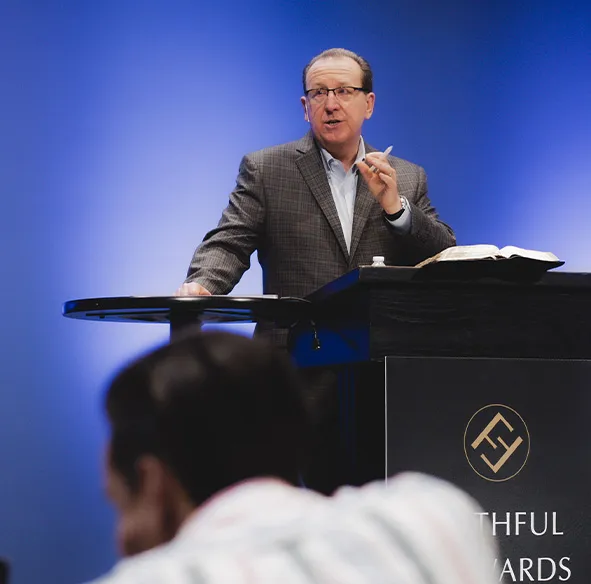
The preaching of God’s Word is central to the life of the church. Tom's pulpit ministry is dedicated to providing clear, biblical teaching to equip believers, strengthen faith, and exalt Christ.


Engage with the most recent teaching from God’s Word.
The preaching of God's Word is central to worship and of the utmost importance for the sanctification of every believer in Christ.

.jpg)
.jpg)

Explore messages organized to help you grow in Christ.
Search and filter sermons for quick access.
Q & A
Pastor Tom Pennington opens a Q&A session, encouraging congregants to ask questions on various topics. He first addresses biblical fasting, clarifying it is a practice tied to extended prayer during difficult life circumstances, not for earning God's favor, long durations, or weight loss, as Jesus assumed believers would fast appropriately. Next, he interprets Romans 11, explaining "all Israel will be saved" refers to a massive future ingathering of Jewish people at the end of the Tribulation, not every historical Jewish individual, aligning with God's ultimate covenantal plan. He affirms the biblical principle of self-defense, stating Scripture permits taking a life to protect one's own or an innocent person's life. On Ephesians 3:17, "Christ may dwell in your hearts through faith," Pennington clarifies "dwell" means to be "at home," signifying a deep, faith-based communion with the ever-present Triune God, not a mystical feeling or initial indwelling. He distinguishes between sinful fear of punishment (cast out by love) and a healthy "fear of God," which is reverent awe and a desire not to offend a loving Father.
Trilemma: Liar, Lunatic, or Lord - Part 4
In a sermon titled "Trilemma: Liar, Lunatic, or Lord (Part 4)," Tom Pennington explores the crucial question of Jesus' identity from Mark 3:20-35. He begins by establishing Jesus' historical existence through secular and scriptural evidence, and the reliability of New Testament accounts detailing His life and divine claims. Pennington highlights Jesus' clear assertions of deity, such as in John 8 ("Before Abraham was, I am") and Mark 14 ("I am" to the high priest). These claims, Pennington asserts, leave only three logical conclusions, a concept popularized by C.S. Lewis: Jesus was either a deluded lunatic, a demonic liar, or the divine Lord He claimed to be. Mark 3 illustrates these options: Jesus' family believed He had "lost His senses" (lunatic), while the scribes accused Him of casting out demons by Beelzebul (liar/demonic). In contrast, His disciples accepted Him as Lord. Pennington emphasizes that there is no middle ground or neutral position regarding Jesus. True faith extends beyond intellectual acceptance to active obedience, where "whoever does the will of God, he is My brother and sister and mother." This means genuine followers are considered Jesus' spiritual family, prioritizing their relationship with Him and His teachings above all else.
Trilemma: Liar, Lunatic, or Lord - Part 3
Pastor Tom Pennington�s sermon, �Trilemma: Liar, Lunatic, or Lord (Part 3),� addresses the essential question of Jesus� identity, presenting a positive outline for sharing the gospel. He asserts Jesus was a real historical figure, verified by secular sources and eyewitnesses, whose life and teachings are reliably documented in historically robust ancient manuscripts. These documents show Jesus unequivocally claimed to be God and the world's savior. Pennington argues that Jesus� claims force humanity into a �trilemma�: he was either a liar, a lunatic, or the Lord. Using Mark 3:20-35, he illustrates these responses. Jesus� own family thought him a lunatic, attempting to restrain him for "losing his senses." Conversely, scribes from Jerusalem accused him of being a demonic liar, possessed by Beelzebul, after he healed a demon-possessed man. They deliberately misattributed this manifest work of the Holy Spirit to Satan, a choice Jesus condemned as the unforgivable sin. Jesus logically refuted their accusation, highlighting the folly of Satan undermining his own kingdom. The sermon concludes that if Jesus were not God, he could not be a good moral teacher; he would necessarily be an unspeakably evil impostor.
Trilemma: Liar, Lunatic, or Lord - Part 2
Pastor Tom Pennington's sermon "Trilemma: Liar, Lunatic, or Lord (Part 2)" explores the fundamental question, "Who do you say that I am?" Building on previous refutations of Jesus as a myth, a mystery, or merely a good man, Pennington affirms the historical reliability of the New Testament and Jesus' undeniable claims to be God. The sermon focuses on the "lunatic" aspect of the trilemma, drawing from Mark 3:20-35 where Jesus' own family concluded He had "lost His senses" or was "insane." This reaction stemmed from His intense ministry, disregard for personal needs, authoritative teaching, and controversial claims. This scenario illustrates one of the three unavoidable conclusions regarding Jesus: He was either a liar (knowing His claims were false), a lunatic (sincerely but falsely believing His claims), or the Lord (His claims were true). Pennington dismisses the "lunatic" option as untenable given Jesus' clear intellect. He highlights implications for believers today, noting they too may be perceived as "nuts" for their faith.
Trilemma: Liar, Lunatic, or Lord - Part 1
This sermon, "Trilemma: Liar, Lunatic, or Lord (Part One)," focuses on Jesus' pivotal question: "Who do you say that I am?" Pastor Tom Pennington challenges three common misconceptions about Jesus Christ. He first refutes "Jesus is a myth." Pennington cites nine reliable secular historians (e.g., Josephus, Tacitus) from within 150 years of Jesus' death, affirming His historical existence and key events. Additionally, Jesus specifically selected 11 apostles as eyewitnesses, whose documented accounts comprise the New Testament. Second, Pennington addresses "Jesus is a mystery," the belief that reliable information about Him is scarce. He highlights the New Testament's unparalleled manuscript evidence�over 25,000 copies, far more than other ancient texts, with fragments dating remarkably close to the originals. Importantly, Jesus pre-authenticated the apostles' writings, promising the Holy Spirit would guide their memory and teachings, ensuring their authority. Finally, the sermon dismantles "Jesus is a real man who never claimed to be God.
The Heart of Thanksgiving
The text traces Thanksgiving's roots to the 1621 Plymouth Pilgrims, who, with strong Christian faith, celebrated God's bounty after a difficult year. This early act of gratitude influenced the eventual establishment of the national holiday, fixed in 1941. The speaker emphasizes a biblical understanding of thanksgiving through Psalm 100. This Psalm outlines how and why we should give thanks, regardless of circumstances. It presents two core reasons: God is great and God is good. Our thanksgiving to a great God involves shouting joyfully, serving with gladness, and singing, acknowledging Him as the self-existent Yahweh, our King, Creator, and particularly our Redeemer who made us His people by sovereign grace. To a good God, we express gratitude by entering His presence with specific thanks, confessing what we're grateful for, and blessing His name, recognizing His enduring goodness, everlasting steadfast love, and unwavering faithfulness across all generations. Practically, our Thanksgiving celebrations should shift focus beyond mere food and fellowship to a conscious meal "with God," rehearsing specific blessings, singing praises, and offering direct prayers of thanks. Such a heart of thanksgiving pleases God more than any sacrifice and magnifies His greatness, especially acknowledging His grace in making us His own.
No Results Found.
We couldn’t find anything matching your search.
Explore The Word Unleashed
Our ministry brings together expository preaching, theological precision, and practical application for the good of Christ's church and the daily living of Christ's people.
.webp)
Sermons
Listen to expository sermons that clearly teach God’s Word and guide you in daily living.

Radio
Tune in to gospel-centered programs that share biblical truth and strengthen your daily walk with Christ.
Training
Join courses and workshops designed to deepen your faith and equip you to serve others with biblical wisdom.
.webp)
From the Pastor's Desk
Read pastoral messages that encourage, instruct, and help you apply God’s Word to every part of your life.
.webp)
Hymns
Discover timeless hymns that lift your heart in worship and remind you of God’s abounding grace and faithfulness.
Podcasts
Stay rooted in Scripture through our podcast series.