Sermons That Exalt Christ
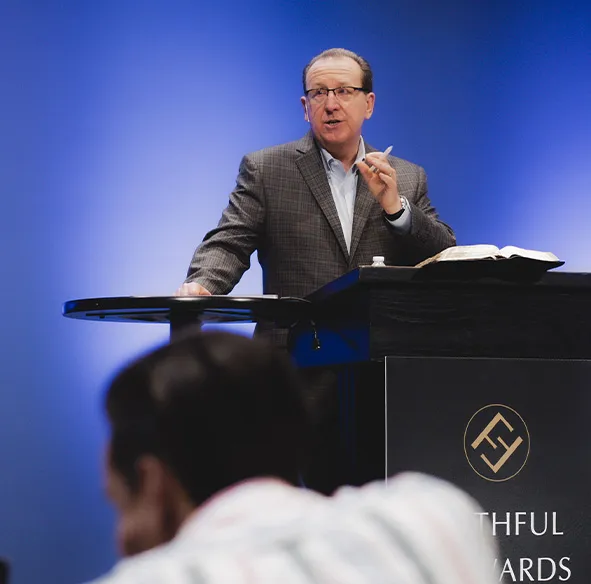
The preaching of God’s Word is central to the life of the church. Tom's pulpit ministry is dedicated to providing clear, biblical teaching to equip believers, strengthen faith, and exalt Christ.


Engage with the most recent teaching from God’s Word.
The preaching of God's Word is central to worship and of the utmost importance for the sanctification of every believer in Christ.

.jpg)
.jpg)

Explore messages organized to help you grow in Christ.
Search and filter sermons for quick access.
Who Matters to God
Pastor Tom Pennington's sermon on Romans 16:1-16, "Romans Who Matters to God," delves into the significance of the numerous individuals mentioned in Paul's closing greetings, transforming what might seem like a mere list into profound spiritual lessons. He begins by commending Phoebe, the letter's carrier, as a faithful servant and benefactor, clarifying that "servant" refers to her dedicated service rather than an official deaconess role. Paul then greets key figures like Priscilla and Aquila, noting their status as fellow workers who risked their lives for him and hosted a house church in Rome. The sermon highlights the remarkable diversity of the Roman churches, composed of Jews and Gentiles, freeborn and slaves, wealthy and poor, from various backgrounds and stages of faith. Despite these differences, their unity was rooted "in the Lord" or "in Christ," a phrase repeated nine times in the passage. Pennington extracts four key lessons: Christ intends His church to be diverse, its unity is found solely in Christ, true Christians love other believers and forge interconnected relationships, and most importantly, Christ cares deeply about every believer, knowing each by name.
Smyrna: Faithful in Suffering
Pastor Tom Pennington's sermon "Smyrna: Faithful in Suffering" from Revelation 2:8-11 addresses the reality of Christian persecution, both as a global phenomenon and an impending threat in America. He defines persecution broadly, encompassing insults, slander, and professional discrimination, not just physical violence. Drawing lessons from Christ's letter to the persecuted church in Smyrna, Pennington emphasizes Christ's self-description as "the first and the last" and "who was dead and has come to life," highlighting His eternal sovereignty and victory over death as a source of comfort. Christ acknowledges Smyrna's severe "tribulation" and "poverty" (spiritually, they are "rich"), and the "blasphemy" (slander) from those He calls a "synagogue of Satan"�unbelieving Jews used as instruments of persecution. The sermon outlines five responses to persecution: do not fear suffering (Christ controls it, is with you, gives courage, and preserves faith), do not mistake its source (Satan orchestrates it), do not miss its purpose (God uses it to test and prove genuine faith), do not question Christ's sovereignty (He determines its duration), and do not forget Christ's reward ("the crown of life," which is eternal life). All true believers, "overcomers," are promised they will never be harmed by the "second death" (eternal punishment).
Risen!
The sermon "Risen!" highlights the unparalleled uniqueness of Christianity, asserting that its founder, Jesus, rose from the dead, leaving an empty tomb, a claim no other major religion makes for its founder. This resurrection is the indispensable foundation of Christian faith; without it, Jesus was a fraud, and faith is rendered worthless. The text recounts the historical events: Jesus' crucifixion, hasty burial, and the Sabbath. On Sunday morning, faithful women, intending to anoint Jesus' body, discovered the massive tombstone rolled away by an angel after an earthquake. Angels proclaimed, "He has risen, just as He said," confirming the empty tomb and designating these women as the first witnesses. The sermon presents compelling evidence for this event: the impossibly displaced stone, the angelic testimonies, Jesus' own prophecies of His resurrection, the empty tomb (unchallenged even by His enemies), and His numerous post-resurrection appearances to over 500 people. Initially, the women reacted with a mix of fear, astonishment, and temporary speechlessness, yet also with profound joy and obedient faith, compelling them to share the news.
Jesus' Last Words
This sermon unpacks Jesus� seventh and final word from the cross, "Father, into Your hands I commit My spirit" (Luke 23:46), emphasizing its profound meaning, example, and uniqueness. The three hours of darkness preceding this statement symbolized God's wrath and judgment against human sin, with Jesus enduring the complete forsakenness sinners deserve. Simultaneously, the miraculous tearing of the temple veil signified that Jesus' death had opened direct access to God, removing the barrier between a holy God and sinful humanity, as He became our ultimate High Priest and sacrifice. Jesus' death also serves as an example for believers. He found comfort in God's Word and prayer, quoting Psalm 31:5, demonstrating a life immersed in Scripture. He understood death as the physical body's demise while the spirit (the true self) lives on, confidently entrusting His soul to the Father. Moreover, His death was unique because it was voluntary; He "yielded up His spirit" with a "mega voice" at a chosen moment, rather than succumbing to slow suffocation.
Jesus' Baptism of Repentance
Pastor Tom Pennington's sermon uses Jesus' baptism (Mark 1:9-11) to explain repentance and prepare congregants for the Lord's Table. He notes that human repentance is often flawed, but Jesus' baptism offers profound lessons. John the Baptist preached a "baptism of repentance for the forgiveness of sins," calling Jews to acknowledge their sinfulness and prepare for the Messiah, akin to Gentile proselyte baptism. Though John initially resisted baptizing His sinless cousin, Jesus insisted to "fulfill all righteousness." This pivotal event involved the heavens tearing open, the Holy Spirit descending visibly "like a dove," and God's voice proclaiming, "You are My beloved Son, in You I am well-pleased." This affirmed Jesus' identity as the Messiah, the suffering servant, and distinctly revealed the Trinity. Jesus' baptism served three key purposes: it confirmed His identity as God's Son and the Messiah; it fulfilled a perfect, righteous life on behalf of His people, with His righteousness later imputed to believers; and critically, it was a substitutionary repentance for His people. Though sinless, Jesus' participation in a "baptism of repentance for the forgiveness of sins" made our own sincere, yet imperfect, repentance acceptable to God.
No Results Found.
We couldn’t find anything matching your search.
Explore The Word Unleashed
Our ministry brings together expository preaching, theological precision, and practical application for the good of Christ's church and the daily living of Christ's people.
.webp)
Sermons
Listen to expository sermons that clearly teach God’s Word and guide you in daily living.

Radio
Tune in to gospel-centered programs that share biblical truth and strengthen your daily walk with Christ.
Training
Join courses and workshops designed to deepen your faith and equip you to serve others with biblical wisdom.
.webp)
From the Pastor's Desk
Read pastoral messages that encourage, instruct, and help you apply God’s Word to every part of your life.
.webp)
Hymns
Discover timeless hymns that lift your heart in worship and remind you of God’s abounding grace and faithfulness.
Podcasts
Stay rooted in Scripture through our podcast series.