Sermons That Exalt Christ
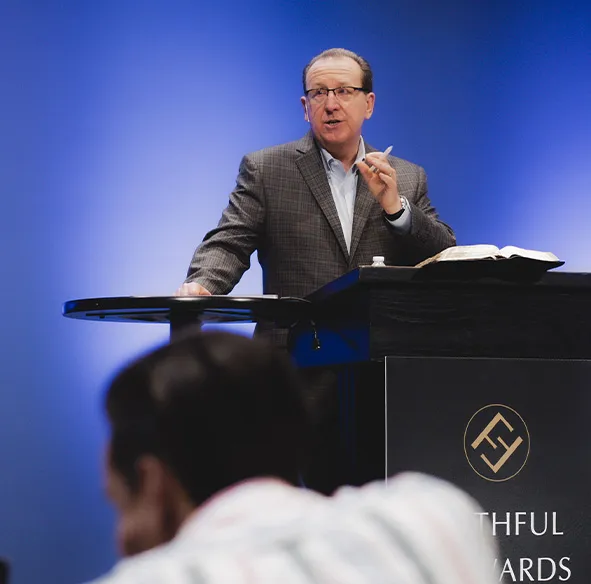
The preaching of God’s Word is central to the life of the church. Tom's pulpit ministry is dedicated to providing clear, biblical teaching to equip believers, strengthen faith, and exalt Christ.


Engage with the most recent teaching from God’s Word.
The preaching of God's Word is central to worship and of the utmost importance for the sanctification of every believer in Christ.

.jpg)
.jpg)

Explore messages organized to help you grow in Christ.
Search and filter sermons for quick access.
Antichrist - Part 1
The sermon "Revelation Antichrist (Part 1)" explores Revelation 13:1-10, introducing the Antichrist as the ultimate human embodiment of evil, controlled by Satan. This figure, also called "the man of lawlessness" and "the beast," will rise during the future seven-year tribulation, surpassing all previous evil rulers in history. Empowered directly by Satan, the Antichrist will experience a meteoric rise to global political dominance. His empire, depicted with ten horns and seven heads, will blend the speed of a leopard, the ferocity of a bear, and the consuming power of a lion, representing the accumulated wickedness of past world powers. He will declare himself divine, using blasphemous names. A key part of his deception involves a counterfeit death and miraculous resurrection � a "fatal wound" that is healed � intended to mimic Christ and garner worldwide worship for himself and Satan. This deception will captivate and enslave those who have rejected the truth of the gospel. The sermon concludes with the assurance that Jesus Christ will ultimately destroy the Antichrist with a mere word, establishing His eternal kingdom, underscoring the vital importance of faith in the true Messiah.
Researching Your Spiritual Ancestry - Part 2
Pastor Tom Pennington's sermon "1 John Researching Your Spiritual Ancestry (Part 2)" uses the analogy of paternity tests to introduce 1 John's role in providing "tests of eternal life," specifically focusing on obedience as evidence of spiritual paternity. He explains that 1 John 3:7-10 reveals one's spiritual father through habitual conduct: practicing righteousness signifies a child of God, while practicing sin indicates being a child of the devil. Pennington clarifies that "No one who is born of God practices sin" does not imply sinless perfection or that believers never sin. Instead, it means true Christians do not live in a *habitual pattern* of sin, nor do they possess the *capacity* for such a lifestyle. This is because "His seed"�the divine principle of life, implanted by the Holy Spirit through the gospel�abides in them, causing a fundamental transformation and an inherent drive towards God's ways (Ezekiel 36). Sin becomes an abnormal "aberration," not the defining characteristic of their life. The text emphasizes that this test of righteousness, coupled with love for fellow believers, makes one's spiritual paternity "obvious.
Researching Your Spiritual Ancestry - Part 1
Pastor Tom Pennington's sermon "Researching Your Spiritual Ancestry (Part 1)," based on 1 John 3:7-10, asserts that every individual is either a child of God or a child of the devil, and this spiritual lineage is definitively proven by one's habitual conduct. He first warns against a "lethal deception" prevalent in various forms (like Gnosticism, easy believism, or pop Christianity) that claims one can be righteous without consistently practicing righteousness, thereby condoning a life of ongoing sin. Pennington debunks the lies that salvation is earned by good deeds or external appearance, emphasizing that true righteousness requires a changed heart. The "Biblical correction" states that habitually practicing righteousness is not how one *becomes* righteous, but rather the undeniable evidence of an already righteous heart and a new birth in Christ. Conversely, habitually practicing sin reveals one to be "of the devil," whose nature and work are characterized by sin, lies, and destruction. Jesus, the Son of God, appeared specifically to destroy the works of the devil�first, by saving His people from the guilt, penalty, and power of sin through His death on the cross, and second, by eternally judging those who remain unrepentant in their sin.
Oil & Water
Pastor Tom Pennington's sermon "1 John Oil & Water" powerfully asserts the complete incompatibility of genuine faith in Jesus Christ and a habitual lifestyle of sin, using the analogy of oil and water. Focusing on 1 John 3:4-6, Pennington explains that a consistent pattern of sin signifies a lack of true knowledge of Christ, irrespective of personal claims. He elaborates on four reasons for this incompatibility. First, habitual sin contradicts God's Law, as sin is inherently lawlessness�an active rebellion against God's revealed will. True believers, through spiritual regeneration, receive a new love and capacity to obey God's commands, making a life of perpetual sin impossible. Second, such a lifestyle is at odds with Christ's mission, given that Jesus "appeared in order to take away sins" through His sacrificial death. Third, it is inconsistent with Christ's nature, for "in Him there is no sin"; Jesus is eternally pure, never having committed sin nor possessing a sin nature. Finally, a life marked by habitual sin is incompatible with Christ's Gospel. Pennington emphasizes that "no one who abides in Him sins," meaning true, saving belief in Jesus and His gospel results in a life where sin is not the governing principle.
The Woman, her Son, and the Dragon - Part 3
This sermon, "The Woman, her Son, and the Dragon (Part 3)," from Revelation 12, explores Satan's ceaseless war against God's people, particularly Israel, a hatred evident throughout history as antisemitism. Following his defeat in a heavenly war, Satan, symbolized as the "dragon," is cast to Earth during the Tribulation. Enraged and knowing his time is short, he intensifies his efforts to thwart God's plans. Satan's objectives include preventing Christ's kingdom, deceiving unbelievers, and destroying all believers, especially Israel, the "woman" who bore the Messiah. He instigates the Antichrist to break a covenant with Israel, setting up the "abomination of desolation" in the rebuilt temple, initiating severe persecution. Though two-thirds of Jews may perish, God supernaturally preserves a remnant. These survivors are given "eagle's wings" (divine protection) to flee to a wilderness "place prepared by God," where they are nourished for 3.5 years (the Great Tribulation). Satan pursues them with Antichrist's invading armies, depicted as a "river" of water, but the "earth helps the woman" by miraculously consuming the flood. Thwarted in his attempts against Israel, Satan redirects his rage to "the rest of her children"�all worldwide believers, Jew and Gentile, who keep God's commandments and hold to Jesus' testimony.
The Woman, her Son, and the Dragon - Part 2
The sermon explores Revelation 12, revealing Satan's character, domain, and future during the Tribulation. Satan, who fell after creation, currently governs the rebellious world and surrounding heavenly realms, with permitted access to God to accuse believers "day and night." Revelation 12 depicts Israel ("the woman") giving birth to the Messiah ("the Son"), whom Satan ("the dragon") sought to devour. Yet, Christ was born, lived, died, rose, and ascended victoriously. At the Tribulation's midpoint, a decisive war breaks out in heaven. Satan, with his fallen angels, futilely attacks God's throne, but Michael and holy angels defeat them. Satan is then permanently cast from heaven to Earth. Heaven erupts in celebration over God's assured salvation, power, and kingdom, rejoicing that the ceaseless "accuser of our brethren" is banished. Conversely, Earth faces "woe" as Satan, knowing his time is short (3.5 years), unleashes his great wrath, particularly on Israel. Believers overcome Satan through "the blood of the Lamb" and faithful testimony, even when facing death. The sermon concludes by affirming God's limitless power, the futility of human opposition, and the assurance that God disregards Satan's accusations against His children due to Christ's unwavering intercession.
No Results Found.
We couldn’t find anything matching your search.
Explore The Word Unleashed
Our ministry brings together expository preaching, theological precision, and practical application for the good of Christ's church and the daily living of Christ's people.
.webp)
Sermons
Listen to expository sermons that clearly teach God’s Word and guide you in daily living.

Radio
Tune in to gospel-centered programs that share biblical truth and strengthen your daily walk with Christ.
Training
Join courses and workshops designed to deepen your faith and equip you to serve others with biblical wisdom.
.webp)
From the Pastor's Desk
Read pastoral messages that encourage, instruct, and help you apply God’s Word to every part of your life.
.webp)
Hymns
Discover timeless hymns that lift your heart in worship and remind you of God’s abounding grace and faithfulness.
Podcasts
Stay rooted in Scripture through our podcast series.