Sermons That Exalt Christ
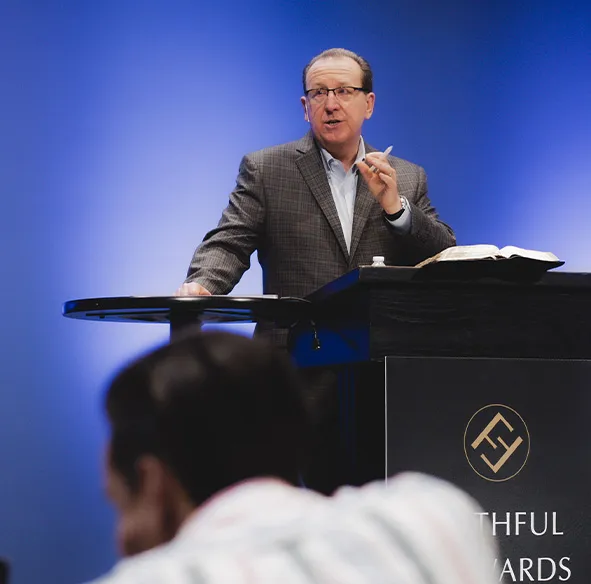
The preaching of God’s Word is central to the life of the church. Tom's pulpit ministry is dedicated to providing clear, biblical teaching to equip believers, strengthen faith, and exalt Christ.


Engage with the most recent teaching from God’s Word.
The preaching of God's Word is central to worship and of the utmost importance for the sanctification of every believer in Christ.

.jpg)
.jpg)

Explore messages organized to help you grow in Christ.
Search and filter sermons for quick access.
No Condemnation - Part 2
This sermon, "No Condemnation (Part 2)" based on Romans 8:1-4, explains the profound truth that believers are free from divine judgment. Pastor Tom Pennington asserts that humanity's sin against God's perfect law justly incurs eternal condemnation. However, for those "in Christ Jesus," this condemnation�the verdict of guilty and the sentence of eternal death�is removed. This incredible shift is possible because believers are inseparably united with Christ, and the Holy Spirit has liberated them from the law's demands. God achieved this through His Son, Jesus. Since the law, weak through human flesh, could not justify us, God sent Jesus in human likeness (without sin) as a substitute. On the cross, God condemned sin in Jesus, pouring out the wrath and punishment due to humanity upon Him. This "Great Exchange" ensures "the requirement of the law might be fulfilled in us," meaning Christ's perfect obedience is credited to us. This "no condemnation" applies to all who "walk according to the Spirit," characterized by a mind set on spiritual things and submission to God's law, which demonstrates their salvation.
Pride and Prejudice - Part 2
Pastor Tom Pennington's sermon on James 2:1-13, titled "Pride and Prejudice," addresses the sin of partiality, or favoritism and prejudice, which involves unfairly judging or favoring individuals based on external factors like wealth or social status. He opens with the story of a Declaration of Independence bought for $4, illustrating how people often misjudge true value, especially concerning human beings made in God's image. Pennington presents four arguments against partiality. First, it's inconsistent with God's sovereign choice, as God often chooses the poor to be rich in faith. Second, it's inconsistent with reality; historically, the wealthy often oppress believers and blaspheme Christ's name. Third, partiality is inconsistent with God's "royal law"�to "love your neighbor as yourself." Breaking this foundational command through partiality makes one guilty of violating the entire Law, which is a unified expression of God's will. Lastly, it is inconsistent with true, saving faith, as genuine faith is characterized by mercy, reflecting the mercy God has shown us. The sermon emphasizes that showing partiality is a serious sin, not a minor offense, and a lack of mercy toward others reveals an absence of vital apprehension of God's mercy in one's own life.
Chosen by God: The Biblical Doctrine of Election
Tom Pennington introduces the controversial doctrine of election, defining it as God's eternal, sovereign act of choosing specific individuals for salvation, not based on any foreseen merit, but solely on His good pleasure. He offers extensive biblical support, particularly from Romans 9, where examples like Jacob and Esau demonstrate God's unconditional choice, predating any human action or worth. Pennington addresses common objections. He refutes the accusation of unfairness, explaining that God has the right to show mercy or justice, and no one receives less than they deserve. He also addresses concerns about human freedom, using the potter and clay metaphor to assert God's sovereign right to determine destiny for His own glory, not to preserve human free will, which is morally fallen. He clarifies that reprobation (God passing over some) is a sorrowful act demonstrating justice based on the sinner's unrepentance, distinct from His active, joyful election. Finally, Pennington highlights the doctrine's positive impacts: fostering humility, encouraging evangelism (as God chose the means as well as the elect), providing comfort in all circumstances, promoting personal holiness, and demanding profound praise for God's amazing, unmerited grace.
The Disasters of God
Prompted by devastating hurricanes and the varied explanations for natural disasters�from random chance to specific moral punishments�Pastor Tom Pennington offers a biblical perspective. He asserts two core truths: First, God is fully responsible for all disasters. He actively directs the laws and processes of His creation, taking responsibility for storms, floods, earthquakes, famines, diseases, and even invading armies (Genesis 6:17, Job 36, Ezekiel 14). God is not a distant deity but intimately involved. Second, God always uses disasters to accomplish spiritual and eternal goals. These events are not random but serve divine purposes: to cause men to fear Him, execute judgment on sin, sanctify believers, drive sinners to repentance (often acting as a wake-up call and grace, as seen in Luke 13), and display His glory (Exodus 9). Christians are urged to respond by exalting God's sovereignty, urging unbelievers to repent, confessing personal sins, allowing circumstances to purify their faith, finding confidence in God�s unfailing love, and trusting Him completely, knowing He has ultimately rescued them from eternal wrath.
The Ordo Salutis
Pastor Tom Pennington's sermon on the "ordo salutis," or the order of salvation, examines the logical and chronological sequence of God's redemptive work. He likens studying this doctrine to appreciating a masterpiece painting, emphasizing that a meticulous understanding brings glory to God. Pennington argues that grasping the ordo salutis is vital because it reveals one's core doctrine of salvation (God-centered vs. man-centered), influences evangelism methods, strengthens assurance, and ultimately maximizes God's glory. He contrasts popular views where human faith might precede divine regeneration. Presenting a biblical framework, Pennington explains that God's work begins with **Election** (foreknowing and predestining in eternity past), followed by **Effectual Calling**. Critically, he asserts that **Regeneration** (God making a dead soul alive) *precedes* **Faith** and **Repentance** (human responses enabled by God's prior work). These, along with **Positional Sanctification, Justification**, and **Adoption**, occur at the moment of salvation. This is succeeded by lifelong **Progressive Sanctification** and **Perseverance**, culminating in future **Glorification**. This understanding profoundly impacts believers by promoting evangelism rooted in prayer and God's power rather than manipulation, strengthening confidence in God's commitment to complete His work, providing comfort through life's difficulties, and fostering deep security in God's unchanging love for His elect.
Pride and Prejudice - Part 1
Pastor Tom Pennington's sermon on James 2:1-13 condemns the sin of prejudice, partiality, and favoritism within the Christian church. He emphasizes that believers must never tolerate such attitudes, which are prone to pride and cause humans to unjustly judge others made in God's image. Pennington illustrates this with the scenario of a wealthy man in fine clothes and a poor man in dirty clothes entering an assembly. While the rich man is given a place of honor, the poor man is told to stand or sit by a footstool. This partiality, James argues, means making distinctions with "evil motives" and acting as biased judges. The sermon highlights that "personal favoritism" or partiality involves showing special favor or contempt based solely on external factors like appearance, wealth, ethnicity, or social status, disregarding a person's intrinsic worth. This behavior is a direct affront to God's character, as scripture repeatedly declares God to be absolutely impartial, uninfluenced by external factors, and commands His people to be the same. Furthermore, partiality is inconsistent with God's sovereign choice.
No Results Found.
We couldn’t find anything matching your search.
Explore The Word Unleashed
Our ministry brings together expository preaching, theological precision, and practical application for the good of Christ's church and the daily living of Christ's people.
.webp)
Sermons
Listen to expository sermons that clearly teach God’s Word and guide you in daily living.

Radio
Tune in to gospel-centered programs that share biblical truth and strengthen your daily walk with Christ.
Training
Join courses and workshops designed to deepen your faith and equip you to serve others with biblical wisdom.
.webp)
From the Pastor's Desk
Read pastoral messages that encourage, instruct, and help you apply God’s Word to every part of your life.
.webp)
Hymns
Discover timeless hymns that lift your heart in worship and remind you of God’s abounding grace and faithfulness.

Podcasts
Stay rooted in Scripture through our podcast series.