Sermons That Exalt Christ
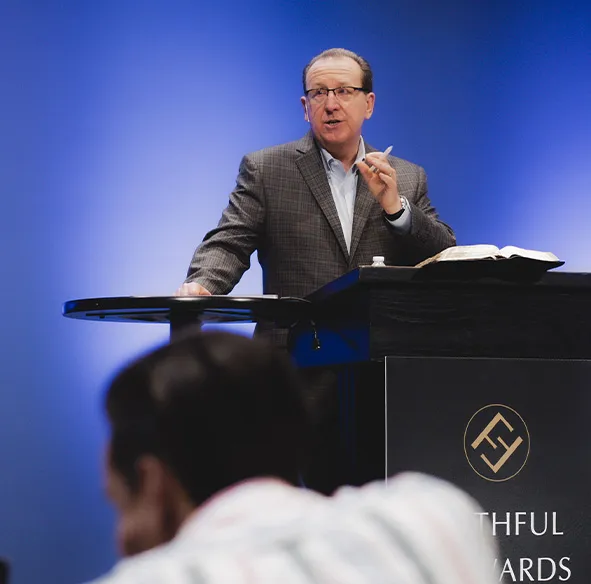
The preaching of God’s Word is central to the life of the church. Tom's pulpit ministry is dedicated to providing clear, biblical teaching to equip believers, strengthen faith, and exalt Christ.


Engage with the most recent teaching from God’s Word.
The preaching of God's Word is central to worship and of the utmost importance for the sanctification of every believer in Christ.

.jpg)
.jpg)

Explore messages organized to help you grow in Christ.
Search and filter sermons for quick access.
God's Standard of Sexual Purity
Pastor Tom Pennington's sermon on Ephesians 5:3-4 urges Christians to adopt God's standard of sexual purity, a topic often culturally avoided but directly addressed in Scripture. He argues that "walking as children of Light" (Ephesians 5:8) necessitates a life of moral and sexual purity, a lifelong battle made possible by God's grace and instruction. The first crucial strategy is embracing God's explicit standard against six sins, categorized into actions, thoughts, and speech. Sexual sins of action include "immorality" (Greek *porneia*, encompassing all illicit sexual intercourse like premarital sex, adultery, and homosexuality) and "impurity" (uncleanness, covering other perversions and misuses of sexuality). Sexual sins of thought, or "covetousness," refer to any sexual desire for someone other than one's spouse, including lustful looking, pornography, and craving relationships outside marriage. Finally, sexual sins of speech comprise "filthiness" (obscene talk), "silly talk" (crude sexual humor), and "coarse jesting" (witty sexual innuendo). These are forbidden because speech both reveals and directs the heart toward sin, and Paul insists there should "not even be a hint" of these among believers. Acknowledging our inability to perfectly meet this high standard, the sermon concludes by emphasizing the importance of justification.
No Chains He Cannot Break!
This sermon, "Peter No Chains He Cannot Break," based on Mark 5:1-20, asserts Jesus' power to free anyone from the deepest slavery to sin and Satan, even the most seemingly hopeless cases. The text describes Jesus' encounter with the demon-possessed man of the Gerasenes, a Gentile area. This man epitomized spiritual enslavement: dwelling among tombs, naked, self-harming, violent, and controlled by a "Legion" of demons. The demons, recognizing Jesus as the "Son of the Most High God," plead not to be tormented. Jesus casts them into a herd of 2,000 pigs, which then drown in the sea, demonstrating His supreme authority over evil. The miraculous deliverance elicits contrasting responses: the townspeople, fearing Jesus and lamenting their financial loss, demand He leave. However, the newly freed man, now sane and clothed, desires to follow Jesus. Instead, Jesus commissions him to return home and proclaim "what great things the Lord has done for you," transforming him into an evangelist for the Decapolis region. The sermon concludes by stressing the infinite value of human life, the international reach of the Gospel, and the priority of personal evangelism.
The Wind & Waves Still Obey Him
Pastor Tom Pennington introduces the biblical account of Jesus calming the storm (Mark 4:35-41) by reflecting on personal experiences with natural disasters, which instilled in him an awe of God's power. He recounts how Jesus intentionally led His disciples, experienced fishermen, into a violent storm on the Sea of Galilee. While the disciples feared for their lives, Jesus slept peacefully. Upon waking Him, they questioned His care, to which Jesus responded by rebuking the wind and sea, instantly bringing perfect calm. This left the disciples more terrified by Jesus' power than by the storm itself, prompting them to wonder, "Who then is this, that even the wind and the sea obey Him?" Pennington extracts five key principles from this narrative: all storms in life are part of Jesus' divine design; though we may doubt His care, Jesus is always present; He can calm any storm with a word, acting in His own time; storms test our faith; and we should fear (revere) Christ more than our circumstances. The story highlights Jesus' unique personhood as both fully human and divine, demonstrating His absolute sovereignty over all creation.
Free from the Slavery of Sexual Sin
Darwin's evolutionary theory, by positing man as merely an animal, profoundly shifted societal morality, replacing traditional ethics with a "new morality" focused on issues like environmentalism while dismissing sexual sin. Figures like Peter Singer, a bioethics professor, exemplify this, advocating extreme consensual behaviors, even bestiality, based on evolution's perceived refutation of man's divine image. Social Darwinians like Margaret Sanger and Alfred Kinsey actively advanced sexual liberation as a "scientific" ideology, portraying Christian morality as the enemy and the source of dysfunction. This agenda has normalized perversion, permeating even academic discourse. The sermon counters that God created humanity in His image, distinct from animals, gifting sexuality for His prescribed use, not perversion. Ephesians 5:3-14 calls Christians to shun immorality and walk as "children of Light" in moral purity, drawing parallels to the pagan culture of ancient Ephesus. Though formerly enslaved to sin (Ephesians 2), believers are now freed by Christ's power, given both the desire and capacity to fight sin's remaining influence and pursue holiness. God, who is able to do "infinitely beyond all that we can ask or imagine," empowers believers to achieve sexual purity.
The Great Theme of the Bible
The sermon asserts that comprehending the Bible requires identifying its unifying theme, much like any great book. This central message is most succinctly revealed in Jesus Christ's longest recorded prayer in John 17. The speaker proposes the Bible's great theme as: "God is rescuing a people by His Son, for His Son, to His own glory." "God" initiates this eternal plan. The phrase "is rescuing" highlights God as a continuous savior, delivering humanity from sin's penalty (salvation), its power (sanctification), and its eventual presence (glorification). "A people" denotes a specific, sovereignly chosen group, both Jewish and Gentile, whom God the Father gives to His Son. This rescue is achieved "by His Son," Jesus, who died as a substitute for these chosen individuals. The entire plan is "for His Son," as the rescued become a divine love gift to Christ, destined to reflect His glory eternally. Ultimately, this grand redemptive work unfolds "to His own glory," God's supreme purpose. Understanding this overarching theme provides comfort and assurance that God will complete His work, shaping every narrative and doctrine within the Scriptures.
The Mysterious Growth of God's Kingdom - Part 2
This sermon, "The Mysterious Growth of God�s Kingdom," analyzes Mark 4:26-34, using the British Empire's expansion as a worldly analogy for divine growth. It reviews the Parable of the Growing Seed, emphasizing the mysterious, God-driven, and slow process of the Gospel taking root in individual hearts, always leading to a certain harvest. The primary focus is the Parable of the Mustard Seed, where Jesus compares His kingdom to this proverbially tiny seed that grows into the largest of garden plants, providing extensive shade. This highlights the incredibly humble and seemingly insignificant beginnings of Jesus�s ministry�an itinerant rabbi with few followers in a backwater region�in stark contrast to its prophesied future. The "birds of the air" finding shelter allude to Old Testament prophecies of Messiah's kingdom expanding to bless and encompass all nations. Jesus shared this parable to reassure His disciples and future believers, acknowledging that while the kingdom has experienced fluctuations of growth and struggle throughout history, its ultimate success is not to be judged by temporary appearances. Referencing Daniel 2, the speaker affirms that Christ�s kingdom, like a stone, will ultimately crush all earthly powers and fill the entire world.
No Results Found.
We couldn’t find anything matching your search.
Explore The Word Unleashed
Our ministry brings together expository preaching, theological precision, and practical application for the good of Christ's church and the daily living of Christ's people.
.webp)
Sermons
Listen to expository sermons that clearly teach God’s Word and guide you in daily living.

Radio
Tune in to gospel-centered programs that share biblical truth and strengthen your daily walk with Christ.
Training
Join courses and workshops designed to deepen your faith and equip you to serve others with biblical wisdom.
.webp)
From the Pastor's Desk
Read pastoral messages that encourage, instruct, and help you apply God’s Word to every part of your life.
.webp)
Hymns
Discover timeless hymns that lift your heart in worship and remind you of God’s abounding grace and faithfulness.
Podcasts
Stay rooted in Scripture through our podcast series.