Sermons That Exalt Christ
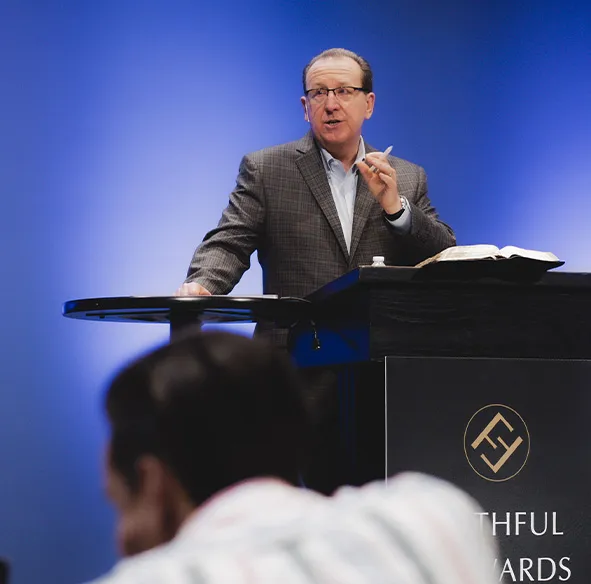
The preaching of God’s Word is central to the life of the church. Tom's pulpit ministry is dedicated to providing clear, biblical teaching to equip believers, strengthen faith, and exalt Christ.


Engage with the most recent teaching from God’s Word.
The preaching of God's Word is central to worship and of the utmost importance for the sanctification of every believer in Christ.

.jpg)
.jpg)

Explore messages organized to help you grow in Christ.
Search and filter sermons for quick access.
Five Hallmarks of a Biblical Church - Part 2
This sermon, "Five Hallmarks of a Biblical Church, Part 2," emphasizes the critical role of Scripture as the church's foundation. Pastor Tom Pennington uses the Leaning Tower of Pisa analogy, built on an unstable foundation, to illustrate how a church can collapse if not grounded in God's Word. He defines "hallmarks" as distinguishing marks of genuineness. Building on the first hallmark (a high view of God), this message focuses on the second: a high view of Scripture. Citing 1 Timothy 3:14-15, Pennington states the church is the "pillar and support of the truth," meaning it upholds and guards God's divinely revealed Word. He identifies four key qualities of Scripture, drawn from 2 Timothy 3:10-17: 1. **Inspiration**: All Scripture is "God-breathed," originating directly from God's mind, down to the very words. 2. **Relevancy**: It is eternally "profitable" and useful for all times, regardless of contemporary opinions. 3. **Sufficiency**: The Bible is fully "able to give you the wisdom that leads to salvation" and to equip believers for "every good work," requiring no supplemental resources. 4. **Authority**: It carries inherent divine authority, demanding proclamation, obedience, and diligent handling.
A Third Shocking Prediction
This sermon unpacks Jesus' third, most detailed prophecy of his impending death and resurrection, found in Mark 10:32-34. The text first establishes Jesus as a true prophet, capable of predicting future events both minor and grand. Just a week before Passover, Jesus, resolutely leading his disciples on the road to Jerusalem, reveals he will be delivered by God, condemned by chief priests and scribes, handed over to Gentiles, mocked, spit upon, scourged, killed, and rise on the third day. Despite this clarity, his disciples did not understand, their comprehension clouded by their own desires for an immediate political kingdom. The prophecy served multiple purposes: it was an apologetic for Jesus' authority, proving his claims through fulfilled prediction; it highlighted his death and resurrection as the central focus of his mission; and it was meant to strengthen the disciples' faith (and ours) by showing Jesus' complete sovereign control over every detail of his passion. Above all, this intentional act underscored Jesus' ultimate love, as he willingly and eagerly embraced his horrific fate, knowing it was the only way to give his life as a ransom for sinners.
Five Hallmarks of a Biblical Church - Part 1
In this sermon, Tom Pennington introduces a series on "Five Hallmarks of a Biblical Church," defining hallmarks as qualities indicating genuine biblical authenticity. Drawing from Paul's letters to Timothy and Titus, he emphasizes that the church's conduct matters to Christ, requiring adherence to God-given principles rather than human methodologies. The series aims to educate new members, unify existing ones, prevent theological drift, help identify sound churches, and establish a lasting legacy. The five foundational hallmarks are: a high view of God, a high view of Scripture, a biblical view of man, a biblical view of the church, and the central place of Christ and the Gospel. This sermon focuses on the first hallmark: "A High View of God." This entails understanding God's majesty, transcendence, and holiness�His unparalleled greatness and separateness, inspiring profound reverence and fear. A church with a high view of God demonstrates this through acknowledging His sovereignty in salvation, dedicating services to real, God-focused prayer, centering worship and sermons on Him, confronting sin, and ensuring everything, including its facilities, reflects His holiness. Individually, it means treating God and His word with respect, prioritizing prayer, studying the Bible to see God, and diligently addressing personal sin.
The First Will Be Last!
Pastor Tom Pennington's sermon examines Jesus' teaching on the benefits of discipleship and the principle of grace, primarily from Mark 10:28-31. After the rich young ruler declined to follow Jesus due to his wealth, Peter asks what disciples, who "left everything," will receive. Jesus promises profound benefits: a hundredfold in relationships and resources "in the present age" through the community of believers (though "along with persecutions"), and "eternal life in the age to come." While apostles have a specific role in Christ's millennial reign, all believers will ultimately reign with Him. Jesus then introduces the principle, "many who are first will be last, and the last, first," which is clarified by the Parable of the Laborers in the Vineyard. Here, a generous landowner pays all laborers, regardless of their hours worked, the same full day's wage. The parable illustrates that the *core benefits of salvation* are equally granted to all believers, irrespective of their length of service or effort. This emphasizes that salvation, and its attendant blessings, are entirely gifts of God's grace, not earned by human merit.
The Gospel According to Genesis
Pastor Tom Pennington�s sermon, "The Gospel According to Genesis," asserts that Jesus Christ is the central character of the Old Testament, from creation (as the Word) to every visible manifestation of God, a view supported by early church fathers. He highlights Genesis 3:15, the "proto-evangelium," as the earliest declaration of the Gospel, revealed immediately after Adam and Eve's sin. This pivotal verse prophesies a "perpetual war" between Satan's spiritual "seed" (those in rebellion) and the "seed of the woman" (Jesus Christ and His followers), an enmity evident from Cain and Abel onward. More significantly, it promises a "future Redeemer" who will "crush" Satan's head, dealing a decisive, debilitating blow to sin and the devil's power. This victory, ultimately achieved by Jesus at the cross, came with immense suffering, symbolized by Satan "bruising His heel." This suffering fulfilled God's eternal plan to redeem humanity, and its full realization is detailed in Revelation 20. Adam and Eve demonstrated faith in this promise by believing in the coming Redeemer, a response crucial for salvation.
The Book of Ephesians
Tom Pennington's sermon summarizes the Book of Ephesians as the "Grand Canyon of Scripture," revealing God's eternal plan of redemption. Paul wrote this "Prison Epistle" around AD 62, and its core message details God's relentless work in human history. The book divides into two parts: chapters 1-3 lay out foundational doctrine, explaining the roles of the Father (sovereign election), Son (atonement and teaching), and Spirit (sealing and application) in salvation. It describes humanity's move from spiritual death to life by grace for good works, emphasizing that the church, uniting all believers, is God's instrument for displaying His wisdom. Chapters 4-6 provide practical application, urging believers to "walk worthy" of their divine calling. This involves living in unity, sanctification (shedding the old self for the new through the Spirit's work and the Word), love, sexual purity, and biblical wisdom (allowing the Word to permeate and direct life, leading to thankfulness, worship, and submission). Pennington concludes by reminding listeners of spiritual warfare and emphasizing that our lives are ultimately part of God's grand purpose, calling us to study doctrine, pray for illumination, and purposefully live out these truths to serve God in our generation.
No Results Found.
We couldn’t find anything matching your search.
Explore The Word Unleashed
Our ministry brings together expository preaching, theological precision, and practical application for the good of Christ's church and the daily living of Christ's people.
.webp)
Sermons
Listen to expository sermons that clearly teach God’s Word and guide you in daily living.

Radio
Tune in to gospel-centered programs that share biblical truth and strengthen your daily walk with Christ.
Training
Join courses and workshops designed to deepen your faith and equip you to serve others with biblical wisdom.
.webp)
From the Pastor's Desk
Read pastoral messages that encourage, instruct, and help you apply God’s Word to every part of your life.
.webp)
Hymns
Discover timeless hymns that lift your heart in worship and remind you of God’s abounding grace and faithfulness.
Podcasts
Stay rooted in Scripture through our podcast series.