Sermons That Exalt Christ
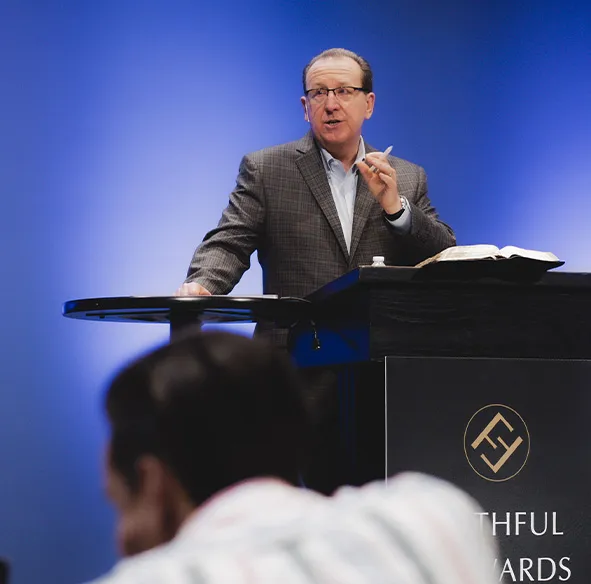
The preaching of God’s Word is central to the life of the church. Tom's pulpit ministry is dedicated to providing clear, biblical teaching to equip believers, strengthen faith, and exalt Christ.


Engage with the most recent teaching from God’s Word.
The preaching of God's Word is central to worship and of the utmost importance for the sanctification of every believer in Christ.

.jpg)
.jpg)

Explore messages organized to help you grow in Christ.
Search and filter sermons for quick access.
Bible Study for Every Christian (Part 2): Observation
Tom Pennington's "Bible Study for Every Christian Part 2: Observation (Part 1)" emphasizes diligent, accurate biblical study, rejecting allegorical methods in favor of understanding the author's original, singular meaning. He outlines six inductive Bible study steps, focusing this session on Observation (exegesis). This crucial step aims to discover what the original author intended to say by careful analysis. Key to observation is understanding context (historical setting and biblical flow) and content (syntax and words, explored later). Recommended tools include study Bibles, concordances, Bible dictionaries, and topical Bibles, with e-sword.net suggested for free software. The observation process begins by recalling the Bible's big picture: God redeeming a people. Then, choose an appropriate, short, New Testament book and research its background. Read the chosen book multiple times (5-30) in various translations. Identify paragraph and poetry section breaks, as these are the smallest units of unified thought for focused study. Finally, make detailed observations and ask comprehensive questions (Who, What, Where, When, Why, How) of each section. This rigorous, systematic approach, exemplified with Ephesians 2:7, encourages hard work to uncover the deep truths of God's Word, contrasting with a superficial, "fast food" desire for spiritual understanding.
Lies Christians Believe (Part 2): Redefining Morality
Pastor Tom Pennington's sermon, "Redefining Morality, Part 2," challenges the widespread belief, even among Christians, that there are no moral absolutes, but rather, morality is relative. This moral relativism, historically linked to philosophers like Pythagoras and modern evolutionary thought, asserts that right and wrong are subjective, changing with circumstances or individual opinion, and denies any action is intrinsically evil. Pennington argues this lie has severe consequences within the church, leading to the redefinition of sin as medical issues, the reinterpretation of biblical teachings to accommodate sinful behaviors like homosexuality, and the widespread toleration of sin, weakening church discipline and personal accountability. The sermon's biblical teaching affirms that God has revealed an objective, universal, and eternal moral law. This law is founded on God's holy character�His inherent moral purity and complete separateness from evil. God reveals this moral standard through humanity's conscience, the written Word (like the Ten Commandments), and perfectly through the person and life of Jesus Christ. This divine law is objective, applying to all people, cultures, and times, and remains eternal.
Lies Christians Believe (Part 1): No Place for Truth
Pastor Tom Pennington's sermon, "No Place for Truth, Part 1," addresses the cultural lie that "truth is relative," a dangerous idea increasingly permeating both society and the professing church. He notes how figures like George Will and Richard Stengel advocate "embracing uncertainty" and disparage those who claim absolute truth. Pennington traces this back to Post-Modern epistemology, which denies objective truth and universal meaning, in contrast to pre-modern and modern views where truth was considered knowable. This mindset, he argues, leads to lethal consequences within Christianity, such as viewing the Bible as a flexible "trajectory" or mere "narrative" rather than propositional truth. This allows for reinterpreting core doctrines (like women pastors or homosexuality) and promotes the idea that no theological issue is ever truly settled, undermining foundational beliefs. It also shifts emphasis from the mind to feelings, the Bible to experience, and preaching to discussion, fostering inclusivism over biblical exclusivity. In stark contrast, the Bible assumes and teaches that truth is objective, universal, eternal, and propositional, rooted in God's unchanging character and self-expression. Jesus Christ Himself declared, "I am the truth," validating the entirety of God's Word.
Bible Study for Every Christian (Part 1): Preparation
Pastor Tom Pennington introduces a series, "Bible Study for Every Christian," beginning with "Preparation." He tackles reasons Christians neglect Scripture, debunking myths that it's too difficult (emphasizing its perspicuity) or boring, and adding that many simply "don't know how." The series aims to teach inductive Bible study, promoting self-discovered knowledge over relying solely on experts. Pennington outlines nine biblical arguments for diligent study: it's a daily duty for all believers, a requirement for leaders, a consistent practice of God's people, a Christian's inherent desire, and a means for spiritual growth and sanctification, exemplified by Jesus's rebukes and the commended Bereans. The goals of Bible study extend beyond accumulating facts to truly understanding the text's original intent, knowing God relationally, and achieving spiritual benefits like protection from sin, personal holiness, and preparation for service. Prerequisites include being a Christian, confessing sin, praying for divine illumination, using a literal Bible translation (like NASB or ESV), and committing to hard work, as spiritual growth demands diligence. This comprehensive preparation ensures believers are equipped for transformative engagement with God's Word.
Your Mind: Conformed, or Transformed?
In his sermon "Lies Christians Believe Your Mind: Conformed, or Transformed?", Pastor Tom Pennington introduces a series on Christians' susceptibility to "spiritually lethal" lies, despite their knowledge of truth. He grounds his message in Romans 12:1-2, explaining these verses as a pivotal link between God's saving work (Romans 1-11) and the believer's grateful response (Romans 12-16). Verse 1 urges believers to present their bodies as a "living and holy sacrifice"�a logical, worshipful act in response to God's mercies. Verse 2, the sermon's core, commands, "Do not be conformed to this world, but be transformed by the renewing of your mind." The negative aspect warns against allowing our thinking to be molded by the "spirit of this age" (aion)�the prevailing, often Satan-inspired, groupthink, opinions, and philosophies bombarding us through culture, media, and social interactions. Pennington stresses that there are no truly independent thinkers; minds are shaped by either God's truth or Satan's worldly influences. The positive command calls for a "metamorphosis," a radical internal change in character, initiated by the Holy Spirit. This renewal occurs by saturating our minds with God's Word, replacing worldly thoughts with divine ones.
The Fig Tree & the Temple: Two Unforgettable Object Lessons - Part 2
Pastor Tom Pennington's sermon on Mark 11:11-18 explores two object lessons demonstrating Jesus's nature as both Lamb and Lion. The first, the cursing of a leafy but fruitless fig tree, symbolizes Israel's outward religiosity lacking genuine spiritual fruit. The second lesson focuses on Jesus's cleansing of the Temple. After detailing the Temple's history as God's designated house of prayer for all nations, the sermon describes Jesus's actions on Monday of Passion Week. He found the Court of the Gentiles, the only area where non-Jews could worship, overrun by an exploitative market. Money changers and animal sellers, profiting exorbitantly under the corrupt high priests, hindered true worship. Jesus forcefully drove them out, overturning tables and declaring, "My house shall be called a house of prayer for all the nations, but you have made it a robbers� den." This act conveyed four key lessons: the Temple was God's house, its primary purpose was worship and prayer for *all nations*, and the religious leaders were robbing the people. Despite fearing Jesus's popularity, the leaders immediately sought His destruction.
No Results Found.
We couldn’t find anything matching your search.
Explore The Word Unleashed
Our ministry brings together expository preaching, theological precision, and practical application for the good of Christ's church and the daily living of Christ's people.
.webp)
Sermons
Listen to expository sermons that clearly teach God’s Word and guide you in daily living.

Radio
Tune in to gospel-centered programs that share biblical truth and strengthen your daily walk with Christ.
Training
Join courses and workshops designed to deepen your faith and equip you to serve others with biblical wisdom.
.webp)
From the Pastor's Desk
Read pastoral messages that encourage, instruct, and help you apply God’s Word to every part of your life.
.webp)
Hymns
Discover timeless hymns that lift your heart in worship and remind you of God’s abounding grace and faithfulness.
Podcasts
Stay rooted in Scripture through our podcast series.