Sermons That Exalt Christ
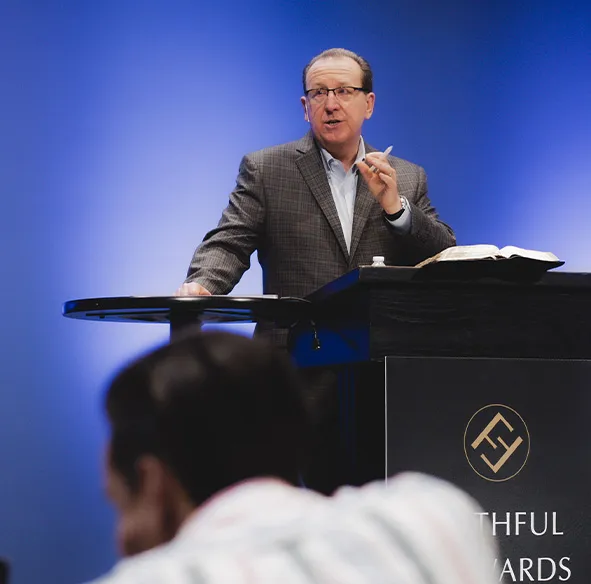
The preaching of God’s Word is central to the life of the church. Tom's pulpit ministry is dedicated to providing clear, biblical teaching to equip believers, strengthen faith, and exalt Christ.


Engage with the most recent teaching from God’s Word.
The preaching of God's Word is central to worship and of the utmost importance for the sanctification of every believer in Christ.

.jpg)
.jpg)

Explore messages organized to help you grow in Christ.
Search and filter sermons for quick access.
What Your View of Scripture Says About You - Part 2
In his sermon "What your View of Scripture Says About You (Part 2)" on Matthew 5:17-20, Tom Pennington argues that everyone's beliefs are built on a foundational authority. While many in contemporary culture construct "designer faiths" based on personal preferences, believers find their ultimate authority in Jesus Christ. Jesus authenticated the Old Testament and pre-authenticated the New Testament, instructing His disciples to share His high view of Scripture. According to Jesus in Matthew 5:18, Scripture holds permanent authority, being more enduring than heaven and earth itself. It is verbally inspired, meaning every word, down to the smallest letter or penstroke, is "God-breathed" and "letter perfect." Additionally, it is plenarily inspired, affirming that the entire Old Testament, including its historical and scientific claims, is divinely true and trustworthy. The implications for believers are profound: the Bible must be our ultimate, consistently relevant authority for every aspect of life. To reject Jesus's unwavering belief in Scripture implies He was either ignorant or dishonest, effectively elevating one's own judgment above Christ's. The sermon concludes by urging listeners to place their full trust in Jesus and His word, which reveals humanity's sin and God's salvation through faith in Christ.
The Future According to Jesus - Part 2
Tom Pennington introduces Jesus' Olivet Discourse (Mark 13) by affirming God's unique ability to declare the future, a characteristic distinguishing the true God from idols. Jesus, as God incarnate, likewise prophesies future events. The sermon, given to four disciples, addresses their questions about the temple's destruction, Christ's coming, and the end of the age, which they mistakenly believed would happen immediately and simultaneously. Jesus confirms the temple's destruction (fulfilled in 70 A.D., Luke 21:20-24) but provides a more complex timeline for His return. Pennington critiques various interpretations, dismissing full preterism as heresy and postmillennialism as incongruent with the text's description of worsening times. He advocates a premillennial view, interpreting Mark 13 in stages: verses 5-13 describe the period from Christ's ascension to the Tribulation's midpoint, characterized by increasing "birth pangs" (wars, famines, earthquakes, persecution) and gospel spread, which are *not* yet the end. Verses 14-23 detail the "Great Tribulation," a period of unparalleled global suffering. Verses 24-27 predict Jesus' visible, glorious Second Coming. Finally, verses 28-37 exhort believers to remain alert and prepared.
What Your View of Scripture Says About You - Part 1
This sermon initiates a new section of Jesus' Sermon on the Mount (Matthew 5:17-20), addressing disciples on "What Your View of Scripture Says About You." The pastor first outlines the Sermon on the Mount, then focuses on Jesus' statement: "Do not think that I came to abolish the Law or the Prophets; I did not come to abolish but to fulfill." "The Law and the Prophets" unequivocally refers to the Old Testament canon, settled as God's inspired word by 400 BC, distinct from the Apocrypha. Jesus commanded His disciples not to believe He came to demolish or invalidate these scriptures, an accusation often leveled against His followers. Rather, He came "to fulfill" the Old Testament. This fulfillment is understood in three ways: first, Jesus clarified its complete, spiritual meaning in His teaching, revealing the deeper intentions behind commands like "do not murder" (including anger) or "do not commit adultery" (including lust). Second, He perfectly obeyed God's law in His life, a righteousness credited to believers. Third, Jesus embodied its entire message, as all Old Testament prophecies, ceremonies, and systems pointed to Him and found their ultimate completion in His person.
The Future According to Jesus - Part 1
In "The Future According to Jesus, Part 1," Pastor Tom Pennington explores humanity's universal fascination with the future, focusing on Jesus' Olivet Discourse in Mark 13. The sermon unpacks the disciples' questions to Jesus after His prophecy of the temple's destruction: "When will these things be," "what will be the sign of Your coming," and "what will be the sign of the end of the age?" Pennington explains that first-century Jews, including the disciples, held a specific eschatological view. They did not anticipate a long gap between the Messiah's first and second comings, nor between the various end-time events. Instead, they expected the Messiah to appear once, triggering a rapid, "staccato" succession of predetermined events. This envisioned sequence included a period of great tribulation, the return of Elijah, Messiah's appearance, the defeat of hostile powers, the renovation of Israel, Jerusalem, and the temple, the gathering of dispersed Jews, the establishment of His global kingdom, a renovation of the entire world, a general resurrection, and a final judgment. Jesus' selective reading of Isaiah 61 in Nazareth, stopping before prophecies about His second coming, subtly highlighted this misunderstanding.
When Your World Is Shaken
Pastor Tom Pennington's sermon, "When Your World Is Shaken," based on Psalm 46:1-2, addresses how believers should respond to life's inevitable troubles. He explains that living in a fallen world means everyone will face trials, from natural disasters to personal illnesses like his wife's breast cancer diagnosis, or man-made conflicts. Psalm 46, an ancient song for public worship, provides a foundation of trust in God during these overwhelming circumstances. It reveals three profound truths about God: 1. **God is our refuge**, meaning He is our protective shelter from external dangers, an inaccessible place of safety. We make Him our refuge by actively trusting His providence and pouring out our hearts to Him. 2. **God is our strength**, not merely *giving* strength, but *being* our strength. He empowers us internally to endure through trials, exchanging our human weakness for His omnipotent power. 3. **God is our very present help**, instantly available and abundantly supportive when we feel helpless. "The Lord of hosts is with us." Because God is our refuge, strength, and ever-present help, believers "will not fear," even if the world seems to be collapsing around them.
The Power of Your Influence - Part 4
In a sermon on Matthew 5:13-16, "The Power of Your Influence," Pastor Tom Pennington explores the metaphors of Christians as "salt of the earth" and "light of the world." He identifies a significant historical drift in their interpretation, especially due to liberalism's "social gospel" and the "emergent church's" "missional" theology, which often prioritize humanitarian efforts and societal transformation over individual salvation and gospel proclamation. Pennington argues that good works are deeds performed by true Christians for God's glory, serving as evidence of genuine faith, not a means to salvation. While believers should embody Christ-like character and perform good works for all people (though primarily for fellow believers), these actions are never an end in themselves. Rather, they must function as a platform for sharing the gospel, guiding others to glorify God. He firmly states that the church's core mission is to "make disciples of all nations," not to solve all societal ills. Individual Christians are called to balance their character, good works, and gospel message, allowing all three aspects to shine collectively as light in the world.
No Results Found.
We couldn’t find anything matching your search.
Explore The Word Unleashed
Our ministry brings together expository preaching, theological precision, and practical application for the good of Christ's church and the daily living of Christ's people.
.webp)
Sermons
Listen to expository sermons that clearly teach God’s Word and guide you in daily living.

Radio
Tune in to gospel-centered programs that share biblical truth and strengthen your daily walk with Christ.
Training
Join courses and workshops designed to deepen your faith and equip you to serve others with biblical wisdom.
.webp)
From the Pastor's Desk
Read pastoral messages that encourage, instruct, and help you apply God’s Word to every part of your life.
.webp)
Hymns
Discover timeless hymns that lift your heart in worship and remind you of God’s abounding grace and faithfulness.
Podcasts
Stay rooted in Scripture through our podcast series.