Sermons That Exalt Christ
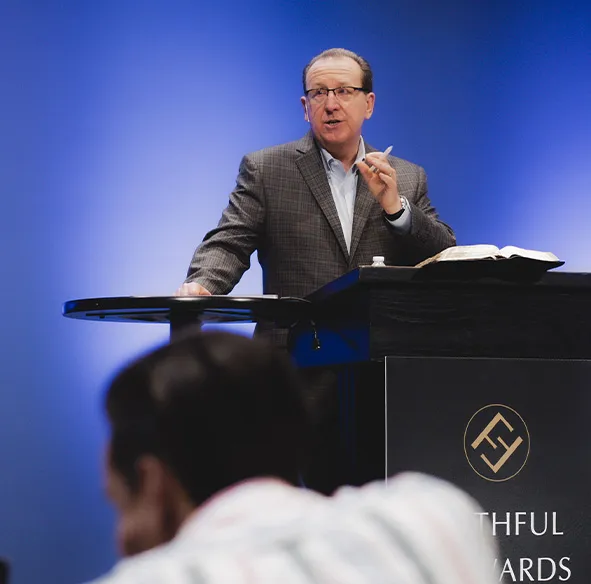
The preaching of God’s Word is central to the life of the church. Tom's pulpit ministry is dedicated to providing clear, biblical teaching to equip believers, strengthen faith, and exalt Christ.


Engage with the most recent teaching from God’s Word.
The preaching of God's Word is central to worship and of the utmost importance for the sanctification of every believer in Christ.

.jpg)
.jpg)

Explore messages organized to help you grow in Christ.
Search and filter sermons for quick access.
The Future According to Jesus - Part 5
The text, "The Future According To Jesus, Part 5," expounds on biblical prophecy regarding a future seven-year "tribulation" period when God's wrath will be poured out on Earth. The speaker emphasizes that the church (believers) will be raptured *before* this tribulation begins, though individuals saved during this time will be present, with Revelation supporting the church's absence from earth. The Olivet Discourse (Mark 13) structures this period into initial "birth pangs" (the first 3.5 years) and the "Great Tribulation" (the latter 3.5 years), where God's full fury is unleashed. The tribulation is initiated by the Antichrist making a seven-year covenant with Israel. At the midpoint, he will break this covenant, stop temple sacrifices, and commit the "Abomination of Desolation" in a rebuilt temple, as prophesied in Daniel's 70-week prophecy, where the "70th week" represents this future seven-year period. The sermon concludes by urging believers to remain alert and share the gospel, while warning non-believers to seek salvation in Jesus Christ as the only refuge from the impending judgment.
The Future According to Jesus - Part 4
This sermon, part of "The Future According To Jesus," unpacks Mark 13:3-37, addressing widespread societal dread about the world's end in contrast to Jesus' clear prophecies. Pastor Tom Pennington explains Jesus' sermon structure: the beginning of birth pangs, the Great Tribulation, the Second Coming, and an exhortation to be alert. The sermon focuses on the "beginning of birth pangs" (Mark 13:5-13), a period from Jesus' life to the mid-Tribulation, marked by events increasing in intensity and frequency. These include false Christs, wars, natural disasters, and intense persecution. Persecution will originate from false religion (e.g., flogging in synagogues), secular authorities (standing before governors), and even intimate personal relationships, where family members betray believers due to spiritual loyalties. Jesus assures followers the Holy Spirit will empower them to speak when facing arrest. Crucially, the gospel must be preached to all nations before the end, its global advancement unstoppable by persecution, a promise exemplified by early church history and Revelation's end-time events. Believers are promised salvation for enduring to the end.
What Your View of Scripture Says About You - Part 5
This sermon, based on Matthew 5:17-20, emphasizes that one's relationship to Scripture accurately diagnoses their spiritual condition. Jesus affirmed the Old Testament's divine authority, inspiration, and inerrancy, stating He came to fulfill it, not abolish it. He describes three types of disciples based on their response to God's word. Dishonorable disciples, while in the kingdom, minimize commands. Honorable disciples uphold and teach them. Critically, Jesus declares that one will not enter the kingdom of heaven unless their righteousness surpasses that of the scribes and Pharisees. The righteousness of the scribes and Pharisees was fatally flawed; it was self-righteous, relying on human effort, and merely external, self-centered, and incomplete. To surpass this, one needs *true righteousness*, which is a gift from God, not achieved through works. This true righteousness originates from two divine acts: **regeneration**�God giving a new heart that desires and enables internal obedience�and **justification**�God declaring a sinner righteous through faith. This transformation, like the repentant tax collector, involves humbling oneself, acknowledging spiritual bankruptcy, and crying out for God's mercy. This genuine, God-given righteousness, characterized by internal, radical obedience for God's glory, is the hallmark of those truly belonging to His kingdom, distinguishing them from false disciples.
The Future According to Jesus - Part 3
Pastor Tom Pennington teaches from Mark 13, Jesus' longest sermon on the future, delivered to four disciples on the Mount of Olives. Jesus answered questions about the temple's destruction, His coming, and the end of the age. Pennington refutes the view that Mark 13 was fulfilled in 70 A.D., citing its description of unparalleled tribulation, extreme celestial signs, and immediate follow-up by Christ's Second Coming�events not seen then. Focusing on Mark 13:5-13, "the beginning of birth pangs," Pennington explains this period extends from Christ's ascension to the midpoint of a future seven-year tribulation. Jesus uses the analogy of birth pangs: false Christs, wars, and natural disasters (earthquakes, famines, plagues) will occur throughout history with increasing frequency and intensity. However, Jesus labels these as "Braxton Hicks" contractions, not the actual start of the end, and not definitive markers for predicting the exact timing of Christ's return. The sermon concludes by urging listeners not to be surprised, afraid, or deceived by these ongoing global events, as God remains sovereign. Instead, it calls for spiritual preparedness, encouraging repentance and faith in Jesus Christ before the prophesied end-time events unfold.
What Your View of Scripture Says About You - Part 4
The sermon "What Your View of Scripture Says About You (Part 4)," based on Matthew 5:17-20, asserts that one's relationship with Scripture is a vital spiritual diagnostic tool. Pastor Tom Pennington explains that Jesus came not to abolish but to fulfill the Law and Prophets, affirming the Old Testament's permanent authority, inspiration, inerrancy, and preservation. The text outlines two types of true believers, distinguished by their regard for scripture, determining their status in the future kingdom. The "dishonorable disciple" minimizes or disregards even the "least" commandments, and influences others to do so, without Christ's or the apostles' authorization. This doesn't mean adhering to ceremonial or civil laws, which were fulfilled or transferred, but rather dismissing moral laws or any scriptural portion without divine warrant. Such a Christian, though saved, will be deemed "least." Conversely, the "honorable disciple" keeps and teaches all scripture, personally obeying and exalting God's word in every aspect. This believer will be called "great." Downplaying scripture can involve replacing it with other authorities, prioritizing personal experience, neglecting it for leisure, or re-interpreting it to align with cultural ideas.
What Your View of Scripture Says About You - Part 3
This sermon emphasizes Jesus' profoundly high view of scripture, contrasting it with modern "low views" exemplified by figures like Rob Bell, who perceive the Bible as a fallible human product, leading to skepticism about core Christian doctrines. Pastor Tom Pennington asserts that Jesus unequivocally affirmed the Old Testament as God's inspired, inerrant word and pre-authenticated the New Testament writers. Focusing on Matthew 5:17-18, the sermon explains Jesus did not abolish the Law and Prophets but fulfilled them by revealing their true meaning, perfectly obeying them, and embodying their message. Jesus affirmed scripture's permanent authority, verbal and plenary inspiration, and complete inerrancy, stating that not the smallest letter or stroke would pass away until all is accomplished. This means scripture is entirely true, trustworthy, and free from error, a belief consistently held by the church historically and supported by scripture's self-claims and Jesus' own words. The remarkable preservation of biblical manuscripts further confirms its reliability. Ultimately, if believers share Jesus' high view, they will actively read, memorize, study, obey, and teach the Bible, recognizing its absolute authority, because Jesus, "the way, the truth, and the life," had absolute confidence in it.
No Results Found.
We couldn’t find anything matching your search.
Explore The Word Unleashed
Our ministry brings together expository preaching, theological precision, and practical application for the good of Christ's church and the daily living of Christ's people.
.webp)
Sermons
Listen to expository sermons that clearly teach God’s Word and guide you in daily living.

Radio
Tune in to gospel-centered programs that share biblical truth and strengthen your daily walk with Christ.
Training
Join courses and workshops designed to deepen your faith and equip you to serve others with biblical wisdom.
.webp)
From the Pastor's Desk
Read pastoral messages that encourage, instruct, and help you apply God’s Word to every part of your life.
.webp)
Hymns
Discover timeless hymns that lift your heart in worship and remind you of God’s abounding grace and faithfulness.
Podcasts
Stay rooted in Scripture through our podcast series.