Sermons That Exalt Christ
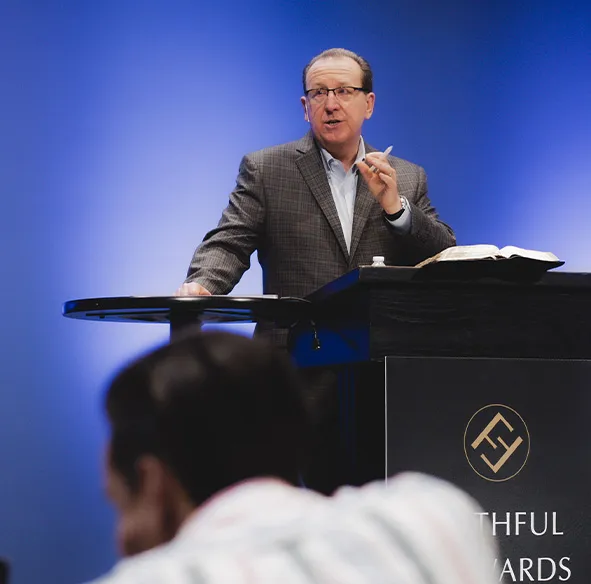
The preaching of God’s Word is central to the life of the church. Tom's pulpit ministry is dedicated to providing clear, biblical teaching to equip believers, strengthen faith, and exalt Christ.


Engage with the most recent teaching from God’s Word.
The preaching of God's Word is central to worship and of the utmost importance for the sanctification of every believer in Christ.

.jpg)
.jpg)

Explore messages organized to help you grow in Christ.
Search and filter sermons for quick access.
Portraits of Grace
The sermon "Portraits of Grace" asserts that humanity's greatest need is forgiveness from God, not from fellow humans. As our Creator and rightful King, God demands perfect obedience, but all have rebelled through sin, accumulating real, legal guilt before an omniscient and omnipresent God who records every infraction. Since God's throne is founded on perfect justice, He cannot simply overlook sin; the penalty must be paid. God's loving and costly solution is His Son, Jesus Christ, who came to live the perfect life we could not and die the punitive death we deserved. Colossians 2:13-14 illustrates this profound forgiveness through three portraits. It is a "king's pardon," where God graciously pardons our acts of rebellion because Christ justly bore the penalty as our substitute. It is a "canceled debt," where our massive, unpayable sin-debt is completely wiped away and obliterated because Christ's perfect obedience fulfilled all demands. Finally, it is a "criminal's substitute," where God nailed the comprehensive record of our sins to the cross, pouring out His just wrath on the innocent Christ instead of on us. For those who repent and believe in Jesus, this amazing grace means all sins are completely forgiven, leaving no condemnation.
An Eye for an Eye - Part 2
In this sermon on Matthew 5:38-42, Tom Pennington explains Jesus' teaching on personal retaliation. He clarifies that the Old Testament law of "an eye for an eye" was not a license for personal revenge, but a legal principle for judges to ensure punishment fit the crime. The scribes and Pharisees, however, had twisted this concept to justify personal vengeance when wronged. Jesus corrects this misunderstanding, commanding his followers not to harbor grudges or seek revenge. The instruction to "turn the other cheek" is not a call for absolute pacifism or a ban on self-defense, but a specific response to personal insults that attack one's dignity. Instead of retaliating in kind, believers should be willing to endure further offense. This is made possible by following the example of Christ, who did not revile when he was reviled, but entrusted himself to God as the righteous judge. The central principle for Christians is to forsake personal revenge, overcome evil with good, and leave all final judgment to God.
The Illegal Arrest of Jesus of Nazareth - Part 1
Pastor Tom Pennington's sermon "The Illegal Arrest of Jesus of Nazareth" (Mark 14:43-52) details the events in the Garden of Gethsemane on Thursday night of Passion Week. After Jesus�s prayer, Judas, one of the twelve, arrived with a large crowd comprising temple police, Sanhedrin members, and hundreds of Roman soldiers. This diverse group, assembled due to fear of a riot, illustrates humanity's universal rebellion against God. Judas used a pre-arranged kiss as a signal to identify Jesus, betraying Him with wicked precision. His actions serve as a stark example of a "false disciple" driven by greed and unfulfilled expectations. Jesus, aware of Judas�s intent, responded with tender compassion, even calling him "friend" and urging him toward repentance. Significantly, Jesus protected his true disciples. When the arresting party approached, Jesus identified himself and explicitly asked them to let his followers go, fulfilling scripture and demonstrating His unwavering care and preservation of His own. This act, where the multitude fell back at Jesus's divine "I AM," assures believers that Jesus always protects their faith, even in His darkest hour.
An Eye for an Eye - Part 1
Tom Pennington's sermon "An Eye for an Eye (Part 1)" from Matthew 5:38-42 addresses the pervasive human tendency to harbor grudges and seek personal revenge. He asserts that Jesus's disciples, as citizens of His spiritual kingdom, must abandon all supposed rights to personal retaliation, as grudges and revenge have no place in God's kingdom. Pennington clarifies the Old Testament meaning of "an eye for an eye" (lex talionis). This principle, found in Exodus, Leviticus, and Deuteronomy, was a foundational legal standard for Israel's civil courts. It ensured punishments fit crimes while *restraining* personal vengeance, often implying monetary compensation rather than literal physical injury. The scribes, however, distorted this judicial law, twisting it into a divine authorization for individuals to seek personal revenge, contrary to other Old Testament commands against vengeance. The sermon applies this understanding in three ways. First, Christians must advocate for legal systems where punishments justly fit the crime. Second, non-Christians should recognize that God's perfect justice means their eternal punishment will precisely fit their rebellion, urging them to seek refuge in Christ's grace.
Radical Truthfulness - Part 2
Pastor Tom Pennington's sermon "Radical Truthfulness (Part 2)" from Matthew 5:33-37 addresses Jesus's call for absolute honesty, contrasting it with the prevalent lying in society. Pennington clarifies that Jesus is not forbidding all oaths, such as legal oaths, vows to God, or solemn affirmations, citing Old Testament practices, Jesus's own testimony under oath, and Paul's actions. Instead, Jesus corrects the scribes' flawed interpretation, which had trivialized oaths. Jesus's first command, "make no oath at all," teaches that all vows are solemn and made before God, regardless of what one swears by (heaven, earth, Jerusalem, or one's head). Therefore, oaths must not be made frivolously or frequently, as all are binding. The second command, "let your statement be, 'Yes, yes' or 'No, no'," demands that disciples be so inherently truthful that their simple word is always sufficient, making oaths unnecessary. Jesus explains that anything beyond this radical truthfulness "is of evil," originating from Satan, the "father of lies." Achieving radical truthfulness requires ceasing to justify lies and confronting the underlying motives, such as self-protection, pride, or hiding guilt.
Gethsemane! - Part 2
Pastor Tom Pennington's sermon "Gethsemane! (Part 2)" explores Jesus' teaching on confronting temptation, an unavoidable reality of life. Even in His deepest agony, Jesus instructed His disciples how to resist succumbing to sin, serving as a pattern for believers. The central command from Mark 14:38 is to "Keep watching and praying that you may not come into temptation." This means enduring temptation without giving in, not its complete removal. "Keeping watching" requires spiritual alertness to danger. Believers must identify personal and common seasons of susceptibility�like unfulfilled expectations, downtime, or peer pressure�and anticipate when temptation is likely to strike. Jesus modeled this awareness Himself. "Keeping praying" means acknowledging complete dependence on God. Jesus' Gethsemane prayer provides the model: reaffirming trust in the Father's love ("Abba! Father!") and power ("All things are possible for You"), asking for intervention, yet submitting completely to God's will ("not what I will, but what You will"). Prayer's purpose is to align our will with His. These instructions are vital because "the spirit is willing, but the flesh is weak." Our redeemed spirit desires obedience, but our unredeemed flesh leans towards sin. Relying on self-strength inevitably leads to failure.
No Results Found.
We couldn’t find anything matching your search.
Explore The Word Unleashed
Our ministry brings together expository preaching, theological precision, and practical application for the good of Christ's church and the daily living of Christ's people.
.webp)
Sermons
Listen to expository sermons that clearly teach God’s Word and guide you in daily living.

Radio
Tune in to gospel-centered programs that share biblical truth and strengthen your daily walk with Christ.
Training
Join courses and workshops designed to deepen your faith and equip you to serve others with biblical wisdom.
.webp)
From the Pastor's Desk
Read pastoral messages that encourage, instruct, and help you apply God’s Word to every part of your life.
.webp)
Hymns
Discover timeless hymns that lift your heart in worship and remind you of God’s abounding grace and faithfulness.

Podcasts
Stay rooted in Scripture through our podcast series.