Sermons That Exalt Christ
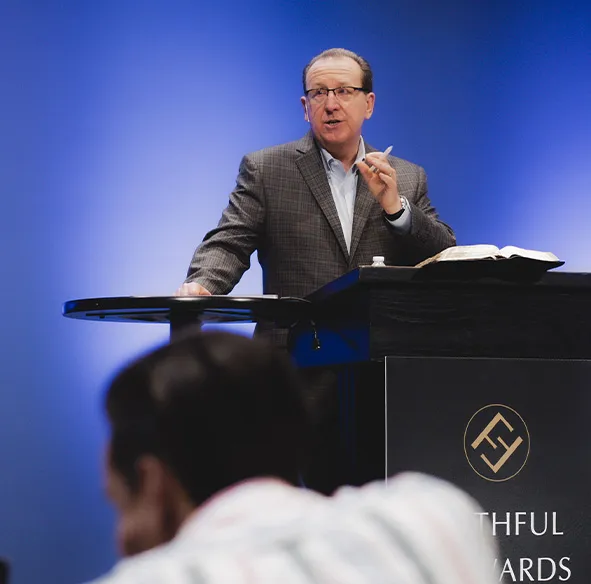
The preaching of God’s Word is central to the life of the church. Tom's pulpit ministry is dedicated to providing clear, biblical teaching to equip believers, strengthen faith, and exalt Christ.


Engage with the most recent teaching from God’s Word.
The preaching of God's Word is central to worship and of the utmost importance for the sanctification of every believer in Christ.

.jpg)
.jpg)

Explore messages organized to help you grow in Christ.
Search and filter sermons for quick access.
The Wrath of God
This sermon, "The Wrath of God," unpacks Romans 1:18, addressing a challenging but essential biblical truth often denied or downplayed in contemporary society. The speaker clarifies that God's wrath is not like fickle human anger, but rather His "settled opposition to evil," a righteous and necessary reaction stemming from His holy and just nature. This divine displeasure is provoked when humanity refuses to honor God, disobeys His commands, or despises the love and grace offered through the gospel. Paul's strategy in Romans begins by revealing God's wrath to underscore humanity's universal need for the gospel's righteousness. This wrath is pervasively evident throughout Scripture, from the consequences of the first sin to the Flood, the destruction of Sodom, and New Testament warnings from John the Baptist, Jesus, and the Apostles, culminating in the "wrath of the Lamb" in Revelation. The proper response to this impending judgment is to flee to Jesus Christ, who, through His propitiatory death, absorbed God's wrath, offering the only refuge. For believers, understanding God's wrath leads to a deeper fear of Him, the relinquishing of personal vengeance, and a profound praise for His unblemished moral purity and unwavering justice.
The Keynote of Romans - Part 3
The provided text delves into Romans 1:16-17, highlighting the gospel's power and its promise of righteousness. It recounts Martin Luther's pivotal experience on Rome's Scala Santa in 1510, where the words "The righteous shall live by faith" challenged the tradition of earning salvation through works. This realization, foundational to the Protestant Reformation, underscores the doctrine of justification by faith alone. The sermon distinguishes between two types of righteousness: the "wrong" inherent righteousness, which is human-achieved and insufficient for God's perfect standard, and the "right" imputed righteousness, which is God's gift received by faith. Justification, a legal concept, involves God making two accounting transactions: crediting our sins to Christ, who paid their penalty, and crediting Christ's perfect righteousness to us, as if we had lived His sinless life. Based on this "magnificent exchange," God makes the legal decision to declare us forgiven and righteous before His law. This righteousness is received "from faith to faith," emphasizing that salvation has always been, and remains, solely by faith, providing freedom from condemnation and an impetus for holy living.
The Keynote of Romans - Part 2
The text centers on Romans 1:16-17, presenting it as the pivotal scripture that transformed Martin Luther's life and ignited the Reformation. Luther, initially a law student, became a monk driven by a deep spiritual crisis and fear of God's judgment, despite exemplary monastic efforts. His relentless confessions and spiritual exercises brought no peace, leading him to "hate" God's righteousness, which he understood as divine punitive justice. Under the guidance of his superior, John Staupitz, Luther began studying scripture. His breakthrough came while lecturing on Romans, realizing that the "righteousness of God" revealed in the gospel is not God's righteous judgment against sinners, but rather His gracious gift of righteousness, imputed to those who live by faith. This discovery brought him profound peace and a sense of being "born again." The sermon then outlines five reasons Christians should never be ashamed of the gospel: 1. **It is God's power:** The Holy Spirit works powerfully through it. 2. **It produces salvation:** It offers spiritual rescue from God's wrath, moral pollution, and eternal death. 3. **It requires no human work or merit:** Salvation is "to everyone who believes," contrasting faith with human effort.
The Keynote of Romans - Part 1
The text, focusing on Romans 1:16-17, explores why the Apostle Paul was "not ashamed of the gospel" despite it being widely scorned and ridiculed throughout history. The speaker highlights that the gospel's message�accusing all humanity of deep sin, identifying a crucified carpenter as God's Son and Savior, and offering radical transformation through faith in Him�is inherently offensive to human pride and wisdom. In the honor-shame culture of the first century, the cross was a symbol of ultimate public humiliation, making Paul's stance particularly defiant. Paul's lack of shame stems from two core truths revealed in these verses. Firstly, the gospel is "the power of God." Unlike worldly power that destroys, the gospel is God's rescuing power, working through the Holy Spirit to bring spiritually dead hearts to life and call sinners to Himself. Secondly, it "produces salvation." This salvation is a comprehensive spiritual rescue, delivering believers from objective guilt to righteousness, moral corruption to holiness, God's wrath to His love, alienation to fellowship, slavery to sin to freedom, and eternal death to eternal life. It encompasses justification (past), sanctification (present), and glorification (future).
Committing to Christian Relationships - Part 4
Pastor Tom Pennington's sermon, "Committing to Christian Relationships (Part 4)," drawn from Romans 1:8-15, underscores the vital importance of unwavering commitment among believers, a quality often lacking in modern society, illustrated by B.B. Warfield's lifelong devotion to his paralyzed wife. Pennington identifies eight commitments Paul modeled for the Roman Christians, encouraging the congregation to adopt them. Building on five previously discussed commitments (thanking God, consistent prayer, enjoying fellowship, promoting spiritual growth, and pursuing mutual benefits), the sermon delves into the final three. First, believers are called to **use their giftedness to serve others**, recognizing that the Holy Spirit equips every Christian for service within the body, not just the leadership. Neglecting this calling constitutes spiritual disobedience. Second, Christians must **receive all fellow believers, even those unlike them**. Paul's dedication to all Gentiles, irrespective of their cultural, educational, or social standing, mirrors God's impartiality. Believers are urged to look beyond superficial external factors like appearance, race, or wealth, acknowledging that all are equally valued in Christ. Lastly, we must **keep the gospel the main thing**.
Green Pastures and Quiet Water
Psalm 23, penned by King David, presents God as our Shepherd King, a metaphor emphasizing His unwavering care for believers, His sheep. The central affirmation, "The LORD is my shepherd, I shall not want," signifies that God, who is Yahweh (the self-sufficient, gracious One) and ultimately Jesus Christ, will never lack the means or desire to meet our every need. This contrasts sharply with negligent "hireling" shepherds, highlighting God's personal, deliberate provision. His care is vividly illustrated by leading sheep to "green pastures" for abundant nourishment and "quiet waters" for serene refreshment. This isn't a promise of wealth or freedom from all deprivation; rather, it assures that God will supply what is *best* for us, even allowing lean times for spiritual growth, as He did for Israel in the wilderness or Paul in his ministry. God's provision is comprehensive (physical and spiritual), consistent, abundant, appropriate, and eternal, extending beyond this life into eternity, where He promises no more hunger, thirst, or tears. Believers can trust their Shepherd King to provide everything they truly need, making what He gives satisfy.
No Results Found.
We couldn’t find anything matching your search.
Explore The Word Unleashed
Our ministry brings together expository preaching, theological precision, and practical application for the good of Christ's church and the daily living of Christ's people.
.webp)
Sermons
Listen to expository sermons that clearly teach God’s Word and guide you in daily living.

Radio
Tune in to gospel-centered programs that share biblical truth and strengthen your daily walk with Christ.
Training
Join courses and workshops designed to deepen your faith and equip you to serve others with biblical wisdom.
.webp)
From the Pastor's Desk
Read pastoral messages that encourage, instruct, and help you apply God’s Word to every part of your life.
.webp)
Hymns
Discover timeless hymns that lift your heart in worship and remind you of God’s abounding grace and faithfulness.

Podcasts
Stay rooted in Scripture through our podcast series.