Sermons That Exalt Christ
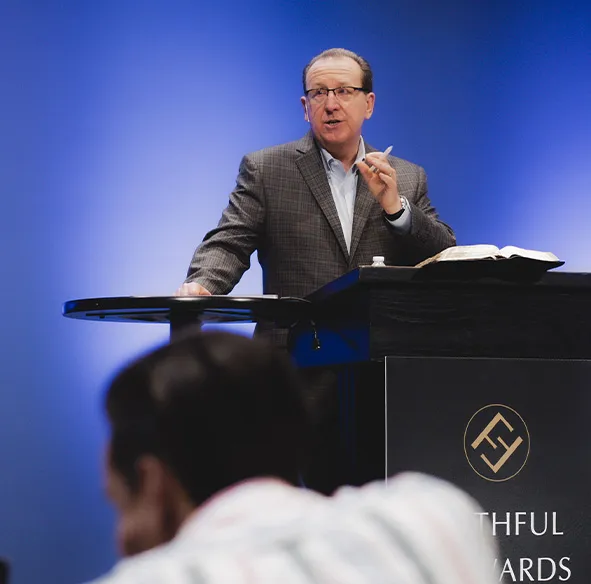
The preaching of God’s Word is central to the life of the church. Tom's pulpit ministry is dedicated to providing clear, biblical teaching to equip believers, strengthen faith, and exalt Christ.


Engage with the most recent teaching from God’s Word.
The preaching of God's Word is central to worship and of the utmost importance for the sanctification of every believer in Christ.

.jpg)
.jpg)

Explore messages organized to help you grow in Christ.
Search and filter sermons for quick access.
We Have Been Justified
In his sermon "We Have Been Justified," Tom Pennington highlights justification as a foundational, yet often forgotten, truth essential for spiritual assurance and central to the gospel. Focusing on Isaiah 53:11, Pennington outlines four core truths. First, **the Servant (Jesus Christ) accomplishes it**, providing the only divine means of salvation, contrasting with all other religions' emphasis on human achievement. Second, **a righteous judge (God) declares it**, resolving the paradox of God declaring sinful people righteous. This is made possible through the third truth: **imputation enables it**. This "double imputation" means our sins are credited to Christ, who bore God's wrath on the cross, and Christ's perfect righteousness is credited to us, treating us as if we had perfectly obeyed God's law (Solus Christus). Finally, **faith receives it**; justification is a gift received solely through faith in Christ, not by works. Pennington concludes by urging the unsaved to embrace this gift and believers to live in the joy and motivating power of their justified standing, understanding that in Christ, there is no condemnation.
Jesus is Lord
The sermon "Jesus Is Lord" argues that the church needs a "Copernican revolution" to recognize Jesus Christ as the absolute center and Lord of everything, a truth often forgotten despite humanity's natural resistance to being ruled. Biblical scriptures consistently affirm Jesus' lordship from His birth to the end of Revelation. The Greek word "kurios" defines Jesus as our rightful owner, ultimate authority, and Master, to whom believers are His "doulos," or slaves. Two primary implications emerge. First, confessing Jesus as Lord is essential for salvation. Romans 10:9-10 mandates believing in the heart that God raised Him from the dead and publicly declaring "Jesus as Lord." This confession isn't just words but a sincere surrender of one's will to His mastership, a point often overlooked by weak gospel presentations that separate belief from submission. Second, obeying Jesus as Lord is a necessary *consequence* of salvation. True confession leads to a life of submission and a genuine pattern of obedience, demonstrating the reality of one's faith. Jesus warned against calling Him "Lord" while failing to do His will, equating such a profession to building a house without a foundation.
We Are In Christ
Tom Pennington's sermon, "Hold Fast We Are In Christ," explores the profound and uniquely Christian concept of "union with Christ," a central yet often forgotten truth. This isn't a natural, mystical, or merely denominational union, but an intimate, vital spiritual bond initiated by God's sovereign act at salvation through the baptism of the Holy Spirit, immersing believers "into Christ." This union bestows four key benefits: Christ's continual presence, a special intimate relationship (likened to marriage), Christ as our personal representative (where God credits us with His perfect life, death, and resurrection), and a vital, life-giving connection (like a vine to its branches). "In Christ" is the source of all spiritual blessings�from grace and justification to sanctification, eternal life, and security�encompassing a believer's entire redemption from election to glorification. Practically, understanding this union provides gospel assurance, promotes sanctification, empowers overcoming sin, and inspires profound praise, fundamentally transforming one's life.
God Is Sovereign in Salvation
This sermon emphasizes God's absolute sovereignty in salvation, arguing that He orchestrates every aspect of a person's rescue from sin. The speaker refutes the common misconception of sinners merely needing a "life preserver" to grab, instead illustrating them as spiritually dead, unwilling, and unable to contribute to their own rescue. The sermon presents six affirmations of God's sovereignty: He planned salvation in eternity past through unconditional election, accomplished it at the cross through Christ's atoning sacrifice, initiated it in time via an "effectual call" that irresistibly draws individuals, accomplished it at conversion by miraculously regenerating the spiritually dead, is working it out throughout this life by enabling sanctification, and will complete it in future glorification. This foundational truth demands a specific response: unbelievers must humble themselves as beggars before God, crying out for mercy; believers are called to overflowing gratitude and praise; and all are encouraged in evangelism and prayer, trusting that God uses the gospel message to draw His chosen to Himself. Ultimately, God's sovereignty in salvation from beginning to end is a profound source of comfort and assurance for believers.
God Is Sovereign
In the sermon "God Is Sovereign," Tom Pennington addresses the often-forgotten truth of God's absolute sovereignty and active providence, contrasting it with worldly philosophies like naturalism, fatalism, chance, and self-determinism. He defines sovereignty as God's inherent nature to rule and providence as the active outworking of this sovereignty in every detail of life. God not only preserves all He created but also governs everything to fulfill His eternal plan: redeeming the elect, exalting Christ, and glorifying Himself. Pennington explains that God's intricate control extends to the physical world (weather, nature), the affairs of nations (rulers, history), seemingly accidental events (like a king's insomnia or an arrow's flight), and individual lives�including birth, successes, failures, and even sinful actions. He clarifies that God is not the source of evil but prevents, permits, limits, and directs sin toward His ultimate good, exemplified by Joseph's story. While human free will and natural laws exist, God superintends these secondary causes to guarantee His will.
The Bible Has One Message
Pastor Tom Pennington argues that the Bible, like any great book, possesses one unifying message, a "forgotten truth" often missed by Christians and pastors who treat it as a collection of random self-help verses. He guides listeners to John 17, Jesus' longest recorded prayer, as the key to understanding this central theme. From this prayer, the Bible's overarching message is revealed: "God is redeeming a people, by His Son, for His Son, to His Own glory." Breaking this theme down, "God" initiated this eternal plan of redemption, with Jesus, who is God, executing it. "Redeeming" signifies a continuous process: salvation from sin's penalty, sanctification from its power through God's Word, and future glorification from its presence. This rescue is for "a people," a specific group chosen by God, evident in their willingness to believe and repent. This is accomplished "by His Son," Jesus, who died on the cross to absorb God's just wrath against sin. Ultimately, this redemptive plan is "for His Son," as redeemed humanity is the Father's gift to Christ, designed to reflect His glory. The supreme purpose behind this entire endeavor is "to His Own glory.
No Results Found.
We couldn’t find anything matching your search.
Explore The Word Unleashed
Our ministry brings together expository preaching, theological precision, and practical application for the good of Christ's church and the daily living of Christ's people.
.webp)
Sermons
Listen to expository sermons that clearly teach God’s Word and guide you in daily living.

Radio
Tune in to gospel-centered programs that share biblical truth and strengthen your daily walk with Christ.
Training
Join courses and workshops designed to deepen your faith and equip you to serve others with biblical wisdom.
.webp)
From the Pastor's Desk
Read pastoral messages that encourage, instruct, and help you apply God’s Word to every part of your life.
.webp)
Hymns
Discover timeless hymns that lift your heart in worship and remind you of God’s abounding grace and faithfulness.

Podcasts
Stay rooted in Scripture through our podcast series.