Sermons That Exalt Christ
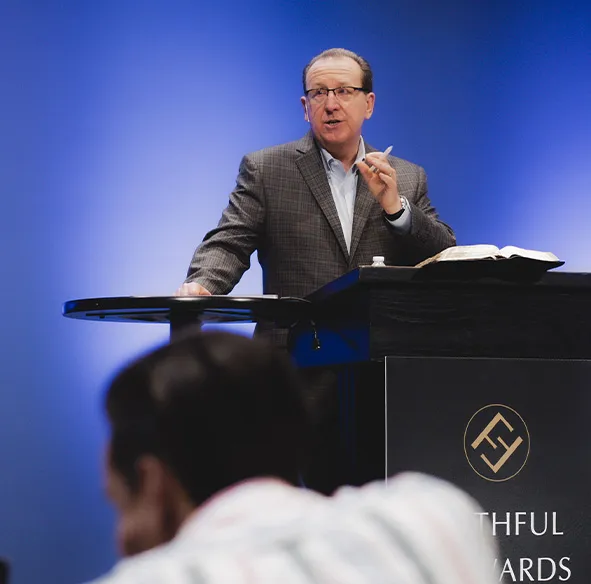
The preaching of God’s Word is central to the life of the church. Tom's pulpit ministry is dedicated to providing clear, biblical teaching to equip believers, strengthen faith, and exalt Christ.


Engage with the most recent teaching from God’s Word.
The preaching of God's Word is central to worship and of the utmost importance for the sanctification of every believer in Christ.

.jpg)
.jpg)

Explore messages organized to help you grow in Christ.
Search and filter sermons for quick access.
The Birth of the Messiah - Part 1
This text serves as a sermon application guide from Countryside Bible Church, complementing a sermon titled "The Birth of the Messiah � Part 1," derived from Matthew 1:18�25. The sermon's central theme posits that Matthew highlights five distinct characteristics proving Jesus's rightful status as the King and Messiah, beginning with His unique conception as detailed in verses 18�20. The guide offers four reflection and application questions designed for personal study or group discussion. These questions prompt individuals to examine their prior beliefs about Jesus before conversion and what influenced their change of mind. Participants are also encouraged to share experiences engaging with people who hold differing views of Jesus compared to the biblical presentation. Furthermore, the questions invite discussion on practical Christian applications drawn from Joseph's respectful actions towards Mary, even in a difficult situation. Finally, the guide asks individuals to reflect on past holiday seasons and how they provided opportunities to share Christ and the gospel with family, friends, and others, emphasizing practical evangelism.
All the World's A Stage - Archive
This sermon application from Countryside Bible Church, "All the World�s Stage" (Ephesians 2:1�10), emphasizes that God�s eternal plan of redemption is fundamentally about His glory, not humanity. The sermon's outline progresses from humanity's past state ("What We Were") to God's transformative action ("What God Did"), culminating in His divine motivation ("Why God Did It"). It highlights that God displays His grace and eternal kindness across all moments of time, from eternity past to eternity future. The application section encourages profound personal reflection and discussion. Participants are prompted to recall their realization of being "dead in trespasses and sins" and, if comfortable, to share their testimonies. It also asks how understanding that redemption is God-centric changes their daily lives and challenges them to identify daily experiences of God's grace, particularly during the holiday season. Crucially, the application stresses the importance of presenting a gospel message that magnifies God, rather than man, when evangelizing the lost, ensuring God's ultimate sovereignty and glory in salvation are upheld.
Give Thanks & Sing! - Archive 2016-11-20
Countryside Bible Church's sermon application on Psalm 92:1-4, originally preached in 2016, emphasizes that this psalm celebrates God's works in redemptive history, specifically highlighting the spiritual value of God's people giving thanks and praise. The application outlines that thanksgiving is inherently "good" and finds its primary expressions through prayer and singing. The core reasons for offering thanks are identified as God's steadfast love and His unwavering faithfulness. The reflection and application questions encourage deep personal engagement with these themes. Believers are prompted to assess how often they give thanks to God and identify practical methods to improve this crucial aspect of their Christian life. The questions also challenge individuals to examine their commitment to singing during corporate worship, ensuring full investment in praising God. Furthermore, the application encourages contemplating how God's lovingkindness should motivate thanksgiving and discussing specific ways God continues to demonstrate His faithfulness in one's life. This encourages a holistic approach to gratitude, encompassing both private devotion and communal worship.
The Book of Daniel
Tom Pennington's sermon outlines the Book of Daniel, emphasizing God's absolute sovereignty over individuals, nations, empires, and all human history. The book is structured into historical narratives (chapters 1-6) and prophetic visions (chapters 7-12), written in both Hebrew and Aramaic to address different audiences. The historical accounts demonstrate God's control in the lives of Daniel and his friends, His power to deliver from persecution (fiery furnace, lion's den), and His orchestration of the rise and fall of proud rulers and empires (Nebuchadnezzar, Belshazzar). These events serve as tangible proof of God's enduring plan for His people. The prophetic visions reveal God's detailed future plan, portraying world empires (Babylon, Medo-Persia, Greece, Rome) from both man's perspective (a magnificent statue) and God's (destructive beasts). These prophecies ultimately culminate in the "Ancient of Days" and the "Son of Man" (Jesus Christ) establishing an eternal, universal kingdom. Daniel 9 provides a precise timeline for Israel, detailing Messiah's arrival, His death, the destruction of Jerusalem, and a future "Seventieth Week" involving Antichrist and the Great Tribulation, all leading to Christ's victorious return.
Navigating Christian Liberty - Part 5
This sermon application from Romans 14:1�15:3, "Navigating Christian Liberty � Part 5," centers on the principle that Christian liberty must be wisely utilized, not misused as a license for sin. The sermon outlines two primary dangers: allowing liberty to cause personal sin by violating one's conscience, and using liberty as an excuse for sin. Citing 1 Corinthians 9:24�10:22, it stresses the risk of causing a fellow believer to stumble, the potential loss of spiritual reward and usefulness, and draws a parallel to the Israelites' misuse of their newfound freedom. The accompanying reflection and application questions prompt believers to examine their attitudes and actions. They encourage group discussion on whether individuals have ever imposed their liberties on others with a sinful heart or tried to justify sinful behavior by categorizing it as Christian liberty. Furthermore, the text emphasizes the importance of studying biblical themes such as the sufficiency of Scripture and understanding issues of conscience. Finally, it calls for mutual accountability among believers when navigating differing views on Christian liberties within fellowship groups, promoting respectful and appropriate responses.
The End of Time - Part 2
Pastor Tom Pennington's sermon on Daniel 12, "The End of Times (Part 2)," contrasts secular world-end theories with God's revealed plan. Daniel's final vision details the "Great Tribulation," a future three-and-a-half-year period of unprecedented global distress. During this time, the archangel Michael will protect Israel, leading to the physical and spiritual deliverance of a Jewish remnant. Outcomes include the resurrection of Old Testament saints and tribulation martyrs, and the ultimate triumph and eternal reward for believers who lead others to righteousness, shining brightly like stars. Daniel's prophecies were preserved, sealed "until the end of time," to provide understanding and comfort for future believers. Christ swears the Great Tribulation lasts "a time, times, and half a time" (3.5 years/1260 days), ending with Israel's shattering, repentance, and His return. Specific timelines extend to 1290 days (including the judgment of nations) and 1335 days (for establishing the millennial government). While many wicked remain unrepentant, those with insight will understand God's sovereign grace. Daniel is assured of rest, resurrection, and an eternal inheritance. The sermon concludes by emphasizing Christ as the Lord of history, establishing an everlasting kingdom, a profound hope for all believers.
No Results Found.
We couldn’t find anything matching your search.
Explore The Word Unleashed
Our ministry brings together expository preaching, theological precision, and practical application for the good of Christ's church and the daily living of Christ's people.
.webp)
Sermons
Listen to expository sermons that clearly teach God’s Word and guide you in daily living.

Radio
Tune in to gospel-centered programs that share biblical truth and strengthen your daily walk with Christ.
Training
Join courses and workshops designed to deepen your faith and equip you to serve others with biblical wisdom.
.webp)
From the Pastor's Desk
Read pastoral messages that encourage, instruct, and help you apply God’s Word to every part of your life.
.webp)
Hymns
Discover timeless hymns that lift your heart in worship and remind you of God’s abounding grace and faithfulness.
Podcasts
Stay rooted in Scripture through our podcast series.