Sermons That Exalt Christ
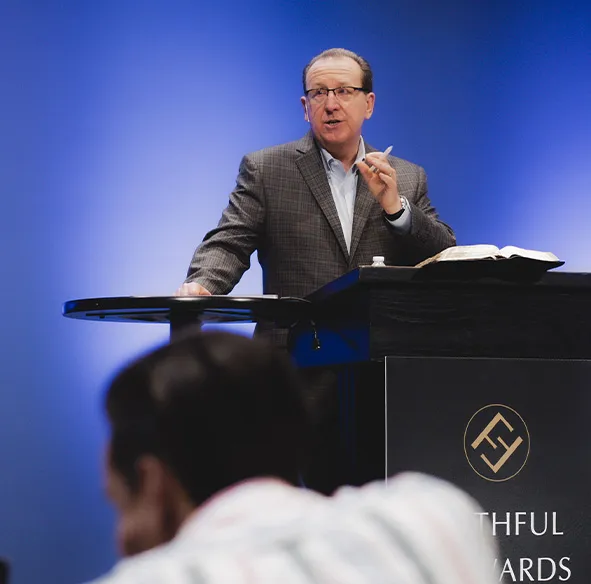
The preaching of God’s Word is central to the life of the church. Tom's pulpit ministry is dedicated to providing clear, biblical teaching to equip believers, strengthen faith, and exalt Christ.


Engage with the most recent teaching from God’s Word.
The preaching of God's Word is central to worship and of the utmost importance for the sanctification of every believer in Christ.

.jpg)
.jpg)

Explore messages organized to help you grow in Christ.
Search and filter sermons for quick access.
The Legacy of Music in Worship - Part 3
Pastor Tom Pennington addresses the tragic loss of biblical understanding regarding music in worship over the past 150 years. He asserts that musical styles are matters of collective conscience for church elders, with no biblical prohibition against any instrument. Lyrics, however, must be biblically based and balanced. The Old Testament pattern for worship music, divinely commanded and not merely David's preference, included musical instruments (forming orchestras), large choirs (comprising men and women), dedicated music directors, and congregational singing. Musicians leading worship were required to be true believers, highly skilled through practice, and genuinely engaged in worship, not mere performance. Pennington refutes the idea that these Old Testament elements were ceremonial law abolished by Christ. He argues that the New Testament doesn't repeal these divine commands, nor does it explicitly link them to ceremonial law. Moreover, the New Testament command to sing "psalms" inherently implies instrumental accompaniment, as the Psalms themselves frequently call for instruments and the word "psalms" can denote string accompaniment. Heavenly worship, as depicted in Revelation, further affirms the use of instruments.
The Legacy of Music in Worship - Part 2
This sermon, "The Legacy of Music in Worship (Part 2)," explores the crucial role of music, a practice largely lost in today's church. Music, an art of sound, surrounds God eternally and is always a hallmark of spiritual revival following the recovery of God's Word. It's essential for both individual and corporate worship. The pastor outlines three biblical purposes for music in worship. First, **personally**, it helps believers remember and rehearse God's Word, embedding truth into their hearts, which motivates praise and obedience. Second, **horizontally**, music allows believers to "speak to one another" through psalms, hymns, and spiritual songs, teaching and admonishing. This emphasizes that worship music is communication for mutual edification, not entertainment, requiring biblically rich lyrics that prioritize others' spiritual growth over personal stylistic preferences. Third, **vertically**, music is directed "to the Lord," expressing hearts to God in praise, thanksgiving, repentance, and petition. Its ultimate purpose is to glorify God, being profoundly Christ-centered and cross-centered. While Scripture doesn't prescribe specific musical styles�leaving it to the collective conscience of elders�it emphasizes that lyrics must be biblically based and balanced, incorporating Old and New Testament truths, subjective and objective expressions, and both traditional and contemporary songs.
The Legacy of Music in Worship - Part 1
Pastor Tom Pennington's sermon, "Recovering a Lost Legacy: The Legacy of Music in Worship (Part 1)," laments the contemporary Christian church's widespread loss of its biblical heritage regarding music. He critiques modern worship practices, identifying problems such as divisiveness, poor lyrical and musical quality, influence from theologically unsound movements, an overemphasis on emotion and performance, and a lack of congregational participation. Pennington grounds music's importance in its divine origin, noting its existence before creation, its rich history in human worship throughout the Old Testament and Jesus' life, and its future role in eternal worship (Revelation). He argues for music's biblical priority based on four points: God commands individual believers to sing (Psalms), a love for God-centered music is an inevitable fruit of being filled by the Spirit (Ephesians 5:19), Christ commands corporate worship in music guided by the Regulative Principle, and profoundly, God Himself sings (Zephaniah 3:17) and Jesus leads in praise (Hebrews 2:12). Music thus serves as a crucial spiritual diagnostic, reflecting one's relationship with God and the Spirit's work.
The Legacy of Expository Preaching
In "Recovering a Lost Legacy: The Legacy of Expository Teaching," Tom Pennington advocates for the biblical mandate of expository preaching, defining it as reading, explaining the text in its context, and applying it to hearers' lives, typically moving verse-by-verse through a book of the Bible. He contends that the modern church has largely abandoned this rich legacy, opting for less biblically rigorous methods. Pennington presents several arguments for its recovery. Practically, it ensures a wholly Bible-centered ministry, helps listeners grasp God's logical development of truth, balances scriptural emphasis, and forces engagement with difficult passages. Theologically, it naturally flows from the verbal inspiration of Scripture, as God gave His Word in cohesive, consecutive units. Historically, expository preaching was the consistent practice from the early church (Justin Martyr, Chrysostom, Augustine) through the Reformers (Calvin, Luther, Zwingli) and Puritans. Most significantly, biblical arguments highlight this pattern in Moses' ministry, Old Testament corporate worship (Levites, Ezra), Jewish synagogue worship, Jesus's own teaching ministry, and the priorities of the New Testament church and its elders.
Eden's Promise
The sermon "Eden's Promise Genesis 3:15" by Pastor Tom Pennington highlights the pervasive presence of Jesus Christ, the eternal Son of God, throughout the Old Testament, not just in prophecies but as the primary agent of creation and the visible manifestation of God. The central focus is Genesis 3:15, dubbed the "Proto-Evangelium," the first declaration of the Gospel immediately following humanity's fall into sin. This pivotal verse contains two intertwined promises. First, it prophesies a "continual conflict" between Satan's "seed" (his spiritual followers) and the woman's "seed" (Jesus Christ and all who believe in Him), explaining the enduring hostility between the wicked and the righteous. Second, it promises a "coming Redeemer" who will inflict a fatal "crushing" blow to Satan's head. This victory, however, will involve the Redeemer suffering a "bruise to His heel," signifying Christ's suffering and sacrificial death on the cross. This act, ordained by God the Father, atoned for humanity's sin, offering hope from the very moment of the fall.
The Biblical View of Abortion - Part 2
Pastor Tom Pennington's sermon, "The Biblical View of Abortion (Part 2)," firmly asserts that Scripture unequivocally upholds the sanctity and personhood of human life from conception, thereby opposing abortion. He assures those who have repented from past abortions of God's complete forgiveness in Christ. Pennington refutes common pro-abortion arguments, stating that claims of historical legality are revisionist, a constitutional "right to privacy" is unfounded, and the unborn child is a distinct, genetically unique human, not merely part of the mother. He dismisses the idea that personhood begins later than conception as unscientific and unbiblical. Key biblical arguments include: all human life is made in God's image from conception; God alone gives and has the right to take life; God condemns all wrongful taking of human life; human life and moral identity begin at conception; and Scripture consistently treats the unborn as persons, regardless of developmental stage, with Old Testament law equating harm to the unborn with harm to the mother. Historically, both ancient Jewish sources and Christian leaders from the Early Church to the Reformation consistently condemned abortion as murder.
No Results Found.
We couldn’t find anything matching your search.
Explore The Word Unleashed
Our ministry brings together expository preaching, theological precision, and practical application for the good of Christ's church and the daily living of Christ's people.
.webp)
Sermons
Listen to expository sermons that clearly teach God’s Word and guide you in daily living.

Radio
Tune in to gospel-centered programs that share biblical truth and strengthen your daily walk with Christ.
Training
Join courses and workshops designed to deepen your faith and equip you to serve others with biblical wisdom.
.webp)
From the Pastor's Desk
Read pastoral messages that encourage, instruct, and help you apply God’s Word to every part of your life.
.webp)
Hymns
Discover timeless hymns that lift your heart in worship and remind you of God’s abounding grace and faithfulness.
Podcasts
Stay rooted in Scripture through our podcast series.