Sermons That Exalt Christ
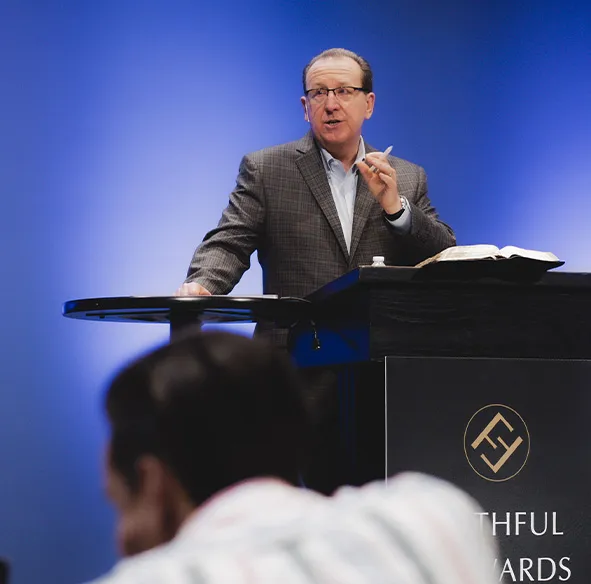
The preaching of God’s Word is central to the life of the church. Tom's pulpit ministry is dedicated to providing clear, biblical teaching to equip believers, strengthen faith, and exalt Christ.


Engage with the most recent teaching from God’s Word.
The preaching of God's Word is central to worship and of the utmost importance for the sanctification of every believer in Christ.

.jpg)
.jpg)

Explore messages organized to help you grow in Christ.
Search and filter sermons for quick access.
Tradition! - Part 1
Pastor Tom Pennington�s sermon, "Tradition! (Part 1)," examines Mark 7:1-13, illustrating the deep conflict between Jesus and first-century Jewish religious leaders concerning human tradition versus God's Word. Drawing an analogy to "Fiddler on the Roof," Pennington describes how tradition profoundly influenced Jewish life, resulting in an elaborate system of external rituals, such as ceremonial hand-washing, not prescribed in the Old Testament. These "traditions of the elders" were elevated above God's divine commandments. When the Pharisees accused Jesus' disciples of eating with "impure hands," neglecting these man-made rules, Jesus exposed their error as the spiritual bankruptcy of substituting human tradition for divine revelation. He asserted that the ultimate source of authority must be the "commandment of God" and the "Word of God" exclusively, not "precepts of men." First-century Judaism had become "worthless" by equating oral traditions, like the Mishnah, with the sacred written Torah. Pennington concludes with three vital implications for believers today: First, Scripture alone must be the sole source of authority ("Sola Scriptura"), rejecting any human additions or personal opinions. Second, it is crucial not to twist or distort the meaning of Scripture, but to interpret it accurately and humbly.
Three Primary Effects of the Spirit's Influence - Part 1
Pastor Tom Pennington's sermon "Three Primary Effects of the Spirit�s Influence, Part 1" from Ephesians 5:19-21, begins by drawing an analogy between being under the influence of alcohol and being "filled with the Spirit." He clarifies that "being filled with the Spirit" (Ephesians 5:18) means allowing the Spirit to fill us with God's Word, an idea echoed in Colossians 3:16's call to let "the word of Christ dwell in you richly." This spiritual influence produces discernible effects in a believer's life. Pennington identifies three primary consequences from Ephesians 5:19-21: a love for God-centered music, a pattern of thankfulness, and a heart of submission. This sermon focuses on the first effect: a love for God-centered music. He posits that this love naturally flows from a heart filled by the Spirit and the Word, as Scripture repeatedly calls people to praise God in song. Music's profound biblical importance is demonstrated from angels singing at creation, its early appearance in human history, its prominence in the Psalms (with over a hundred commands to sing), its presence in Jesus's life, and its continuation into eternity, where Christ himself will lead His redeemed in praise (Hebrews 2:11-12).
Watch Where You Step! - Part 4
Pastor Tom Pennington's sermon on Ephesians 5:15-18 emphasizes that believers must live under the Spirit's influence, not the flesh, to walk in biblical wisdom. He distinguishes two forms of spiritual "filling": "special empowering," a sovereign act by God for specific tasks (like speaking in tongues), and "normal filling," an ongoing state commanded for all Christians. Ephesians 5:18's command, "be filled with the Spirit," refers to this continuous state. Pennington illustrates this by contrasting it with drunkenness: just as alcohol influences a person, believers are to be under the Holy Spirit's influence, yielding self-control to Him. The Spirit is the agent who fills us, and our role is to "permit or allow yourselves to be filled." The content with which the Spirit fills us is revealed by Colossians 3:16, a parallel passage, which states, "Let the word of Christ richly dwell within you." Thus, being filled with the Spirit means being saturated and controlled by God's Word, as the Spirit always works in and through Scripture to illumine understanding and prompt obedience.
Pursuing Jesus for All the Wrong Reasons
Tom Pennington's sermon "The Memoirs of Peter Pursuing Jesus for All the Wrong Reasons" argues that many individuals, both in Jesus's time and today, seek Christ for misguided, self-centered motivations rather than genuine faith. Drawing from Mark and John's gospels, Pennington identifies three common "wrong reasons" people pursued Jesus. Firstly, some sought **personal advancement**, exemplified by the crowd wanting to forcibly make Jesus king after the feeding of the 5,000, hoping for political liberation and earthly benefits. Even disciples exhibited this, seeking positions of power. Secondly, many desired the **improvement of physical circumstances**, as seen in Gennesaret, where people brought the sick for healing, often seeking only physical relief to resume their lives, not spiritual transformation. Thirdly, others pursued **material prosperity**, following Jesus after the miraculous feeding simply because they were filled, wanting more physical sustenance over spiritual truth. Jesus frequently challenged these superficial motives, directing people towards Him as the "bread of life" and the "food which endures to eternal life." Pennington concludes that genuine followers of Christ perceive Him as the ultimate treasure, echoing the parables of the hidden treasure and pearl of great value.
Walk on Water? Jesus' Incomparable Power Over Matter, Time & Space
Tom Pennington's sermon "The Memoirs of Peter Walk on Water?" examines Mark 6:45-52, revealing Jesus' divine authority. After feeding 5,000, Jesus urgently sends His disciples away, preventing both the crowd and disciples from seizing Him as king, and retreats to a mountain for prayer. Simultaneously, His disciples toil for hours against a severe storm on the Sea of Galilee. Jesus, observing their struggle, walks on the water towards them. Initially terrified, mistaking Him for a ghost, they are calmed by His voice, proclaiming, "It is I," (Ego Eimi), a possible divine self-identification. As Jesus enters their boat, the violent wind immediately stops. John's Gospel adds a third miracle: the boat instantly transports to their destination shore. Pennington highlights these three miracles�Jesus' power over liquid (walking), gas (calming wind), and matter, space, and time (instant transport)�as conclusive proof of His identity as the sovereign Creator and Sustainer of the universe. He reconciles Old Testament descriptions of Yahweh as the sole creator with the New Testament's portrayal of Jesus' divine role. The disciples' initial astonishment and "hardened hearts" underscore their struggle to grasp the full extent of His power.
Watch Where You Step! - Part 3
The sermon "Watch Where You Step (Part 3)" from Ephesians 5:15-18 emphasizes that walking worthy of one's calling in Christ requires biblical wisdom. This wisdom involves examining one's ways, seizing opportunities, and understanding God's revealed will. The crucial fourth component and bridge to living out this wisdom, according to Paul, is "being filled with the Spirit." The pastor explains the Holy Spirit's role in the Old Testament included regeneration, sanctification, and special empowering. In the New Testament, the Spirit additionally indwells every believer permanently for spiritual growth and baptizes them into Christ's body at salvation�both being one-time events for all believers. He addresses prevalent confusion from Pentecostal, Charismatic, and Third Wave movements, which often portray "filling" as a subjective, miraculous, or a subsequent crisis experience distinct from or identical to baptism, or as multiple events. The sermon argues these views are flawed. Ultimately, the filling of the Spirit is paramount because without it, believers lack the power to obey any of the practical commands in Ephesians 5-6, such as in marriage, family, and work. Christian life cannot be lived in one's own strength; the Spirit provides the necessary enablement, a truth central to spiritual progress and obedience.
No Results Found.
We couldn’t find anything matching your search.
Explore The Word Unleashed
Our ministry brings together expository preaching, theological precision, and practical application for the good of Christ's church and the daily living of Christ's people.
.webp)
Sermons
Listen to expository sermons that clearly teach God’s Word and guide you in daily living.

Radio
Tune in to gospel-centered programs that share biblical truth and strengthen your daily walk with Christ.
Training
Join courses and workshops designed to deepen your faith and equip you to serve others with biblical wisdom.
.webp)
From the Pastor's Desk
Read pastoral messages that encourage, instruct, and help you apply God’s Word to every part of your life.
.webp)
Hymns
Discover timeless hymns that lift your heart in worship and remind you of God’s abounding grace and faithfulness.
Podcasts
Stay rooted in Scripture through our podcast series.